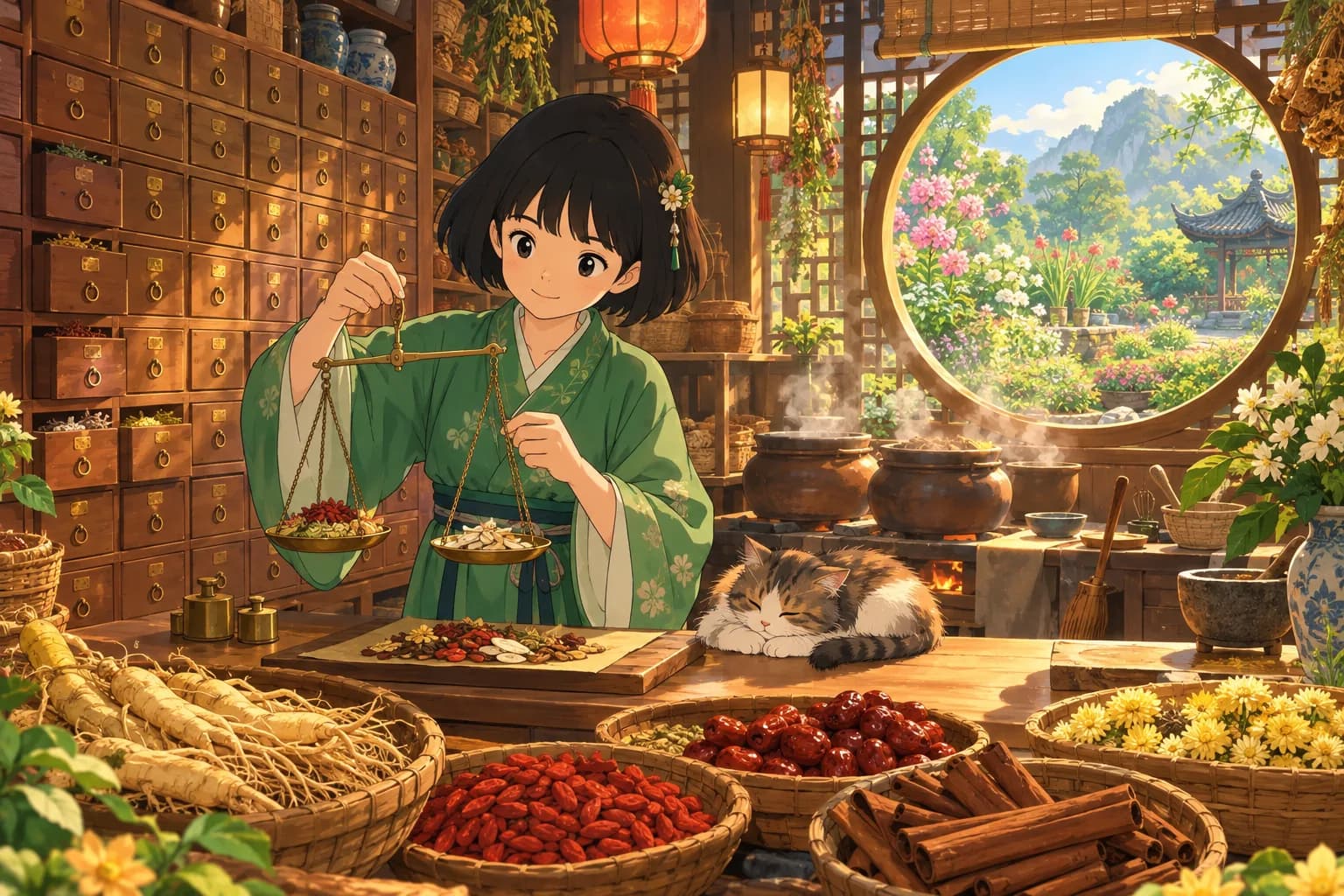
Specialty
Chinese Herbal MedicineMateria Medica and Formulas
«The needle moves; the herb replenishes.»
The other half of Chinese medicine. How a plant is described in the language of Chinese medicine (the four Qi, the five flavors, channel tropism), the nine major categories of the materia medica, the Jun-Chen-Zuo-Shi architecture of a formula, the twenty classical formulas that anchor practice, and real-world safety: interactions, hepatotoxicity, pregnancy, and product quality.
By the end, you will know how to
- Read the profile of any Chinese herb and know what it does and where it acts.
- Recognize the nine categories of the materia medica and their leading herbs.
- Break down a classical formula into emperor, minister, assistant, and envoy.
- Modify a base formula to fit a specific patient.
- Spot the interactions and risks that mean you should not prescribe.
- Divide the work between needle and herb in the same case.
RequirementsAcupuncture I, or equivalent knowledge of Yin-Yang, Wu Xing, the vital substances, and Zang-Fu.
Syllabus
The language of herbs
Before the first herb: how Chinese medicine describes what a remedy does.
The materia medica
The nine major categories, with the key herbs of each and their full profile.
 6Releasing the exterior (Jie Biao Yao)
 7Clearing Heat (Qing Re Yao)
 8Purging and warming the interior
 9Dampness, water, and Bi pattern
 10Phlegm, cough, and dyspnea
 11Regulating Qi and resolving food stagnation
 12Moving Blood and stopping bleeding
 13Calming the Shen, pacifying the Liver, and opening the orifices
The tonics
Bu Xu Yao: the star category of modern herbal medicine, and the one most often misprescribed.

Building a formula
From the single herb to the prescription: the part that truly sets Chinese herbal medicine apart.

Beyond the decoction
The other three ways a plant enters treatment: the plate, the skin and the local herbalist.


Safety and clinical practice
The part that separates a professional from someone selling herbal teas.
 25Interactions, liver, and kidney
 26Pregnancy, breastfeeding, childhood, and older adults
 27Clinic I: digestive and respiratory
 28Clinic II: gynecology, Shen, and pain
 29Clinic III: dermatology
 30Supportive care in oncology
 31Integrating needle and herb (and using Fitoki)
 32Integrated clinical case
 33Final exam · Chinese Herbal Medicine