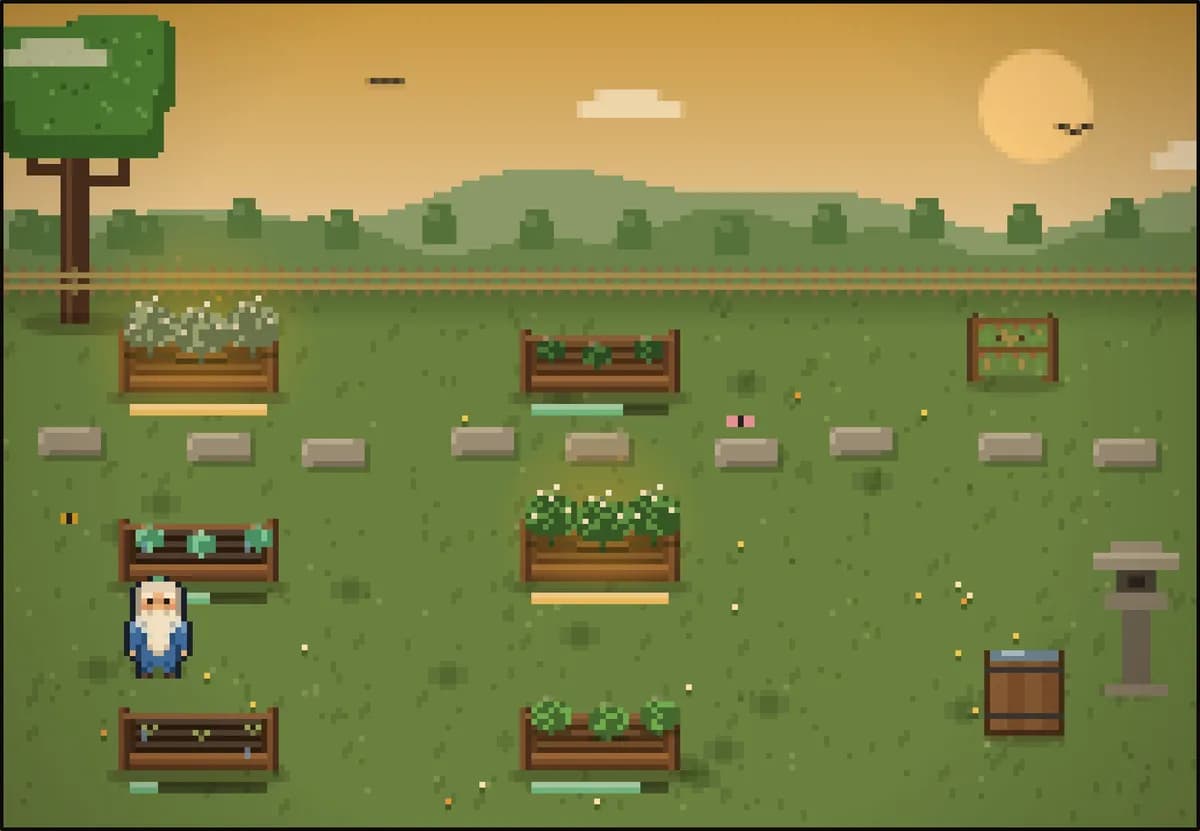
The Garden
Mugwort, mint, ginseng, angelica. You sow, water and wait: what grows here is something you never have to buy.
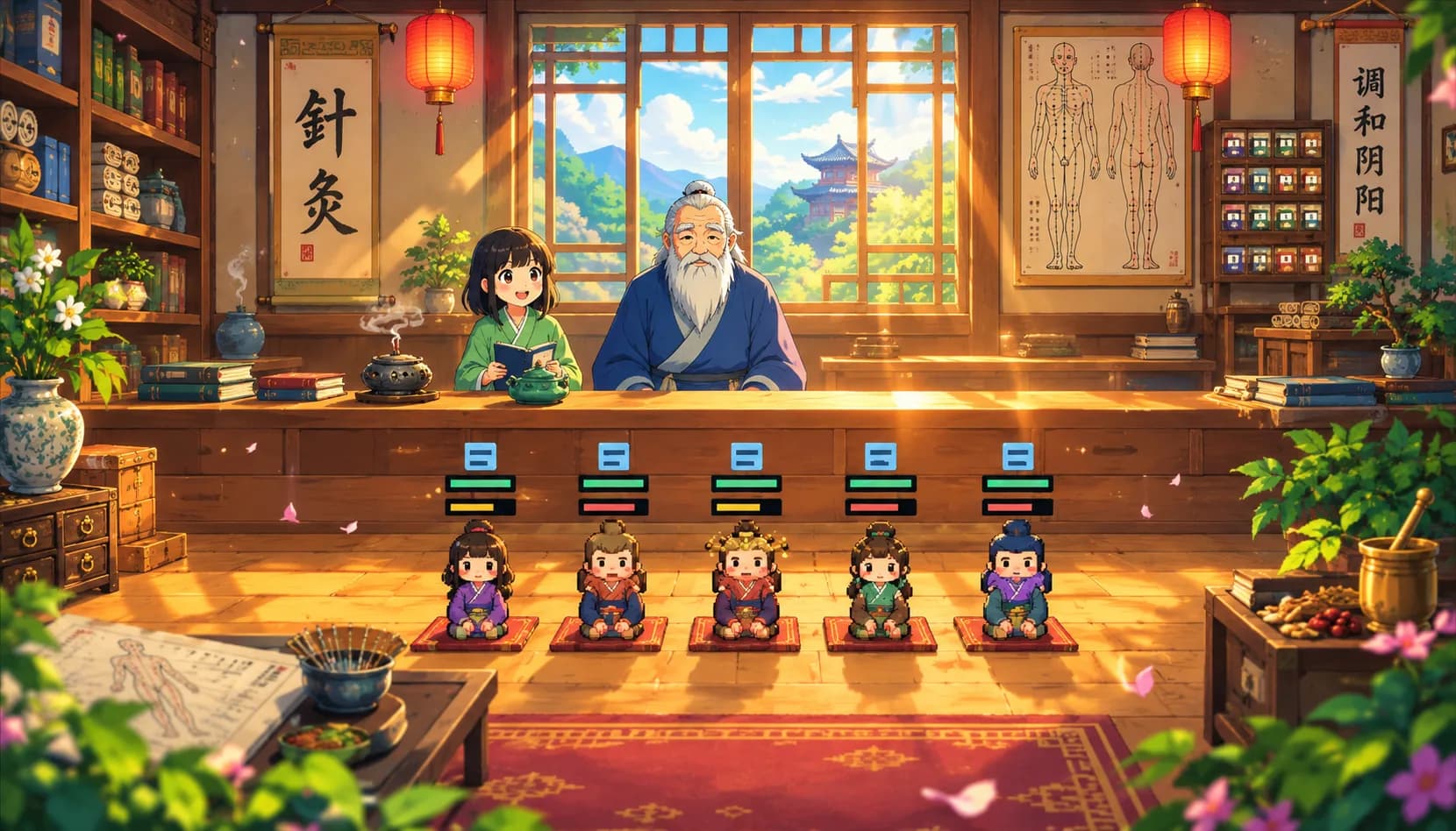
神門 Shenmen · the clinic game
You inherit a small room with five chairs, a set of bamboo needles and a single treatise on the shelf. It's not about picking the right answer from a list: it's about examining the patient, reasoning out the pattern and treating it with the technique it calls for.
Switch the game to English with its 🌐 button: the interface is translated; the story and dialogue are still in Spanish.
Your practice
You open a practice in a neighborhood of a Chinese city, at no particular point in history. The waiting room fills, the light slides across the floor from morning to afternoon, and every examination eats into your day. Nobody waits forever: the ones who tire of it get up and cross the street to your rival.
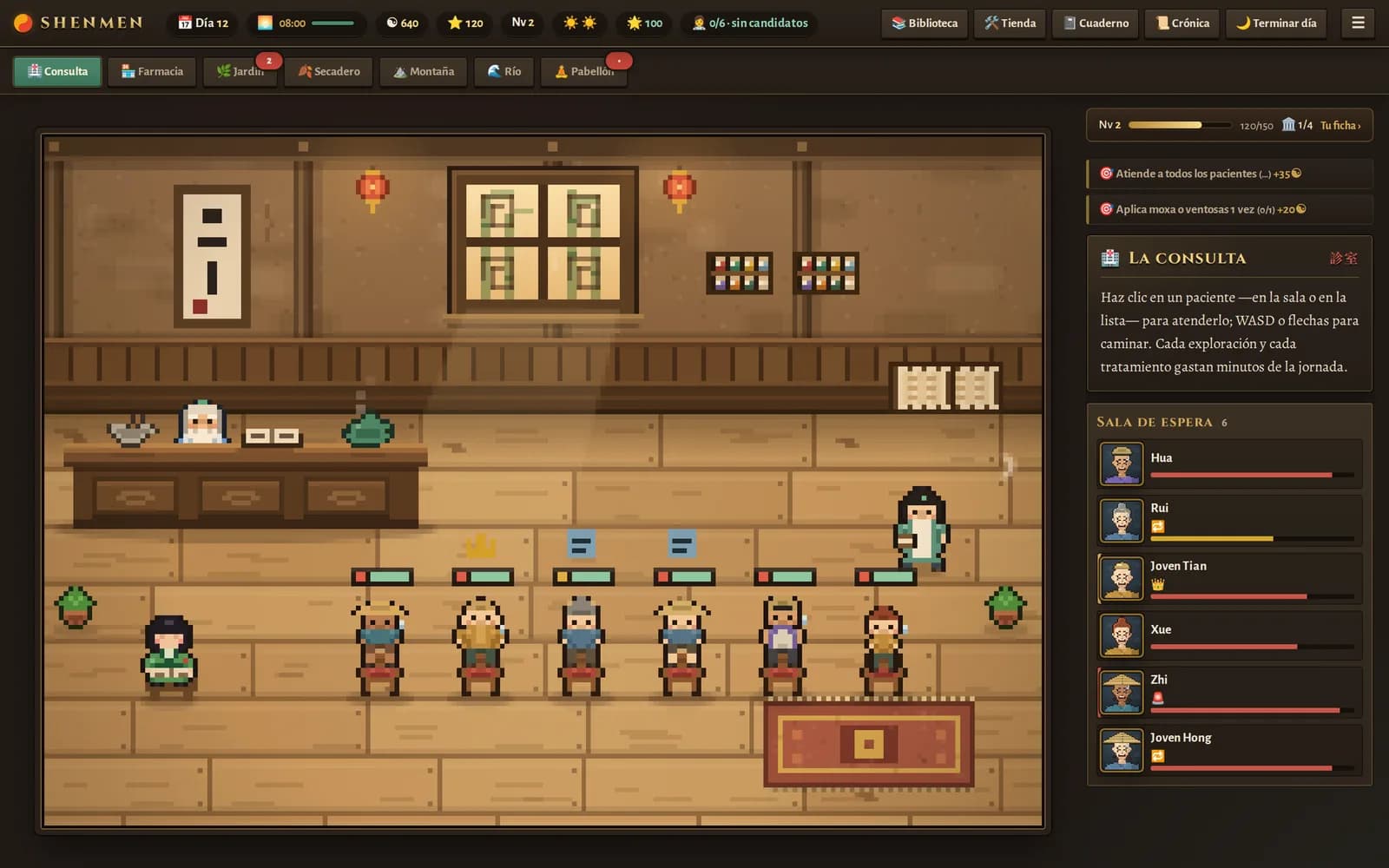
The loop
四診 Sì Zhěn · the four examinations
The patient arrives with two complaints and little else. Everything more has to be earned, and each examination costs minutes of your day.
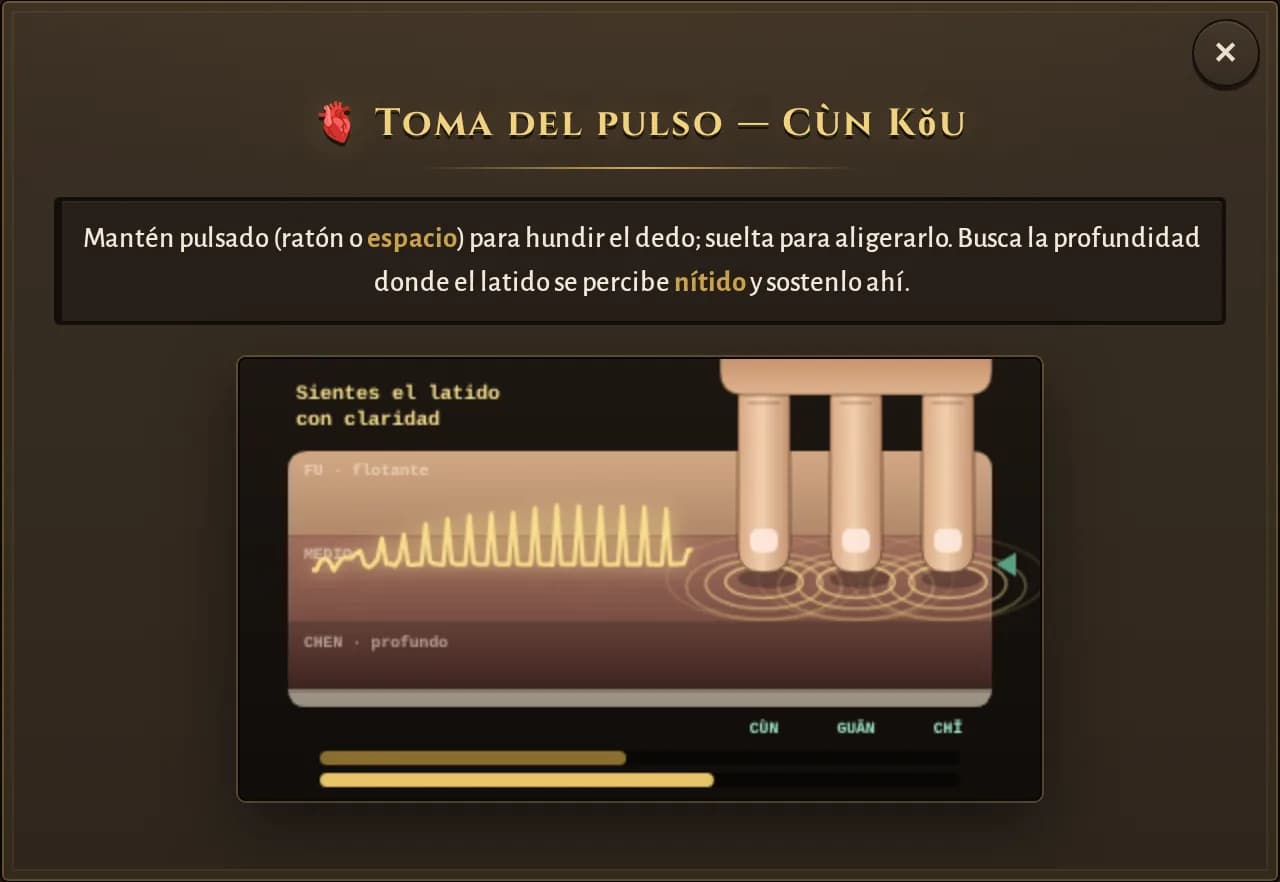
The pulse is felt the way it's really felt: at three depths. You press your three fingers down, look for the level where the beat comes through clearly, and hold it. If your hand can't find it, the data stays blurry and you'll have to work out the nature of the pattern from other signs.
八綱 Bā Gāng · the Eight Principles
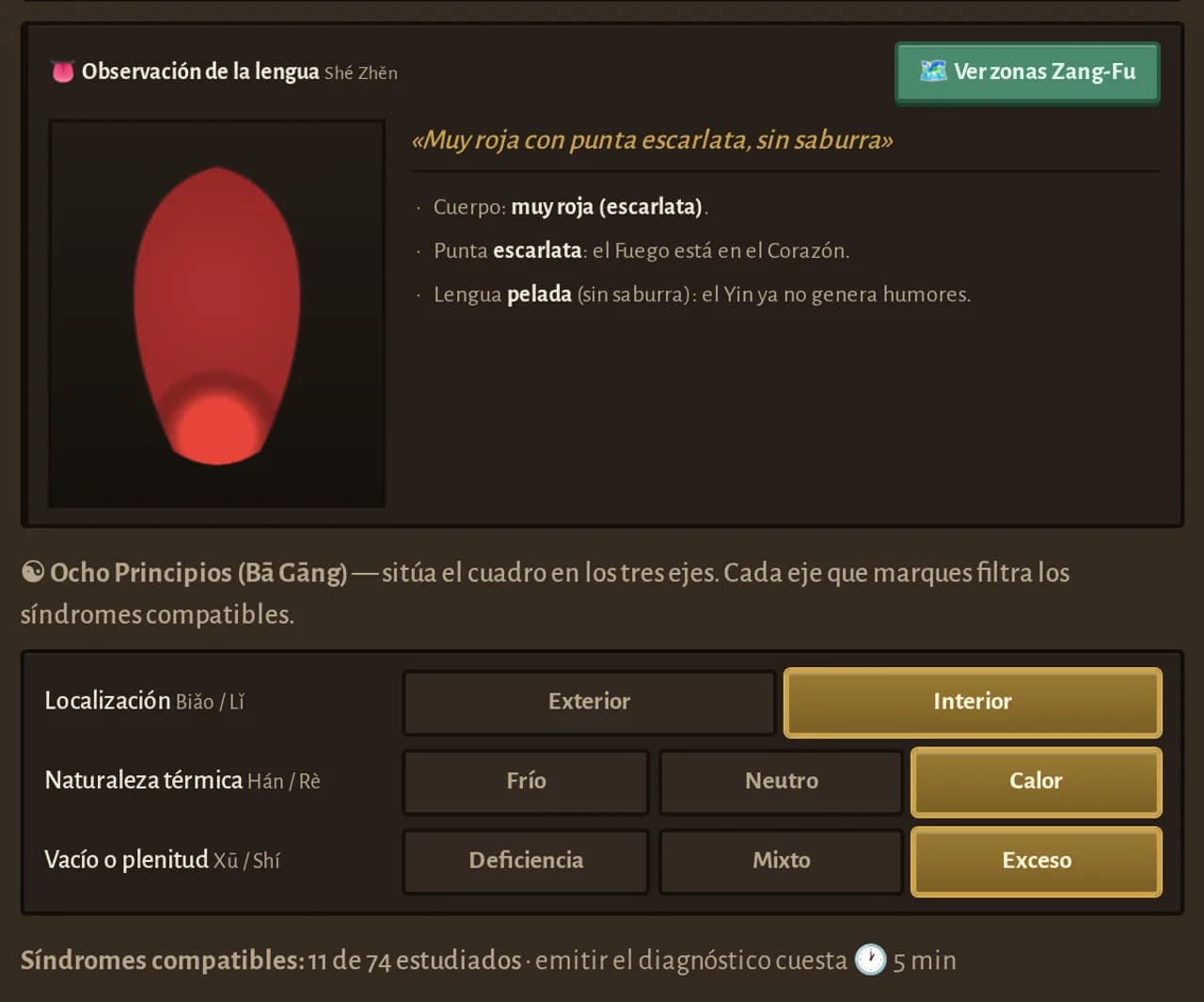
The tongue is seen: not a sentence of text but an illustration drawn from the picture in front of you. Pale and moist in Cold, scarlet at the tip when the Heart burns, scalloped when the Spleen fails to contain. One button lights up the Zang-Fu zone map.
Then you think. You place the picture on three axes (Exterior or Interior, Cold or Heat, Deficiency or Excess) and every axis you fix rules out patterns. Nobody hands you the short list: you earn it.
辨證 Biàn Zhèng · finding the pattern
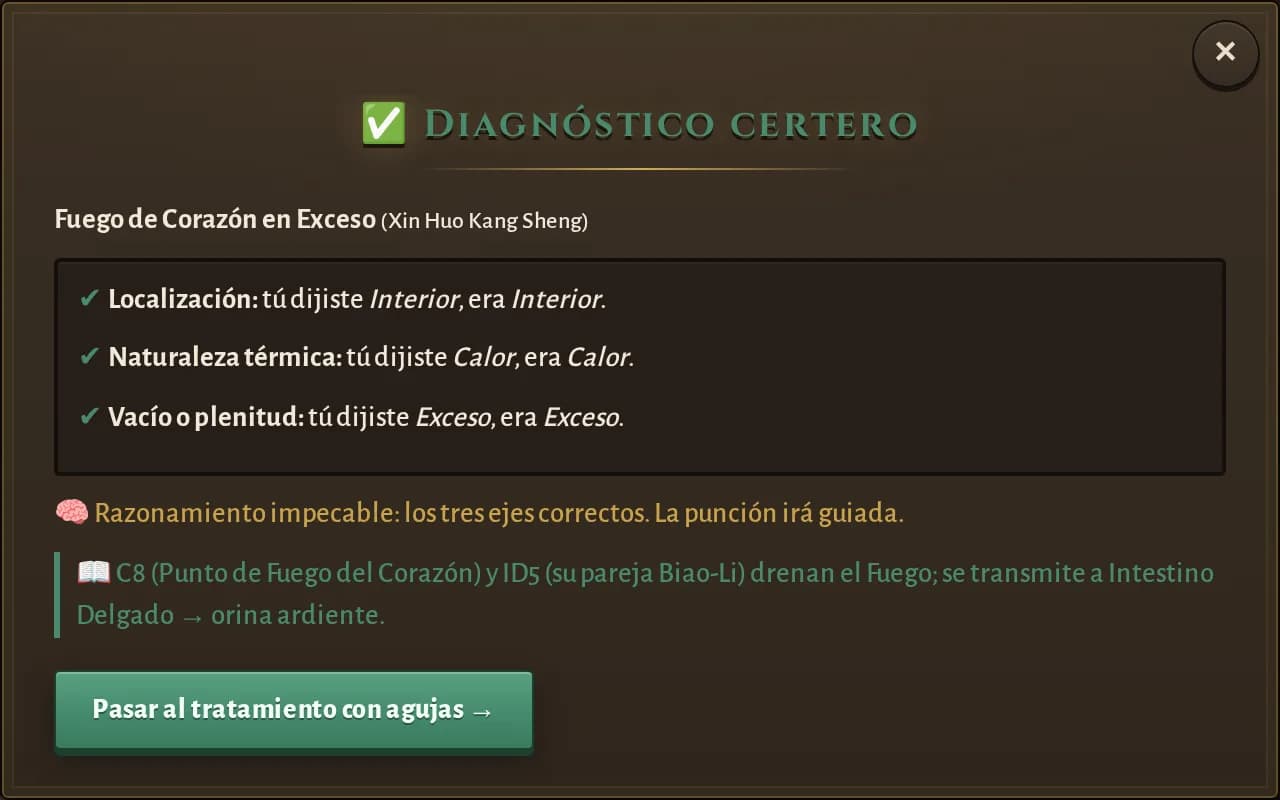
You make your diagnosis and the game corrects you axis by axis: what you said and what it really was. When you're right, it tells you why these points and not others. When you're wrong, it spells it out in full.
And the one you got wrong comes back. A chronic patient who was badly treated leaves worse than he came, and the next time he walks through the door, he tells you so.
針 Zhēn · the needle and the technique
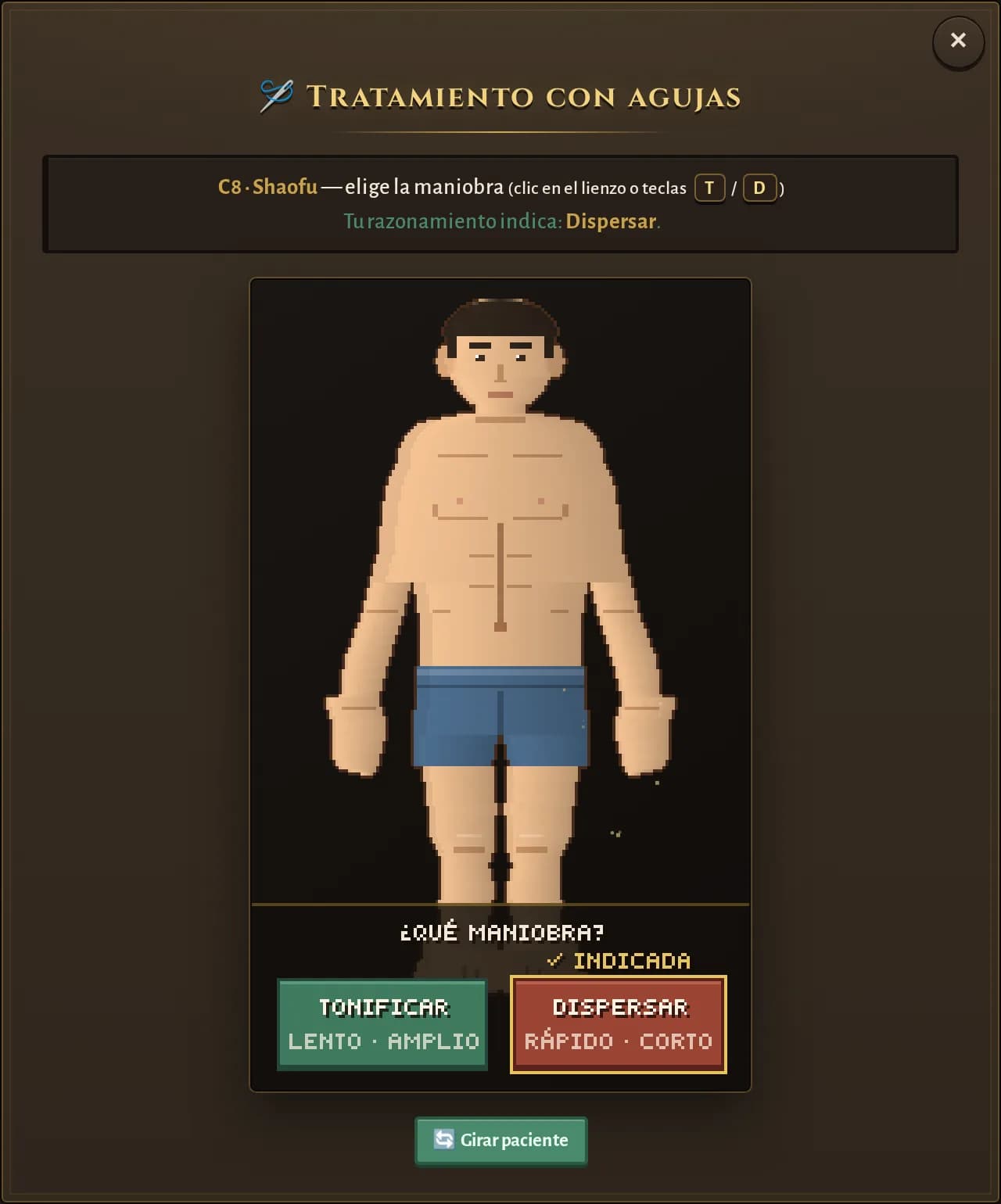
You locate the point on the body, insert, and choose the technique: tonify what is deficient, disperse what is full. If needed, you weigh out the formula at the pharmacy and send the patient home with lifestyle advice.
Treating the branch instead of the root costs you reputation. Getting paid is easy; getting them to come back happy is not.
Veiled patterns · 真寒假熱 / 真熱假寒
The patient never lies.
It's the disease that deceives.
They arrive with a red face, thirst and restlessness: it looks like Heat, but it's a Cold so deep it has pushed out the little Yang that remained. The signs on the surface shout; the root whispers in the pulse, in the body of the tongue, and in whether the patient asks for hot water or cold. Whoever adds up symptoms, falls. Whoever ranks them, gets it right.
When you close the door
Twelve hours don't stretch to cover everything. The garden, the Mountain, the River and the Pavilion compete with your patients for your day, and every day you have to decide what truly deserves your time.
Mugwort, mint, ginseng, angelica. You sow, water and wait: what grows here is something you never have to buy.
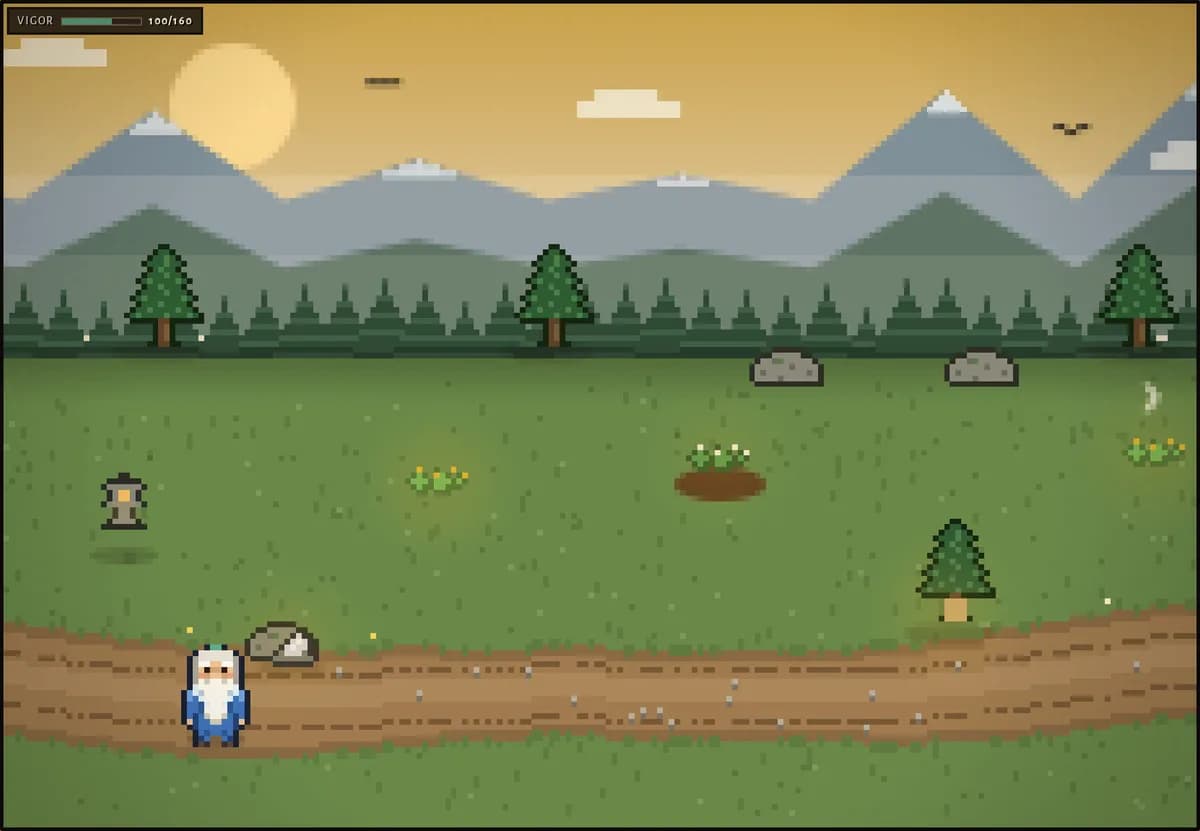
The climb costs forty minutes of your day. At the top you dig up the root without breaking it and gather what the apothecary doesn't have.
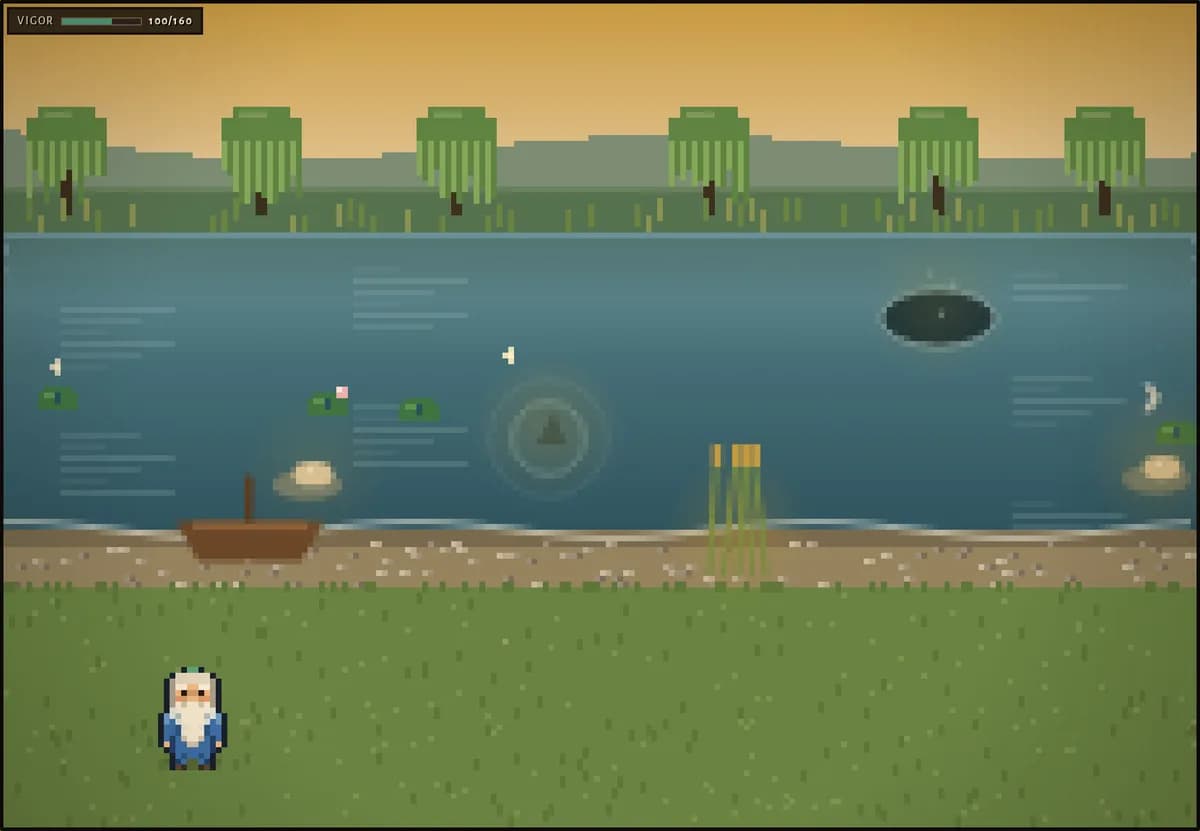
Reeds, shells and the oyster pool. And the leech on your ankle, which an acupuncturist doesn't pull off: it's Shui Zhi.
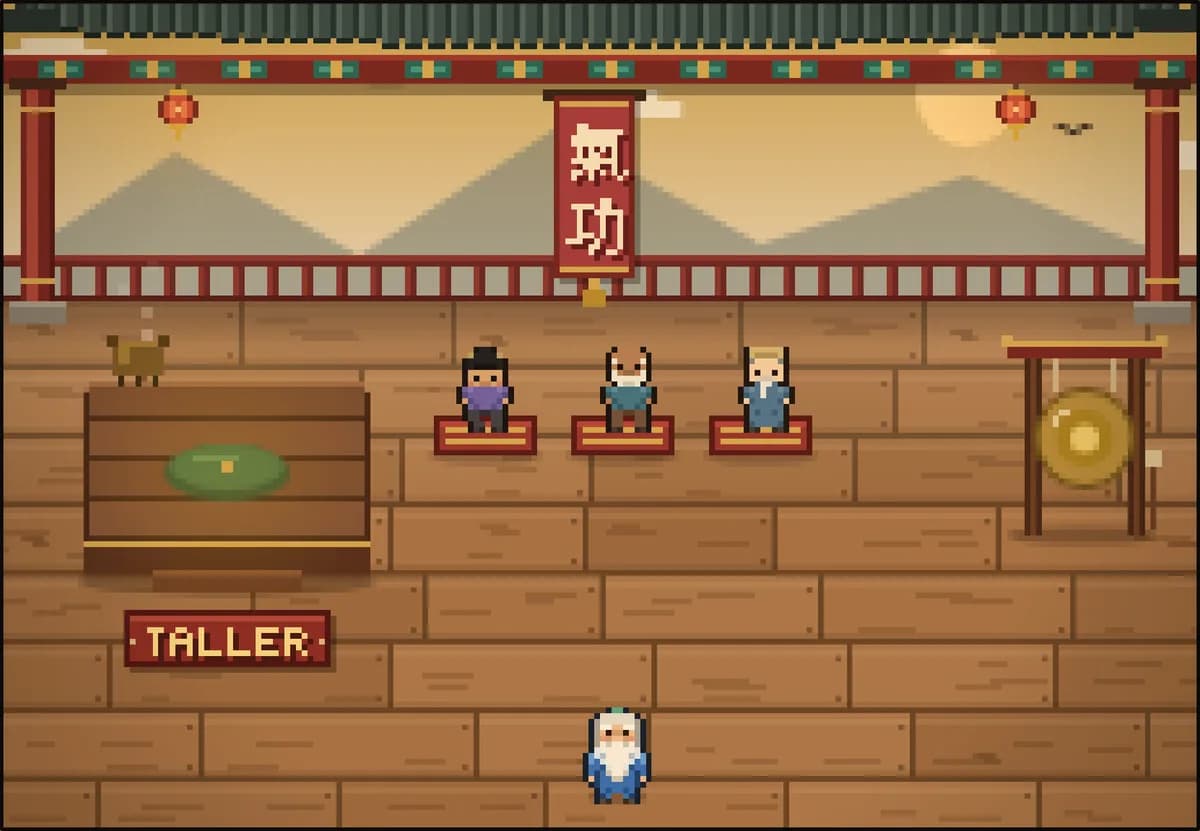
Qigong workshops: students pay fees, bring others and restore your Qi. An acupuncturist is no bystander to their own medicine.
The chronicle
There's no tutorial: there's an inheritance. And then a neighborhood that lives on. Some milestones fall on their day and open up the game; others come once you've earned them. In between come the storm that empties the street, the water carrier who pays in eggs, and the shopkeeper who asks for thirty coins on credit and comes back to pay you forty.
Day 1
Master Bái Héshān hands you the keys and watches how you treat Chen, the water carrier.
Day 2
It arrives from the river: “it's not about needles: it's about time.”
Day 3
The Guild wants to know who you learned from.
Day 5
A huge bundle on your doorstep: rare seeds, mountain tools and whatever the market doesn't have.
Day 8
A mortar, hemp thread and the handwriting of the old master. The craft workshop opens.
Day 10
A little girl sits on the step across the way and won't take her eyes off your door.
Day 11
What came in, what you said, what it really was. And in the morning it asks you exactly what you're weakest at.
Day 14
Master Húa crosses the street. From that day on, the neighborhood compares.
“I left worse than I came. I don't blame you. I'm just telling you.”
“While you were taking his pulse for the third time, I'd already taken away his pain.”
“Luck. Anyone can have a good day.”
Where its teaching comes from
Every formula carries its book, its author and its century. Xiao Yao San isn't “a game formula”: it comes from the 1107 formulary of the Imperial Pharmacy, and you read that right after you've weighed it out.
Each citation carries its confidence level, because in the Chinese pharmacopeia attribution isn't always unanimous. And for the three that couldn't be verified, the game says so instead of inventing an origin for them.
Who it's for
Patterns stop being a table: they have a face, a pulse and a tongue, and they trip you up if you don't examine them. It's review that doesn't feel like review.
Bā Gāng as a reflex, veiled patterns as an exam, and a rival who heals while you're taking the pulse for the third time. Here you play with a clinical eye, not memory.
You don't need to know anything. On day one the Master teaches you the trade with a textbook patient, and doesn't move on until you do it yourself.
神門 · The Spirit Gate
$20one time, yours for good
Included in the Complete Training of the Academy, which teaches what the game puts to the test.
No. The first-day handover teaches you to examine, to place the picture on the three axes and to needle, with a textbook patient and the Master by your side. The treatises for each pattern are bought later, in the in-game library, as you level up.
In your browser, at shenmen.app, with nothing to install. On a computer, with keyboard and mouse; on a phone or tablet, with your finger: you aim the needle through a magnifier and it goes in when you lift, and you trace the Qigong with a swipe. You can also add it to your home screen like an app.
The whole first day, no account or card: the handover, the practice, the rooms. If you like it, you buy and carry on with the same game.
No. It's a one-time payment and the game is yours for good.
In your acupuntura.app account. Sign in from any computer or phone and pick up the day where you left off.
No. The content is drawn from real TCM, with its sources cited, but it's a game: it doesn't replace a health professional and must not be used to treat anyone.
This is a game. Its patterns, points and formulas are drawn from real traditional Chinese medicine, with their sources cited, but it is not medical advice and does not replace a health professional.