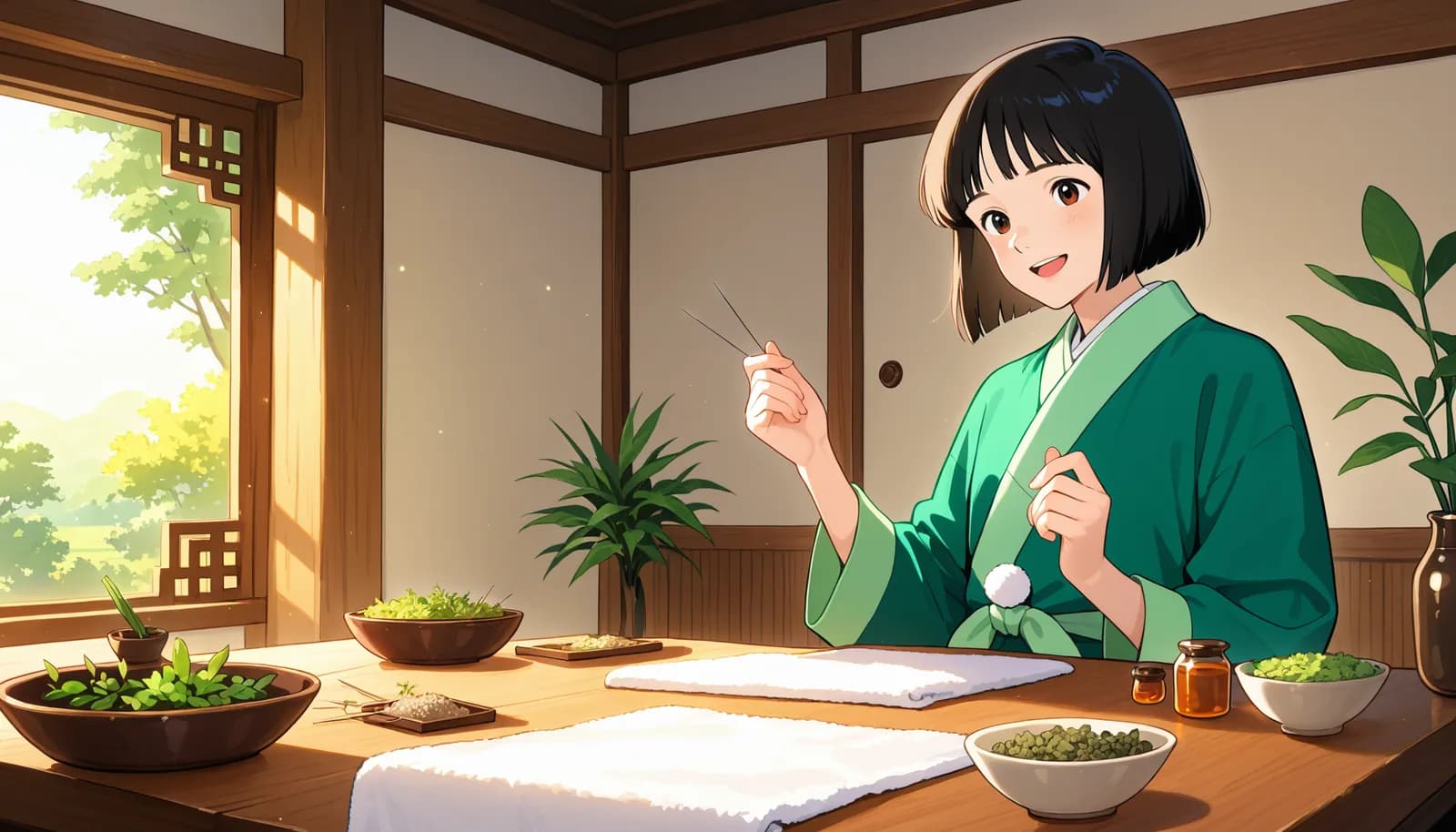
Integrating Tuina, needle, and herb
How the three tools share the work in the same patient and in the same week.
How it starts
The three courses in the pathway end here, in the same place: a patient who needs more than one thing. This lesson is a sister to Integrating needle and herb (and using Fitoki) and looks at the same question from the other side, the side of the hand.
The rest of the lesson opens with Tuina.
In this lesson you will learn
- Divide the work among hand, needle, and herb in a concrete treatment plan.
- Combine tools in a single session without stacking doses.
- Design the pacing of a treatment over a span of weeks.
- Keep records that actually help you make decisions.
What is inside
- 1How the work is divided, in concrete terms
- 2Combining tools in a single session
- 3The plan over the weeks
- 4How to measure
- 5Record keeping
One of the 31 lessons in
TuinaChinese Therapeutic Massage
“The hand reaches where the needle can't.”
The manual therapy of Chinese medicine, taught the way a school teaches it: first posture and economy of the hand, then the fifteen basic techniques one by one with their timing and rhythm, then joint mobilization with its safety limits, and finally protocols by region and pediatric Tuina, a discipline of its own.
By the end of the course, you will know how to
- Perform the fifteen basic techniques with correct posture and rhythm.
- Build a complete session with opening, work, mobilization, and closing.
- Treat the cervical, thoracolumbar, and limb regions with sound judgment.
- Apply pediatric Tuina with its specific points and techniques.
- Recognize the red flags that mean you must not touch and must refer.
What you will study
Module 1 · 5 lessons
The treating hand
Before the first manipulation: what Tuina is, how the body is positioned and which tissue you work on.
- What Tuina is (and what it isn't)
- Posture, support, and economy of effort
- What you work on: Jing Jin, layers, and regions
- Palpatory anatomy: the landmarks
- Palpatory assessment and session plan
Module 2 · 7 lessons
The basic techniques
Fifteen manipulations, grouped by family. Each with its technique, rhythm, dose and indication.
- Family 1 · Friction: Tui, Ca, and Mo
- Family 2 · Pressure: An, Dian, and Ya
- Family 3 · Kneading: Rou, Na, and Nie
- Family 4 · Vibration and percussion
- Gun Fa, the signature technique
- Joint mobilization: Yao, Ban, and Ba Shen
- Stretching and muscle energy
Module 3 · 3 lessons
The craft
Media, dosage, hygiene and session structure.
- Media, heat, table, and hygiene
- Dosage and session structure
- Clinical record and practice management
Module 4 · 6 lessons
Protocols by region
What you see every day, region by region, with differential, sequence and referral criteria.
- Neck and shoulder
- Thoracic and lumbar region
- Hip, knee, and leg
- Elbow, wrist, and hand
- Head and face
- Abdomen
Module 5 · 10 lessons
Specialized Tuina
Pediatrics, internal conditions, sport and the complete safety framework.
- Pediatric Tuina (Xiao Er Tui Na)
- Tuina in pregnancy and postpartum
- Geriatric Tuina
- Tuina for internal conditions
- Sports and postural Tuina
- Self-Tuina and exercise for the patient
- Safety, red flags, and accidents
- Integrating Tuina, needle, and herbYou are here
- Integrated clinical case
- Final exam · Tuina
Requirements
Acupuncture I. Having seen the channels in Acupuncture II is recommended.
How it works
Specialties
Save with a bundle
Complete Training
All five courses, saving you €180, plus five years of Atlas Pro and the game included.
You save $180 compared with buying the courses separately
5 years of Atlas Pro included
Valued at $395 free
Already have Atlas Pro? Nothing is overwritten: 5 years is added on top of whatever you have left.
Read “Integrating Tuina, needle, and herb” today
This lesson and the rest of the course: 31 lessons, 10 hours, quizzes and exercises. You pay once and it is yours for life, with one year of Atlas Pro as a gift (if you already have it, it adds to the time you have left).
Tuina
One-time payment