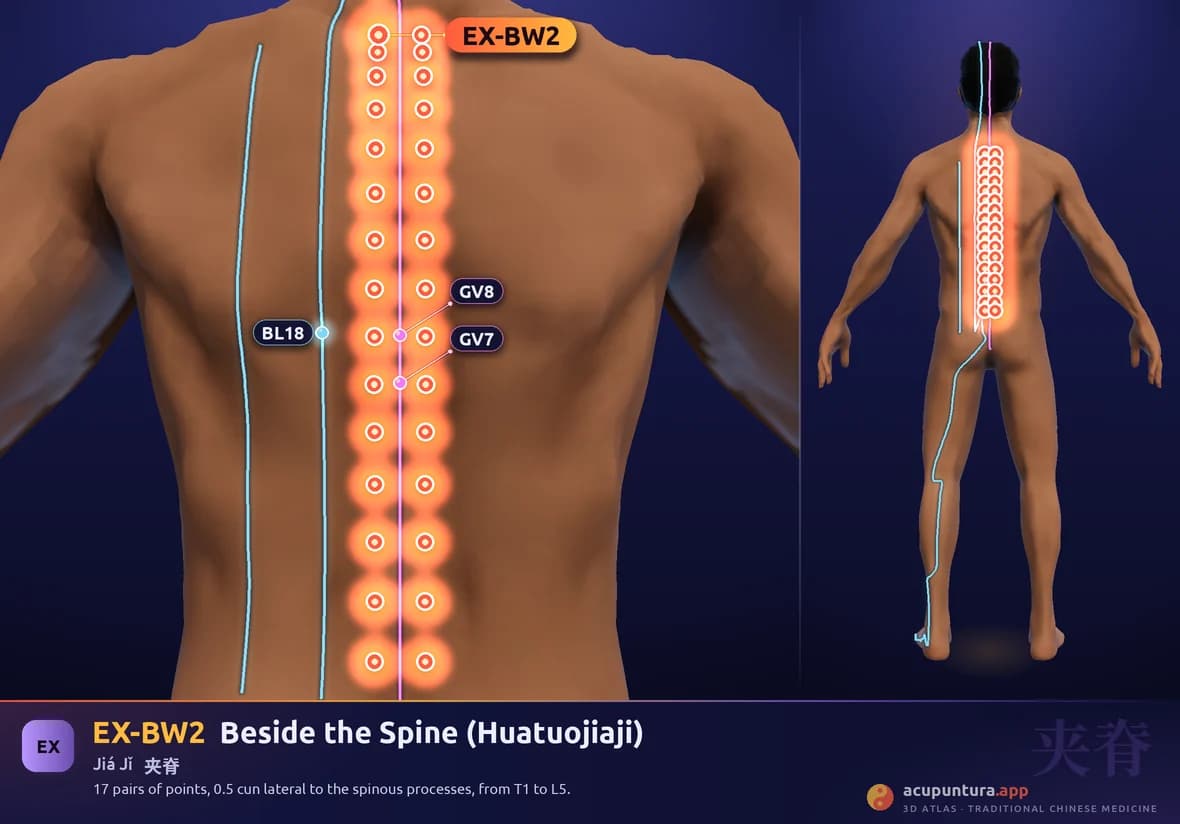
Extra point · Back
Beside the Spine (Huatuojiaji)
夹脊Jiá JǐAnatomical location
17 pairs of points, 0.5 cun lateral to the spinous processes, from T1 to L5.
Same point as CP85 · Huá Tuó Jiā Jǐ — Curious Points catalogMain function
Regulates the Qi and Blood of the organs corresponding to each vertebral level (upper thoracic: Heart/Lung; middle: digestive system; lower: reproductive/urinary system).
- A series of 17 pairs, widely used for spinal pain and segmental disorders
Therapeutic indications
- Back pain
- sciatica
- visceral disorders according to the level needled
- spasticity
Name and classical tradition
Jiaji, 夹脊, are the points “beside the spine”: 夹 (夾), to flank; 脊, the spine. There are seventeen pairs, from the first thoracic vertebra to the fifth lumbar, half a cun from the spinous processes. They are also called 華佗夾脊, the Jiaji of Hua Tuo, the legendary physician of the late Han.
The attribution to Hua Tuo has some basis in the texts. The Qianjin Yaofang (Essential Prescriptions Worth a Thousand Gold) of Sun Simiao, in chapter 20, describes for the cramps of cholera a moxibustion on both sides of the spine, level with the elbows of the patient lying face down: “挾脊骨兩邊相去各一寸半,灸一百壯,無不瘥,此華佗法” — one and a half cun on each side of the spine, one hundred cones, and there is no one it does not cure; this is the method of Hua Tuo. The distance is not the modern one, and the method involved a single level, not a series of seventeen. The idea of needling beside the spine is older still: the chapter Ci Nüe (刺瘧) of the Suwen (Basic Questions), for intermittent fevers that do not resolve, instructs “又刺項已下俠脊者必已” — needle both sides of the spine, below the nape.