Auricular therapy is a Traditional Chinese Medicine technique that involves stimulating specific areas of the ear to support the body's overall well-being. If you've heard of it but aren't sure what it involves, what it's used for, or whether it hurts, this article explains it in plain terms. You'll learn where it comes from, what a session looks like step by step, which situations it's commonly used for as a complement, and what sensations to expect if you decide to try it.
What Is Auricular Therapy? A Simple Explanation
Auricular therapy (also called auricular acupuncture or ear acupuncture) starts from a very specific idea: the auricle, meaning the outer, visible part of the ear, is understood as a kind of "map" of the body. According to this tradition, each area of the ear corresponds to a part of the body, so by stimulating particular points on the ear you can influence overall balance and well-being.
An easy way to picture it is to think of the ear as a small remote control for the body. The practitioner doesn't work directly on the area that bothers you, but on its matching "button" on the ear. From the perspective of Traditional Chinese Medicine, this stimulation helps regulate the flow of energy and restore inner balance. From a more Western point of view, the ear is richly supplied with blood and connected to the nervous system, which would explain why stimulating it can produce feelings of relaxation and well-being.
It's important to understand that auricular therapy is not a standalone technique invented out of nowhere: it is part of the broad family of acupuncture practices, an ancient discipline that the World Health Organization (WHO) recognizes as a traditional practice and on which scientific research is ongoing.
Origins of Ear Acupuncture: A Technique With a History
Although many people assume it's a modern invention, stimulating the ear for therapeutic purposes has very ancient roots. The classical texts of Chinese medicine already mention relationships between the ear and the rest of the body, and for centuries various cultures in the Mediterranean and the East have described practices of cauterizing or piercing the auricle.
The modern push, however, came in the 20th century thanks to the French physician Paul Nogier. In the 1950s, Nogier noticed that some of his patients had small cautery scars on the ear, made by local healers to relieve certain complaints. Intrigued, he began to investigate and ended up producing a detailed map of the auricle, in which the body is represented much like an inverted human figure: the head toward the earlobe and the limbs toward the top.
From there, auricular therapy developed and spread across Europe and Asia, becoming part of the practice of many acupuncturists. Today it's common to find it as a complement within acupuncture sessions or as the main technique in certain practices.
How an Auricular Therapy Session Works
If you've never visited a practice like this, it's normal to wonder what exactly is going to happen. The good news is that it's a simple, calm experience that is generally well tolerated.
The First Visit: Initial Assessment
Before placing anything on your ear, the practitioner will ask you a series of questions about your reason for coming, your habits, your rest, your diet, and your general condition. This assessment matters because Traditional Chinese Medicine sees the person as a whole and doesn't limit itself to treating an isolated symptom. With that information, the practitioner decides which areas of the ear to stimulate.
The Techniques Used
There are several ways to stimulate the ear, and it's common to combine them:
Very fine needles. These are small acupuncture needles, sometimes made specifically for the ear, that are inserted superficially for a few minutes. In some cases, tiny semi-permanent needles are used instead, held in place with a small piece of adhesive tape and removed after a few days.
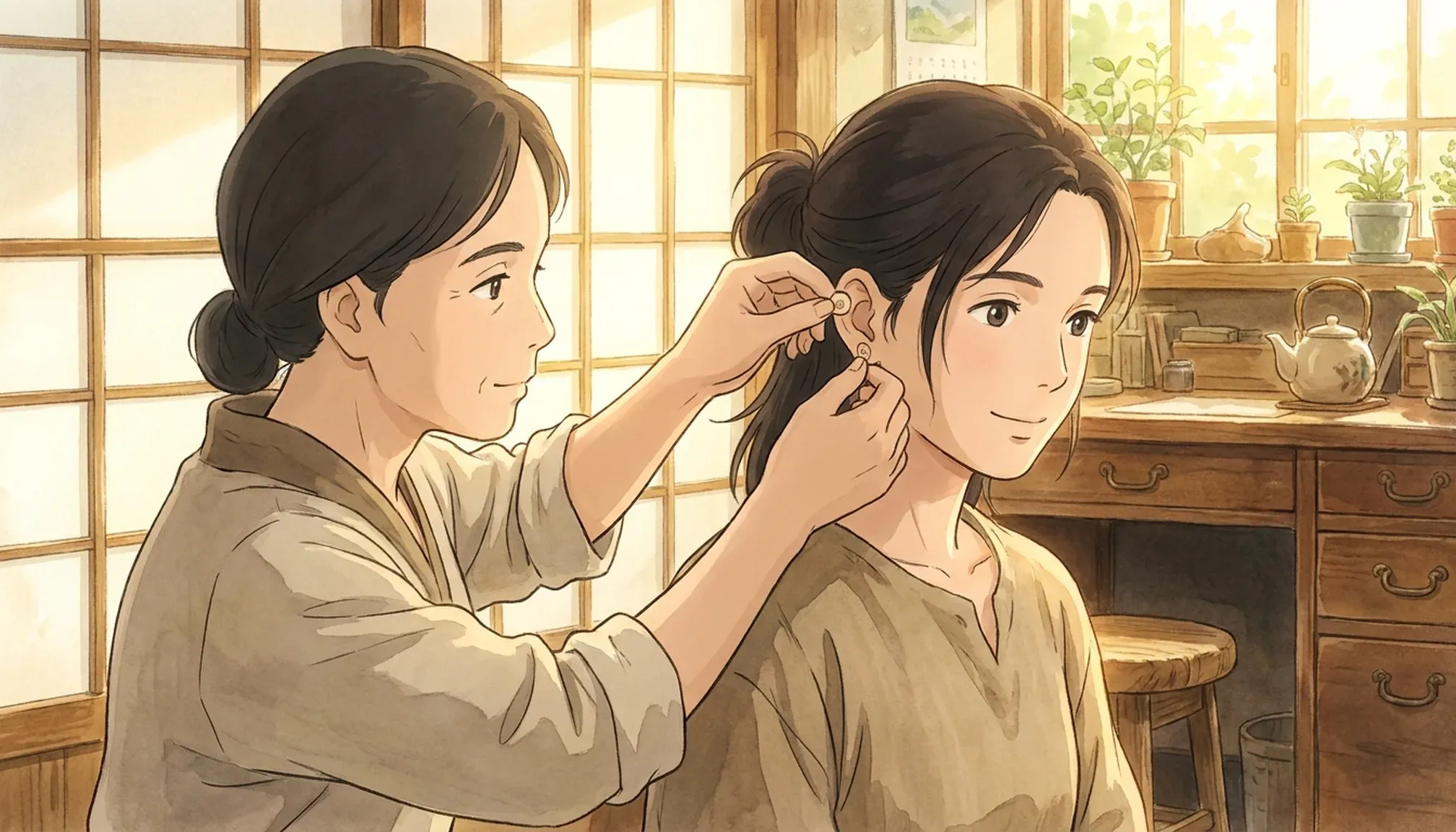
Adhered seeds. One of the most popular techniques is to place small plant seeds (traditionally from a plant called vaccaria) on specific points of the ear, held in place with a hypoallergenic adhesive. They don't pierce the skin: they simply apply pressure.
Magnets or tiny metal beads. These work the same way as the seeds: they stick to the skin and apply gentle, constant pressure.
Other forms of stimulation. Some practitioners also use ear massage, light, or very gentle microcurrents, always in a non-invasive way.
Follow-Up at Home
An interesting feature of seeds and magnets is that the patient goes home with them in place. The practitioner will usually tell you to press each adhesive gently several times a day, for a few seconds each time. This way, the stimulation continues between sessions and you take an active part in your own process. The seeds are usually removed after a few days, at the next session, or sooner if they bother you.
What Auricular Therapy Is Done With: What the Practitioner Uses
Many people want to know exactly what materials are used before their first appointment, and that makes sense: picturing a needle is not the same as picturing a seed stuck on with tape. Auricular therapy uses very few instruments, almost all of them small and single-use, and the practitioner chooses among them based on the person, the reason for the visit, and how well they tolerate needling.
Instruments for Locating the Points
Before stimulating anything, the point has to be found precisely, because the areas of the ear are packed very close together. For this, the practitioner usually uses a probe, a kind of blunt-tipped stylus that glides over the skin in search of the most tender points or those with a different appearance (slight redness, a somewhat sunken or flaky area). Some practitioners also use an electrical detector that measures the skin's resistance and signals with a beep or a light when it finds an active point. Neither of the two pierces the skin: they only press on or brush the ear. As a guide, the practitioner relies on an auricular map, the diagram of the inverted figure we described when talking about its origins.
What Is Used to Stimulate the Ear
Once the points have been located, auricular therapy can be done with different materials:
Auricular filiform needles, shorter than those used in body acupuncture, which are inserted superficially during the session and removed at the end.
Semi-permanent or press needles, tiny and mounted on an adhesive, which stay in place for a few days. Because of the risk of infection, only a professional should place and remove them.
Vaccaria seeds, the most widespread option, placed on a small square of hypoallergenic adhesive tape.
Metal beads or magnets, which serve the same purpose as the seeds with somewhat firmer pressure.
Gentle electrical stimulation or low-level laser, which some practitioners use with specific devices instead of needles.
Besides these, on the treatment table you'll see cotton, alcohol or another antiseptic to clean the ear, tweezers to handle the seeds, and a container for disposing of needles. Everything that goes through the skin must be sterile and disposable.
Are Acupuncture Points Near the Ear Used Too?
Yes, although they aren't part of the auricular map itself. Around the ear there are points on the classical channels, such as Ermen (TE21), Tinggong (SI19), or Tinghui (GB2), which the acupuncturist may combine with auricular therapy when appropriate. At the apex of the ear is Erjian (EX-HN6), an extra point that in the tradition is sometimes treated with a lancet to draw a drop of blood; this is a strictly professional technique, never to be done at home.
What Is Auricular Therapy Used For?
Auricular therapy is used as a complement in a range of situations related mainly to the nervous system, habits, and general well-being. These are the most common ones in practice:
Stress and nervousness. This is probably the most frequent reason for a visit. Many people turn to auricular therapy for support in relaxing, slowing down mental chatter, and feeling more balanced during stressful periods.
Trouble sleeping. As a complement, it can help promote the relaxation needed to fall asleep and improve the feeling of being rested, especially when the problem is related to tension or worry.
Support for quitting smoking. Auricular acupuncture is often used as an aid in the process of giving up tobacco, with the aim of easing anxiety and the urge to smoke. It's not a magic wand: it works best when there is a firm decision to quit and, often, support from other professionals.
Support with habits and appetite control. Likewise, some people use it as a complement while changing their eating habits, always within a comprehensive approach that includes diet, movement, and, where appropriate, medical supervision.
Assorted aches and tension. It's also used as a complement for muscle aches, tension, or general discomfort, aiming to promote relaxation and balance in the body.
One fundamental point needs to be made clear: auricular therapy is a complementary practice. It does not replace medical diagnosis or treatment, and it does not promise cures. If you have symptoms that are persistent, severe, or worrying, the first step is to see your doctor. Auricular therapy can be a good companion along the way, never a replacement for health care.
Does Auricular Therapy Hurt? What It Feels Like During and After
This is, without a doubt, one of the most frequently asked questions, and the answer reassures almost everyone: no, it generally doesn't hurt.
If needles are used, at most you'll feel a very slight, brief prick, because they are extremely fine and placed superficially. Many people describe the sensation as a small pressure or a tingle that disappears within seconds. With seeds and magnets there is no prick at all: you'll only feel the adhesive on your skin and a gentle pressure when you touch it.
During the session, it's common to feel a pleasant sense of relaxation. Some people notice warmth in the ear, a slight, pleasant heaviness, or even the urge to doze off. After the session, you'll usually feel calm and relaxed, although everyone responds differently.
As for side effects, they are uncommon and mild: you may notice slight redness or tenderness in the treated area, or mild discomfort if you sleep with the ear that has a seed on it pressed against the pillow. If the adhesive irritates your skin, simply remove it and let the practitioner know at your next visit.
Who Is It For, and When to See a Professional First
Auricular therapy is a gentle technique that most people tolerate well, including those who are afraid of needles, since there are options without needling, such as seeds or magnets. That is precisely why it is often the gateway into Traditional Chinese Medicine for many people.
Even so, there are situations in which you should talk it over with the practitioner or your doctor beforehand:
- If you are pregnant or think you might be.
- If you take anticoagulant medication or have a clotting disorder.
- If you have an injury, infection, or irritation on the skin of the ear.
- If you have a chronic condition or are under medical treatment, so that your care can be coordinated responsibly.
A qualified professional will always assess your case before starting and will give you honest guidance on whether auricular therapy may be right for you or whether it makes more sense to prioritize another type of care.
Frequently asked questions
How many auricular therapy sessions are usually needed?
It depends on the reason for the visit and on each person. Some people feel a sense of calm from the very first session, while for goals such as quitting smoking or sleeping better, a course of several weekly sessions is usually recommended. The practitioner will propose a plan tailored to your case after the initial assessment.
Are the seeds on the ear very noticeable?
The seeds and magnets are small and discreet, and the adhesive is usually skin-toned, so they barely draw attention. You can go about your life completely as usual with them in place: working, exercising, or sleeping, with the only precautions being not to get them overly wet and to press them as directed.
Does auricular therapy help you lose weight?
It's used as support while changing eating habits, helping to ease food-related anxiety, but on its own it does not make you lose weight. Real results come with a balanced diet, physical activity, and, when necessary, the supervision of a doctor or dietitian.
Is there scientific evidence behind it?
Acupuncture, of which auricular therapy is a part, is recognized by the WHO as a traditional practice, and research on its mechanisms and applications is ongoing. As with many complementary techniques, the evidence varies depending on the area, so the responsible approach is to consider it a complement and not a substitute for conventional medicine.
Can I have auricular therapy if I'm afraid of needles?
Yes. Seeds, magnets, and the small adhered beads don't pierce the skin, so they are a perfect option for people who are apprehensive about needles. Besides, when auricular needles are used, they are so fine that most people barely feel them.
What is used in auricular therapy, needles or seeds?
Both, depending on the case. Auricular therapy can be done with fine needles that are removed at the end of the session, with tiny semi-permanent needles, or, without needling, with vaccaria seeds, metal beads, or magnets stuck on with adhesive tape. Seeds are the most common because they don't pierce the skin and let you keep stimulating the ear at home between sessions.
What do you use for auricular therapy if you want to practice it at home?
At home, it's best to only press the seeds or beads that the practitioner has placed for you, following their instructions. Needles, press needles, and the lancet are professional equipment, and locating the points on the ear correctly requires training. If you want to try it, the most prudent approach is to start with a session in a practice and have them show you how to continue.
Conclusion
Auricular therapy is a simple, gentle, well-tolerated technique that uses the ear as a pathway to support balance and well-being, especially for stress, rest, and support while changing habits. If you're interested in trying it, always look for a qualified professional in acupuncture and Traditional Chinese Medicine who will assess your case individually, answer your questions, and work in coordination with your doctor when necessary. Your health deserves expert hands.