Small Intestine Channel
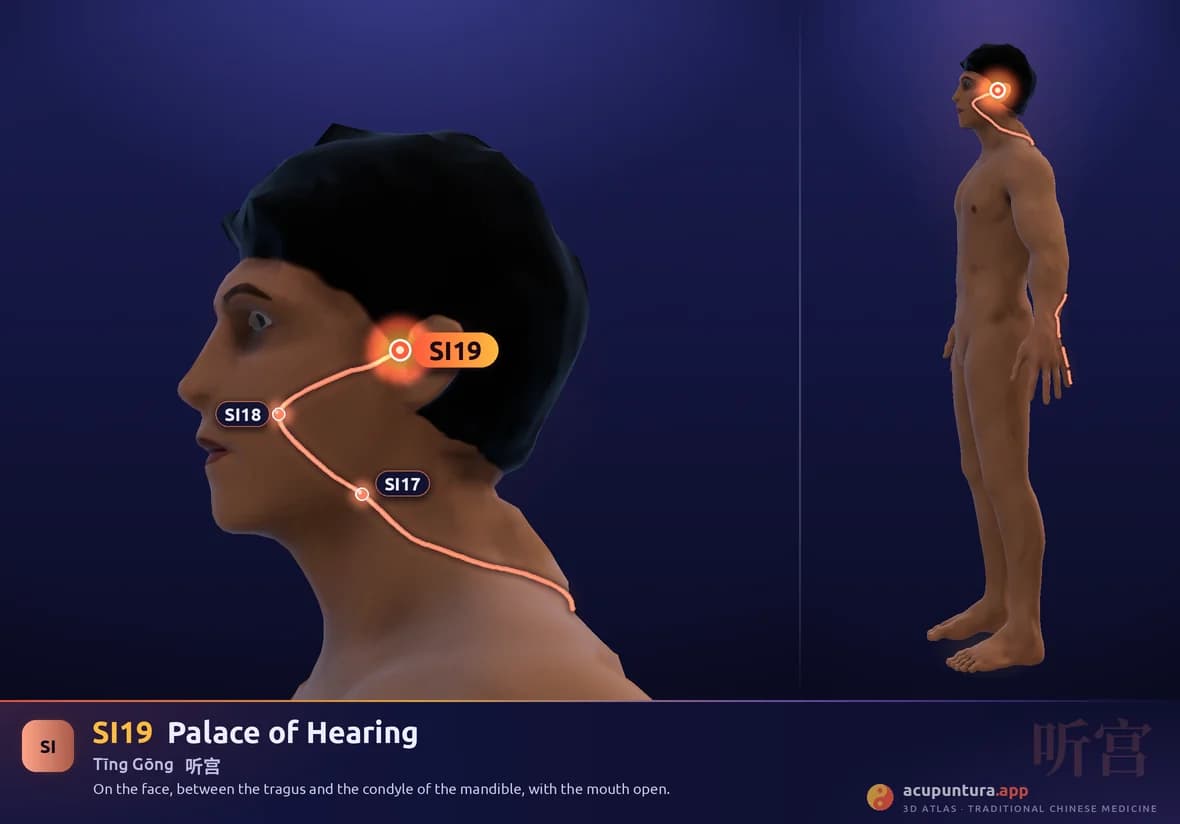
Palace of Hearing
听宫Tīng GōngAnatomical location
On the face, between the tragus and the condyle of the mandible, with the mouth open.
Main function
Benefits the ears, clears Heat, relieves ear pain.
- Crossing point with the Gallbladder and Triple Energizer
Therapeutic indications
- Tinnitus
- deafness
- otitis media
- ear pain
- facial paralysis
- Otitis
- Toothache
- Vertigo
- Mania
Name and classical tradition
Tinggong, 听宫, is the “palace of hearing.” 听 (聽) is to hear; 宫 (宮), the palace, and here, by metonymy, the enclosure of the ear. The point lies in front of the tragus, with the mouth open, and treats hearing. The name is both anatomical and functional. A modern gloss understands that the Qi of the channel enters from the outside to the interior through this palace, a reading less convincing than the simple one.
Its textual origin is well identified: the Lingshu (Spiritual Pivot), in the chapter Ci Jie Zhen Xie (刺節真邪). Its alternative names insist on hearing: 多所聞, “the one who hears much,” and 聽多聞.
It is the last point of the channel and a meeting place: the hand Shaoyang, that of the Triple Energizer, the foot Shaoyang, that of the Gallbladder, and the hand Taiyang, that of the Small Intestine itself, all meet here. In the region in front of the ear lie two other ear points, GB2, Tinghui, the “meeting of the ear,” and TE21, Ermen, the “gate of the ear.”