Have you ever wondered who first thought of inserting fine needles into the body to relieve pain or improve health? The history of acupuncture is one of the most fascinating stories in medicine: it spans more than two thousand years of accumulated knowledge in China and a long journey to becoming a recognized therapy in hospitals and clinics around the world.
In this article, we explain in plain language how this practice began, how it evolved within Traditional Chinese Medicine (TCM), and what happened when the West realized that those thin needles could be more than an Eastern curiosity. If you've never worked with concepts like qi or the balance between yin and yang, don't worry: we walk you through them step by step.
What are the origins of acupuncture in ancient China?
Acupuncture developed in China, although its exact origin is hard to date precisely. The earliest written evidence appears in very old texts, such as the Huangdi Neijing (the "Yellow Emperor's Inner Classic"), compiled more than 2,000 years ago, which already describes a complete system for understanding the human body and treating it with needles.
But the practice is probably even older. There are references to primitive forms of body stimulation with sharpened stones or warm objects long before metal needles existed. The central idea, in any case, was the same: the body works best when something the Chinese called qi (pronounced "chee") flows freely.
What is qi?
Qi is a key concept in Chinese medicine and is often translated as "vital energy," although it's easier to think of it this way: it is the body's capacity to function, move, digest, warm itself, and defend itself. When qi flows normally, we feel well; when it stagnates or weakens, discomfort appears. Acupuncture was born as a method of stimulating specific points on the body to support that flow.
The balance between yin and yang
Another fundamental idea is the balance between yin and yang, two complementary forces that oppose each other and need each other at the same time. Yin represents what is cool, still, and nourishing; yang represents what is warm, active, and dynamic. In everyday life, a person who is always exhausted, feels cold inside, and has heavy digestion has, according to TCM, a predominance of yin or a weakness of vital energy. Acupuncture seeks to restore that balance, like adjusting the thermostat in a house.
The origin of acupuncture: what history tells us and what is legend
When we talk about the origin of acupuncture, it helps to separate three things: what the legends say, what ancient objects and texts show, and what historians still debate. Mixing them up is why so many different versions circulate.
Legends about its birth
Chinese tradition attributes medicine to mythical figures, such as the Yellow Emperor himself, who gives his name to the Huangdi Neijing. That text is written as a dialogue between the emperor and his advisors, but scholars agree that it is not the work of a single person: it is a compilation of knowledge from many authors and eras, gathered under a prestigious name. Another often-repeated story says that soldiers wounded by arrows noticed relief from old ailments, and that this is how the idea of piercing the body was born. It's a nice anecdote, but there is no evidence to support it, and it's best taken for what it is: a tale.
Sharpened stones and the nine needles
What does seem clear is that, before metal, people used polished, sharpened stones called bian shi to press, to open small abscesses, or to stimulate the skin. Many historians see them as the most likely forerunner of the needle. Later, the classical texts already describe the so-called "nine needles," a set of instruments of different shapes: some for shallow piercing, others for pressing without breaking the skin, others for bloodletting or draining. In other words, acupuncture did not begin with the fine needle we know today, but with a very varied repertoire of tools.
Channels first, points later
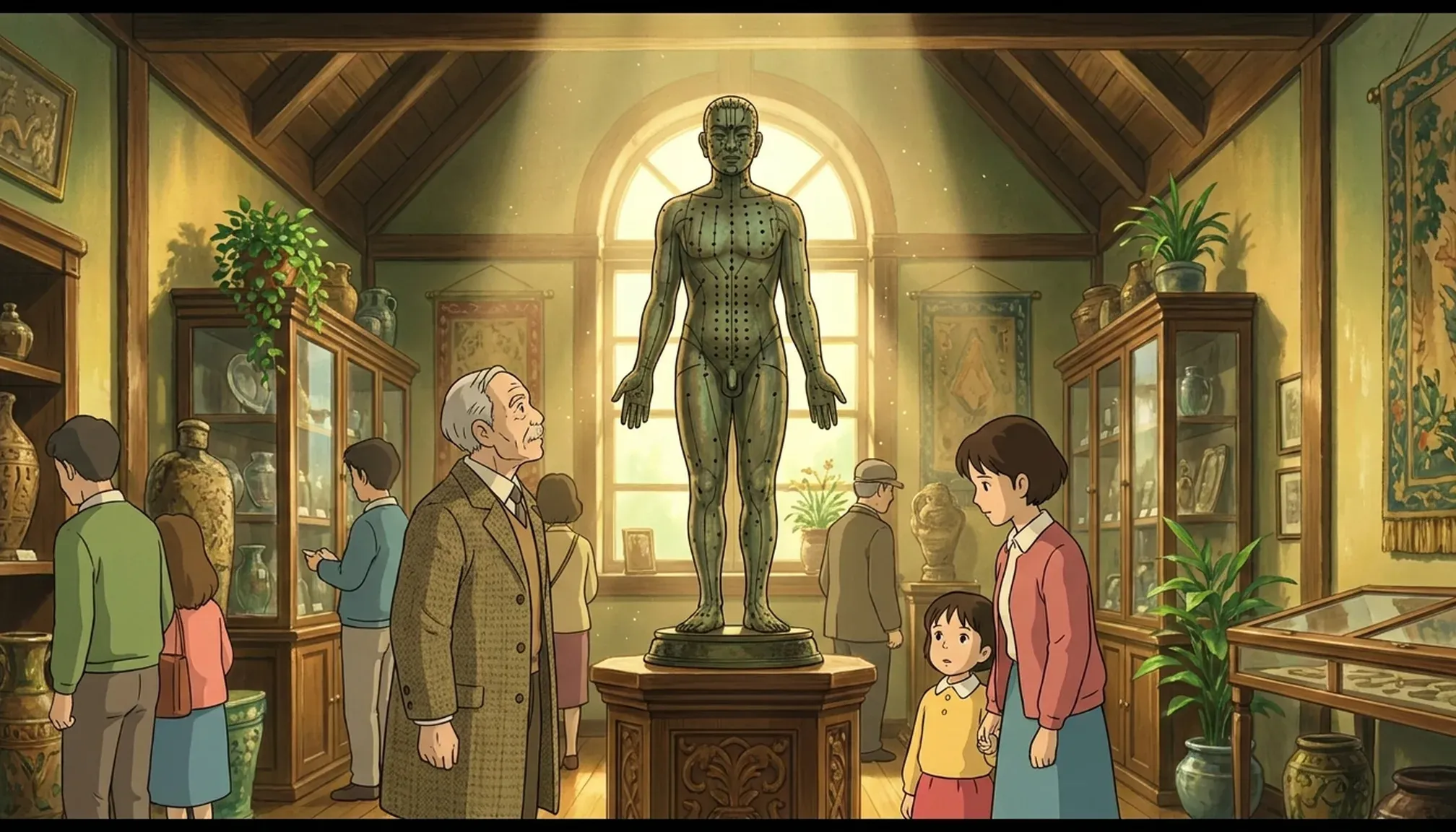
A curious detail about the origin of acupuncture is that the idea of channels seems to predate the idea of specific points. Some ancient manuscripts found in excavations describe the vessels or channels of the body and their relationship to various complaints, and they recommend, above all, warming with moxa (mugwort burned near the skin) rather than needling. Over time, named points were fixed along those pathways, such as Hé Gǔ (LI4), the "Union Valley," on the hand, or Zú Sān Lǐ (ST36), the "Leg Three Miles," below the knee, which are still used today. That is why the practice is called zhenjiu in Chinese, "needle and moxa": the two techniques were born together.
Was there acupuncture outside China?
From time to time it is suggested that other ancient cultures may have stimulated points on the body on their own, and it is a hypothesis that is being studied. But the complete system, with its theory of qi, its channels, and its points, is a construction of Chinese medicine, which later spread to Korea, Japan, and Vietnam, where each country developed its own style.
How did acupuncture develop throughout history?
Over the centuries, acupuncture was refined and became one of the main therapies of official Chinese medicine.
From stone to steel needle
The tools evolved a great deal: from stone points, practitioners moved on to bronze, iron, and finally steel. As metalworking techniques improved, needles became finer, more precise, and more comfortable for the patient, very different from the thick needles used in remote times.
A system of energy channels
Chinese physicians gradually mapped the body along lines called channels (meridians), through which, in their view, vital energy circulates. The areas where needles are inserted are located along those lines. You don't need to memorize any of this: it's enough to know that acupuncture has a very orderly internal logic, the fruit of centuries of clinical observation, and that it is not a matter of poking "at random."
Periods of decline and revival
Interestingly, acupuncture went through dark times. In some periods of Chinese history it was sidelined in favor of other practices, and in the 19th century it lost official support. In the 20th century, however, it experienced a great revival in China, where its study was promoted systematically and it was integrated into modern hospitals. That 20th-century push was, in large part, what catapulted it to the West.
How did acupuncture reach the West?
Although European travelers and missionaries described acupuncture as early as the 16th and 17th centuries, its real arrival in Europe and America came much later.
The first European contacts
In past centuries, the West viewed acupuncture with a mix of curiosity and skepticism. European physicians didn't know how to fit it into their theories, and many considered it a superstition. Even so, some practices inspired by it were tried now and then, without much success, mostly because the complete system it belonged to was not understood.
The turning point: the 20th century and the opening of China
The real turning point came in the 1970s, when the opening of China allowed an unprecedented cultural exchange. Many Westerners traveled to the country, were fascinated by acupuncture (which was used there, for example, in surgical procedures as a complement to anesthesia), and began to train in it. That is how the first acupuncture clinics and schools opened in Europe and America.
Acupuncture in the West today
Today acupuncture is regulated or recognized in many countries, and it is common to see it as a complementary therapy in physical therapy clinics, pain centers, and integrative medicine practices. The scientific evidence for its effectiveness varies by condition: several studies suggest benefits for certain types of pain, for nausea, or for general well-being, although research is ongoing and science still doesn't fully explain all of its mechanisms. What matters is to understand it as a complement to conventional medicine, never a substitute for medical diagnosis and treatment.
What benefits are traditionally attributed to acupuncture?
According to the traditional view of Chinese medicine, acupuncture helps the body regain its natural balance. In practical terms for people who aren't familiar with TCM, it is commonly used as support in situations such as:
Chronic pain or muscle tension: neck pain, low back pain, muscle knots, or frequent headaches.
Stress and trouble sleeping: a constant feeling of being overwhelmed, nervousness, or occasional insomnia.
Digestive discomfort: heavy digestion, bloating, or a feeling of heaviness after eating.
Emotional well-being: many people notice more calm and a better mood after sessions.
TCM would interpret these cases as signs that vital energy is flowing poorly: there are areas where energy stagnates (like an emotional storm that doesn't dissipate) or, on the contrary, there is a shortage of warmth and inner strength (like a campfire burning low). Acupuncture seeks to accompany the body so it can regain its rhythm. From the Western perspective, researchers are studying how stimulation with needles might modulate the nervous system and the perception of pain.
Is acupuncture safe, and does it have contraindications?
When performed by a qualified professional, acupuncture is considered a safe technique. Even so, it's important to know a few precautions:
Needles must be sterile, single-use, and disposable.
If you are pregnant, always tell your acupuncturist: there are areas and stages of pregnancy in which it is applied with special caution.
If you take anticoagulants or have clotting problems, let your practitioner know before the session.
The usual side effects are mild: small bruises, brief tenderness, or a slight feeling of heaviness that disappears within hours.
If you have any symptom that is persistent, intense, or worrying, always consult your doctor. Acupuncture works best hand in hand with conventional medicine, not in place of it.
Frequently asked questions
How many years of history does acupuncture have?
It is estimated to have more than 2,000 years of documented development in China, although primitive forms of body stimulation may be even older.
What is the origin of acupuncture according to history?
Acupuncture originated in China. Its most likely forerunners are the sharpened stones (bian shi) used to press or pierce the skin, and moxa, which was applied along the body's channels. Over time the points were fixed and metal needles appeared, and the Huangdi Neijing gathered all that knowledge into an orderly system.
Who invented acupuncture?
No one in particular. Tradition attributes it to the Yellow Emperor, a legendary figure, but acupuncture is the result of generations of Chinese physicians who observed the body, tried techniques, and gradually wrote them down. The classical texts are compilations by many authors, not the work of a single inventor.
Where does the word "acupuncture" come from?
From Latin: acus (needle) and punctura (puncture). It is a Western term; in Chinese the practice is known by names related to the idea of inserting and withdrawing the needle.
Does acupuncture hurt?
Today's needles are very thin, much thinner than the ones used for a blood draw. Most people feel only a slight pressure or a sensation of warmth or spreading heaviness that is relaxing.
How many acupuncture sessions are needed?
It depends on the person and the reason for the visit. It's common to start with a series of weekly or biweekly sessions and then assess the results. Your acupuncturist will guide you based on your case.
Does acupuncture have a scientific basis?
Current research shows promising results for some conditions, such as certain types of pain or nausea, although the evidence is mixed depending on the problem being treated. The exact mechanisms are still being studied.
Can acupuncture replace medical treatment?
No. Acupuncture is a complement that can help improve well-being, but it should never replace your doctor's diagnosis or treatment.
Conclusion: an ancient tradition that is still alive
The history of acupuncture is the story of how a culture observed the human body for centuries and built a language of its own —qi, yin and yang, blood, and internal heat— to understand it. From stone points to today's sterile steel needles, this therapy has come a long way to reach our time.
If you're interested in trying it, do so with qualified professionals, with single-use needles, and always as a complement to your regular medical care. And remember: if symptoms persist or get worse, consult a health professional. Your health always deserves the best available evidence and warm, safe care.