Large Intestine Channel
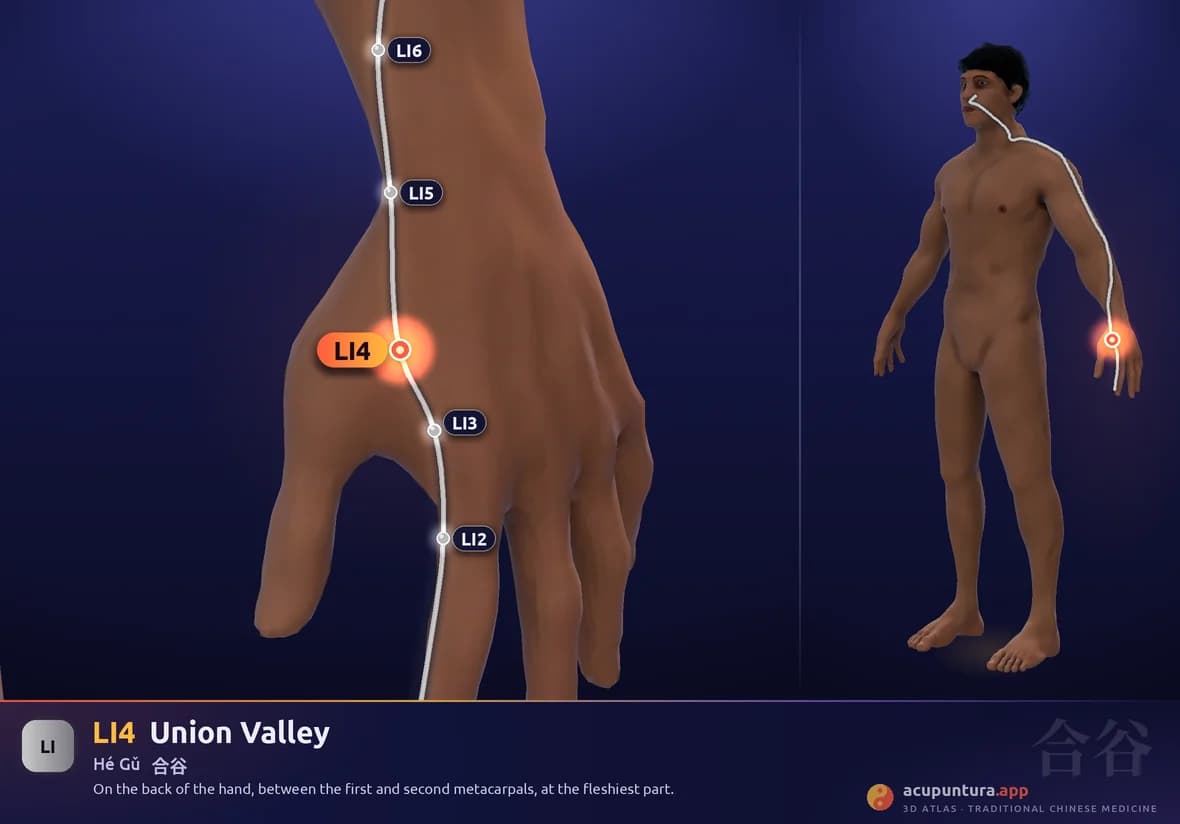
Union Valley
合谷Hé GǔContraindicated during pregnancy
Moves Qi and Blood forcefully and directs them downward. Prohibited throughout pregnancy; in the tradition it is reserved for encouraging a labor that has already begun.
Anatomical location
On the back of the hand, between the first and second metacarpals, at the fleshiest part.
Main function
Disperses Wind-Heat, regulates Wei Qi (Defensive Qi), relieves pain.
- Yuan (Source) point
Therapeutic indications
- Headache
- sore throat
- fever
- facial pain
- frontal headache
- sinusitis
- rhinitis
- conjunctivitis
- common cold
- fever without sweating or with excessive sweating
- tonsillitis
- trismus
- deafness
- hives
- dysmenorrhea
- constipation
- abdominal pain
- facial hemiplegia
- pain in any location
- insomnia due to pain
- induction of labor at term
- post-traumatic stress
- depression
- Parkinson's disease (tremor due to Internal Wind)
- fibromyalgia
- trigeminal neuralgia
- tension headache
- addictions and smoking cessation
- bruxism
- irritable bowel syndrome
- allergic rhinitis
- premenstrual syndrome
- rheumatoid arthritis
- psoriasis
- atopic dermatitis
- acne
- herpes zoster and postherpetic neuralgia
- chemotherapy-induced nausea and vomiting
Name and classical tradition
Hegu, 合谷, is probably the best-known acupuncture point, and its name describes exactly what you see and what you do. 合 means to join, bring together, close; 谷 is a valley, a hollow between two ridges. The valley is the depression between the first and second metacarpals, between two mountains of bone, and 合 alludes to the gesture of pressing the thumb and index finger together, which raises the muscle bulge where the point is found. It is a double geometric reading on which all the sources agree.
The Lingshu (Spiritual Pivot), chapter Ben Shu (本輸), locates it with a precise phrase: “過於合谷,合谷在大指歧骨之間,為原.” The qi passes through Hegu, which lies between the bones that fork off from the thumb; it is the Yuan-Source point. 歧骨, “forked bones,” is the classical way of naming the V formed by the two metacarpals. On the yang channels, the Yuan-Source point (原穴) is independent of the Shu-Stream point and occupies its own place in the sequence.
Its popular name is 虎口, “tiger's mouth”: when you open the thumb and index finger, the hand forms a pair of open jaws. The alias is well attested in the tradition. Another name, 容谷, “valley that receives,” circulates in modern references without a citation. In later literature, Hegu became one of the most frequently cited points, above all for the head and face, and the song of the four major points sums it up in a single line: “面口合谷收,” for the face and mouth, Hegu. The other three points in the song are ST36, BL40, and LU7.
Other names
- 虎口Jiayi Jing