Stomach Channel
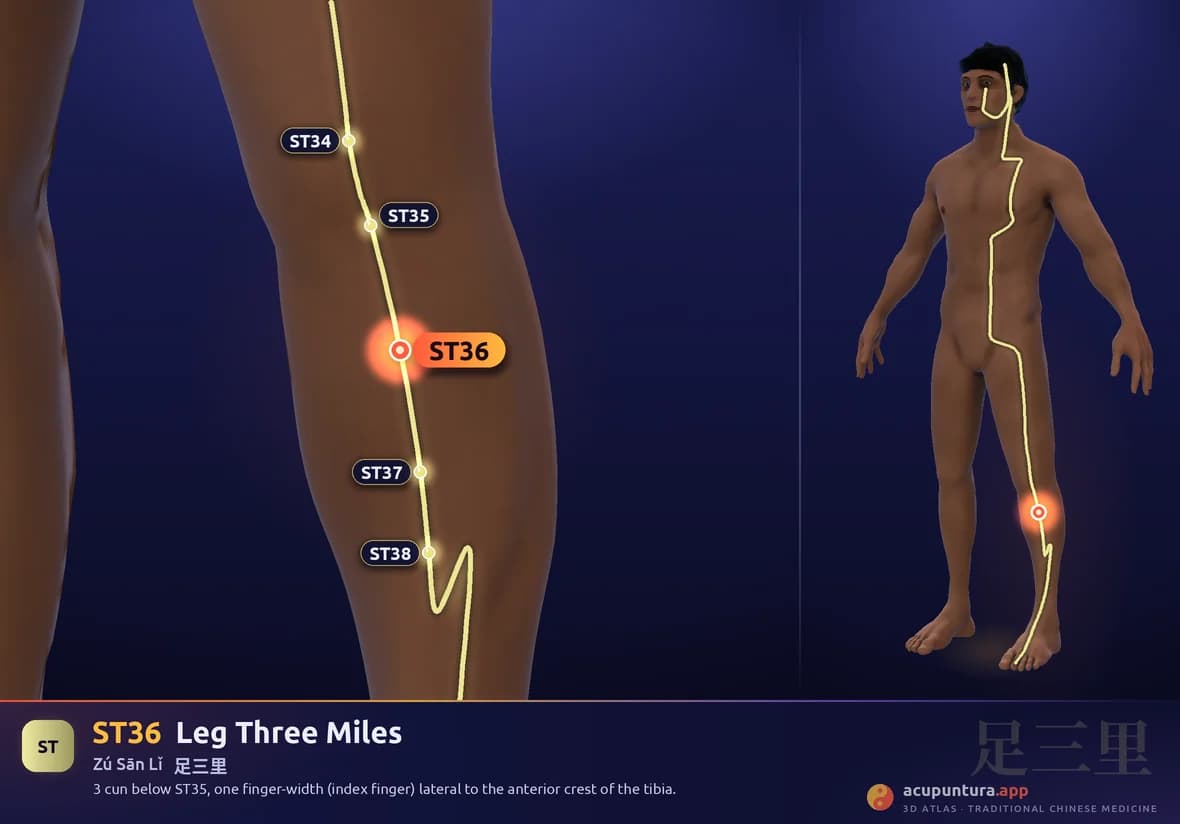
Leg Three Miles
足三里Zú Sān LǐAnatomical location
3 cun below ST35, one finger-width (index finger) lateral to the anterior crest of the tibia.
Main function
Strengthens the Spleen and Stomach, regulates Qi, reinforces Zheng Qi, benefits immunity.
- He-Sea point (Earth)
- Lower He-Sea point of the Stomach
- Sea of Nourishment point
Therapeutic indications
- Abdominal pain
- diarrhea
- constipation
- vomiting
- gastritis
- fatigue
- low immunity
- gastric pain
- abdominal distension
- indigestion
- poor appetite
- general weakness
- dizziness
- insomnia
- hypertension
- palpitations
- mastitis
- knee and leg pain
- hemiplegia
- edema
- low defenses
- convalescence
- depression
- cognitive decline and dementia
- multiple sclerosis (Wei syndrome)
- fibromyalgia
- Ménière’s disease
- addictions and smoking cessation
- diabetes mellitus (Xiao Ke)
- obesity and overweight
- hyperlipidemia (high cholesterol and triglycerides)
- hypothyroidism
- irritable bowel syndrome
- ulcerative colitis and Crohn’s disease
- fatty liver
- gallstones and biliary colic
- kidney stones and renal colic
- gastroesophageal reflux
- COPD and chronic bronchitis
- allergic rhinitis
- low blood pressure
- venous insufficiency and varicose veins
- prostatitis and benign prostatic hyperplasia
- polycystic ovary syndrome
- rheumatoid arthritis
- knee osteoarthritis
- osteoporosis
- psoriasis
- atopic dermatitis
- chemotherapy-induced nausea and vomiting
- chemotherapy-induced leukopenia
- anemia
Name and classical tradition
The name 足三里, Zusanli, combines a piece of location information with a piece of functional information, and the tradition has made use of both. In its oldest form, the point was simply called 三里. The Lingshu (Spiritual Pivot), in the chapter Ben Shu (本輸), also presents it as 下陵, “lower hill,” and describes it as the He point of the Stomach channel.
The Suwen (Basic Questions), in its chapter Zhen Jie (鍼解篇), fixes the geometric reference with a brief sentence: “所謂三里者,下膝三寸也,” what is called sanli lies three cun below the knee. The 里 in the name works here as a measure, and the commentator Yang Shangshan, in the seventh century, glossed the equivalence of that ancient measure in the Huangdi Neijing Taisu. There is also a second reading, widespread in textbooks, that plays on the homophony between 里 and 理, “to regulate”: the point would regulate the three regions of the abdomen. It is an interpretation that fits the clinical use of the point, but it has not been possible to document it in ancient commentators, and its dating is uncertain.
The prefix 足, “foot,” came much later. It was the Shengji Zonglu, the great official medical compilation of the Song dynasty, in the twelfth century, that fixed 足三里 to distinguish it from LI10, Shousanli, the Sanli of the arm. The same procedure of adding 手 or 足, or 頭 and 足, was applied in that period to other pairs of homonymous points, such as GB11 and GB44.
Among its alternate names are 下陵, the one from the Lingshu, and 中俞髎. Another, 鬼邪, comes from the tradition of the spirits in the Qianjin Yaofang (Essential Formulas Worth a Thousand Gold), which for the illness that makes a person shout, curse, and run off prescribes “三里主之(一名鬼邪)”; the text does not specify which Sanli, the one on the leg or the one on the arm, and the alias has been attributed to both. In the song of the four major points, the first line belongs to it: “肚腹三里留,” for the belly, Sanli. The other three are BL40, LU7, and LI4.