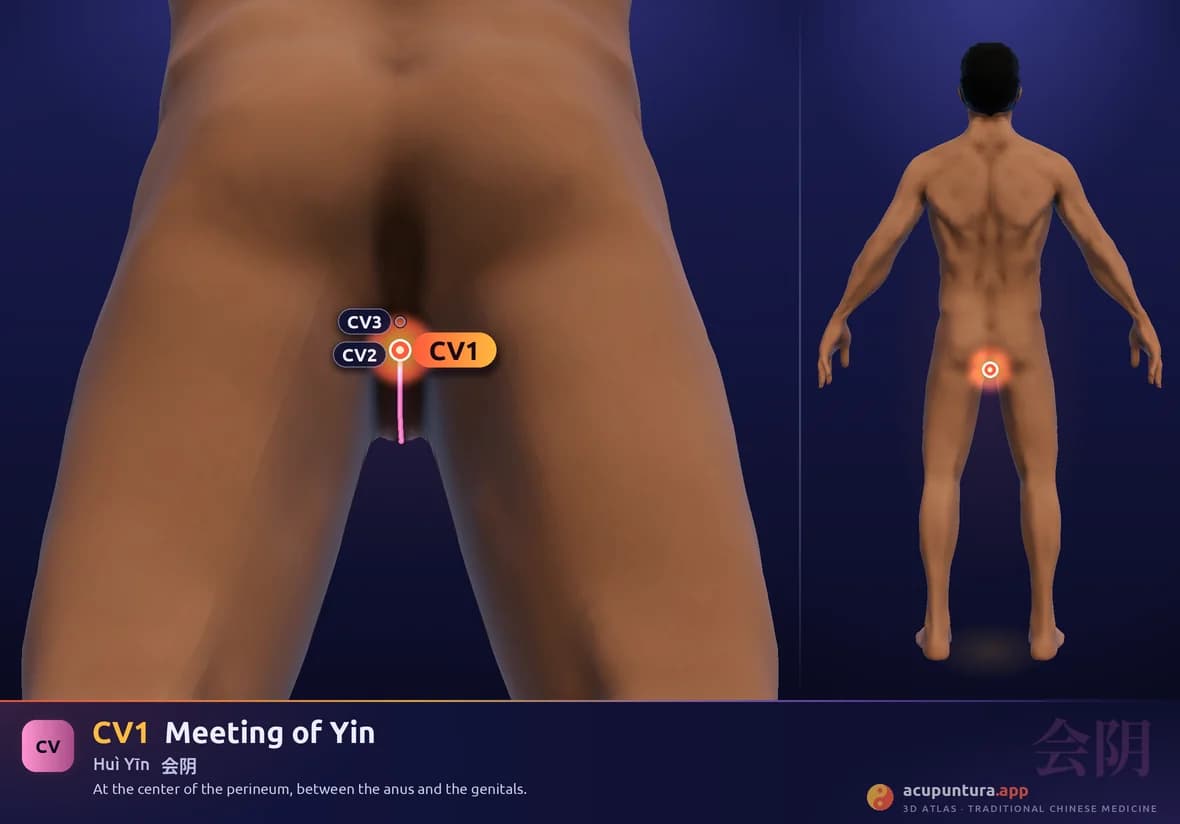
Ren Mai (Conception Vessel) Channel
Meeting of Yin
会阴Huì YīnAnatomical location
At the center of the perineum, between the anus and the genitals.
Main function
Regulates the Ren Mai and Du Mai, calms the Shen, benefits the urogenital system.
- Crossing point with the Du Mai and Chong Mai
Therapeutic indications
- Urogenital dysfunction
- hemorrhoids
- anal prolapse
- loss of consciousness
- rectal prolapse
- urinary retention
- genital itching
- irregular menstruation
- resuscitation after drowning
- impotence
- amenorrhea
Name and classical tradition
Huiyin, 会阴, is the “meeting of the Yin.” 会 (會) means to gather, to converge; 阴 (陰) is Yin. The point lies on the perineum, between the anus and the genitals, the “two Yin” of the body, and it is the starting point of the Ren Mai. Modern glosses explain it in two ways: as the place where the Yin fluids descending from above converge, or as the point of origin where the Ren Mai, Du Mai, and Chong Mai emerge and meet. Tradition does indeed consider it a crossing point of those three vessels.
The Zhenjiu Jiayi Jing (Systematic Classic of Acupuncture and Moxibustion) records it with a sentence that gives both its alias and its location: «會陰,一名屏翳,在大便前,小便後,兩陰之間». Huiyin, also called Pingyi, lies in front of the anus and behind the genitals, between the two Yin. The alias 屏翳, “screen that covers,” thus has support in the same work. The citation comes from secondary sources.
Other names in circulation, such as 海底, “bottom of the sea,” 下極, or 神田, belong mainly to the literature of internal alchemy and qigong, and should not be presented as ancient medical names.
In Sun Simiao's Qianjin Yaofang (Essential Prescriptions Worth a Thousand Gold), the eleventh of the thirteen spirit points lies in this region: «陰下縫灸三壯,女人即玉門頭,名鬼藏», at the seam below the genitals, with three cones of moxa, and in women at the edge of the “jade gate”; it is called the “hiding place of the spirits.”
Other names
- 屏翳Jiayi Jing