Ren Mai (Conception Vessel) Channel
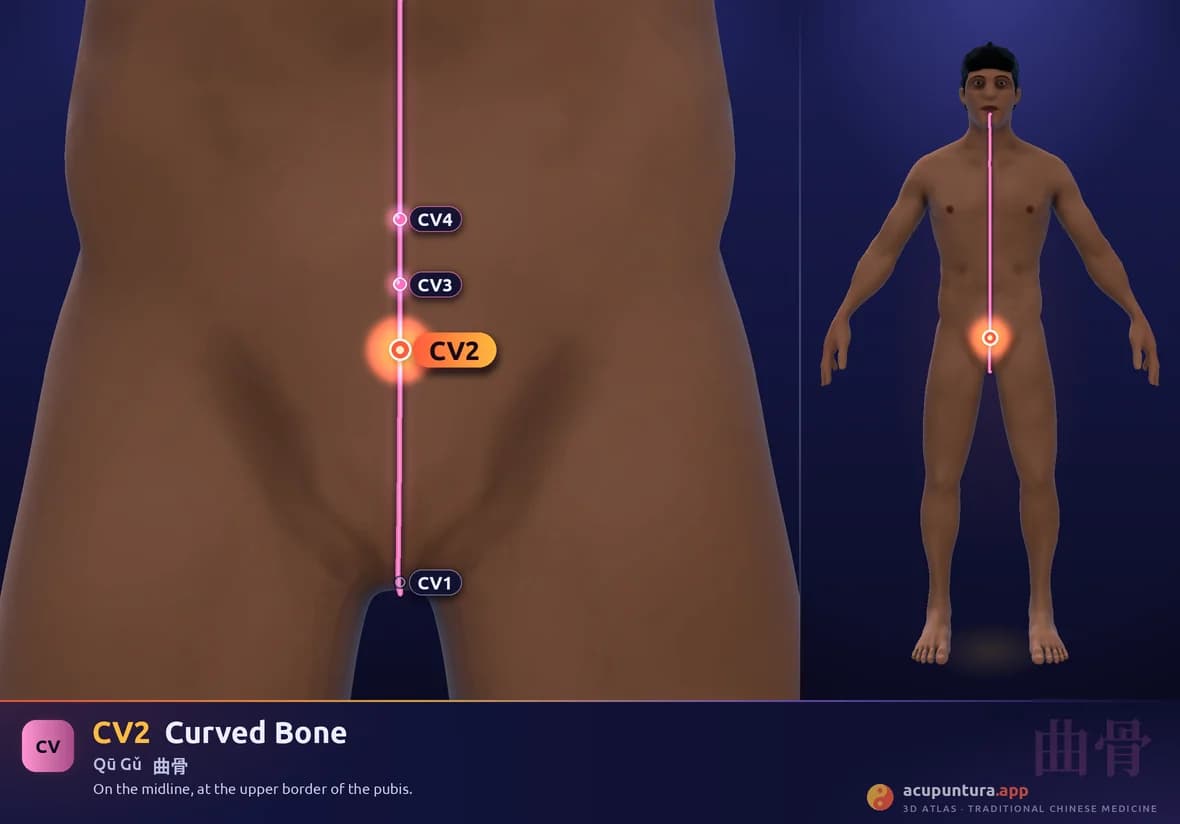
Curved Bone
曲骨Qū GǔContraindicated during pregnancy
Over the pubic symphysis, directly over the pregnant uterus.
Anatomical location
On the midline, at the upper border of the pubis.
Main function
Regulates the Bladder, benefits the genitals, strengthens the lumbar region.
Therapeutic indications
- Abdominal pain
- dysuria
- impotence
- leukorrhea
- urinary retention
- enuresis
- nocturnal emission
- irregular menstruation
- pain in the hypogastrium
Name and classical tradition
Qugu, 曲骨, is the “curved bone.” 曲 means curved, bent; 骨 is bone. The bone is the upper border of the pubic symphysis, and Sun Simiao's Qianjin Yaofang (Essential Prescriptions Worth a Thousand Gold) describes its shape with a comparison: «在陰上橫骨中央,宛曲如卻月中央是», in the center of the transverse bone above the genitals, curved like the waning moon; that is the place. The name is anatomical, with no symbolic load.
The Zhenjiu Jiayi Jing (Systematic Classic of Acupuncture and Moxibustion) locates it «在橫骨上,中極下一寸,毛際陷者中», above the pubic bone, one cun below Zhongji, in the depression at the edge of the pubic hair. Both citations come from the Yibian collection. It is a crossing point of the Ren Mai with the Liver channel. The reference works record the graphic variant 屈骨, close in sound and meaning. On either side of it is KI11, Henggu, the “transverse bone,” the ancient name of the same bone.