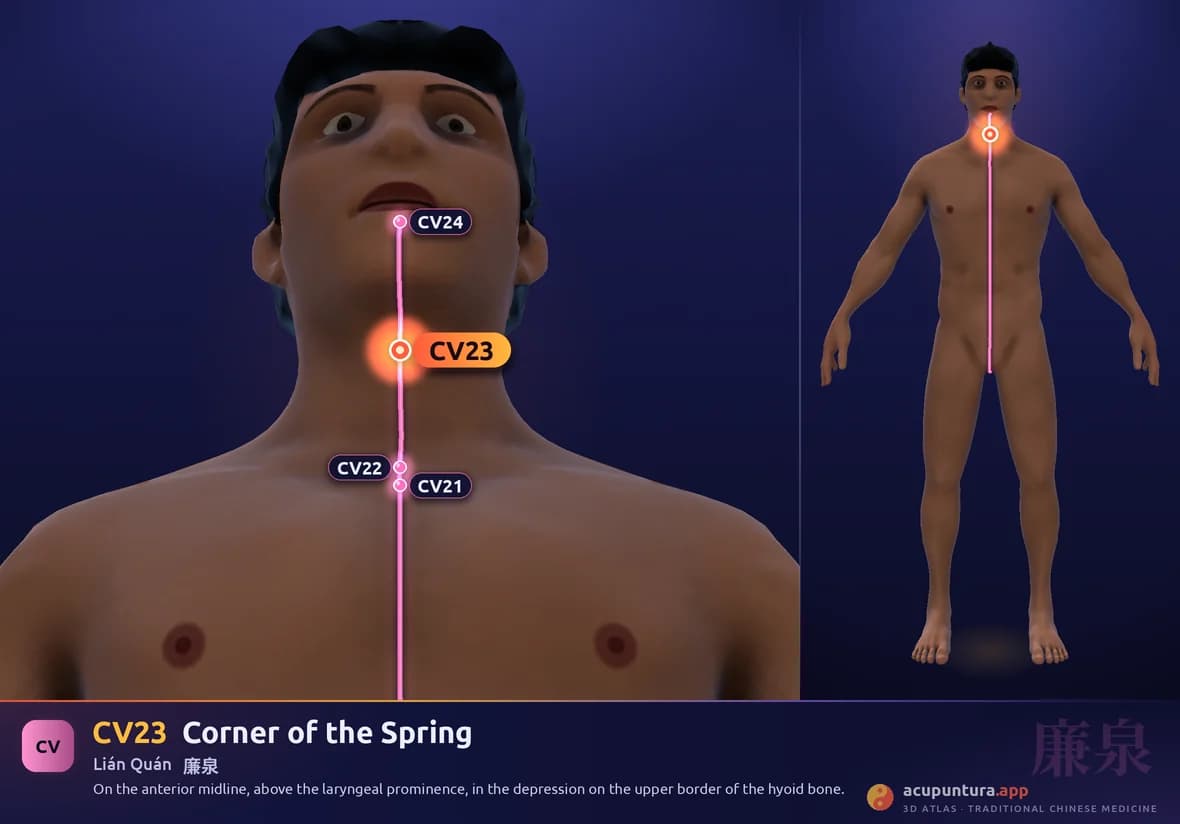
Ren Mai (Conception Vessel) Channel
Corner of the Spring
廉泉Lián QuánAnatomical location
On the anterior midline, above the laryngeal prominence, in the depression on the upper border of the hyoid bone.
Main function
Benefits the throat and tongue, regulates Qi.
Therapeutic indications
- Sore throat
- difficulty speaking
- excessive salivation
- aphonia
- stiff tongue
- difficulty swallowing
- aphasia after stroke
- dysarthria
Name and classical tradition
Lianquan, 廉泉, combines 廉, which means edge, border, and also, in medical texts, to gather, to contain, and 泉, the spring. The usual translation, “corner of the spring,” follows the first meaning; the modern medical gloss prefers the second and understands the point as the place where descending moisture is gathered. Both readings are legitimate. The point lies on the neck, above the laryngeal prominence, under the root of the tongue.
It has two high-quality ancient citations. The Zhenjiu Jiayi Jing (Systematic Classic of Acupuncture and Moxibustion) locates it, in the section on the seventeen points of the neck: «廉泉,一名本池,在頷下,結喉上,舌本下», Lianquan, also called Benchi, below the jaw, above the laryngeal prominence, under the root of the tongue. And the Lingshu (Spiritual Pivot), in the Ci Jie Zhen Xie chapter (刺節真邪), prescribes it for cough with ascending Qi and chest pain, with a very specific needling criterion: «取廉泉者,血變而止», when needling Lianquan, stop when the color of the blood changes. Both citations come from secondary sources.
It is a meeting point of the Ren Mai with the Yin Wei Mai. Its alternative names are 本池 and 舌本, “root of the tongue.”
Other names
- 本池Jiayi Jing