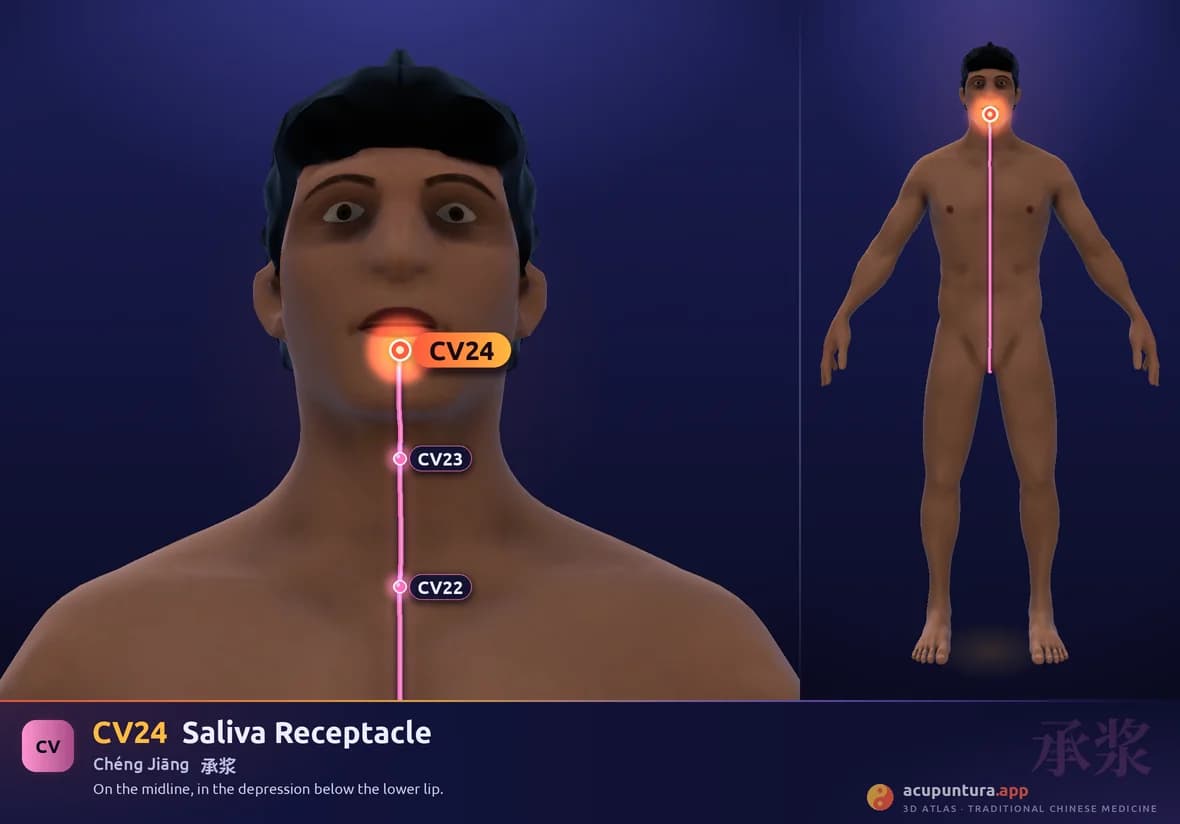
Ren Mai (Conception Vessel) Channel
Saliva Receptacle
承浆Chéng JiāngAnatomical location
On the midline, in the depression below the lower lip.
Main function
Disperses Wind, regulates the face, calms the Shen.
- Crossing point with the Du Mai, Stomach, and Large Intestine
Therapeutic indications
- Facial deviation
- toothache
- excessive salivation
- facial paralysis
- deviation of the mouth
- gum pain
- mania
- facial edema
- intense thirst
- schizophrenia (Dian Kuang)
Name and classical tradition
Chengjiang, 承浆, is the “receiver of saliva.” 承 means to receive, to support from below what falls; 浆 (漿), the thick liquid, here saliva. The point lies in the groove below the lower lip, right where saliva escaping from the mouth would collect. It is one of the least disputed etymologies in the whole Ren Mai. The reference works record aliases from the same field: 懸漿, “hanging saliva,” and 垂漿, “dripping saliva.” The Zhenjiu Jiayi Jing (Systematic Classic of Acupuncture and Moxibustion) gives it another, unexpected one, «承漿,一名天池», the same name as PC1, Tianchi, a different point on the chest. And Sun Simiao's Qianjin Yaofang (Essential Prescriptions Worth a Thousand in Gold) puts it on the list of the thirteen ghost points, each with its own name: «第八針承漿,名鬼市», the eighth, Chengjiang, is called the “ghost market.”
The Jiayi Jing presents it as the meeting of the foot Yangming and the Ren Mai. Most significant is its position in the system: it is the last point of the Ren Mai and the place where it meets the Du Mai and the Stomach channel. Here the circuit of the two great midline vessels closes: the Du Mai, which rises along the back from GV1, and the Ren Mai, which rises along the front from CV1.
This circuit is what Taoist internal alchemy calls the “small celestial orbit” (小周天), an exercise in circulating Qi through the two vessels. The idea comes from that tradition and not from the ancient medical canon, but it helps explain why the meeting of the two vessels at the mouth has carried so much symbolic weight.
Other names
- 天池Jiayi Jing
- 鬼市Qianjin Yaofang