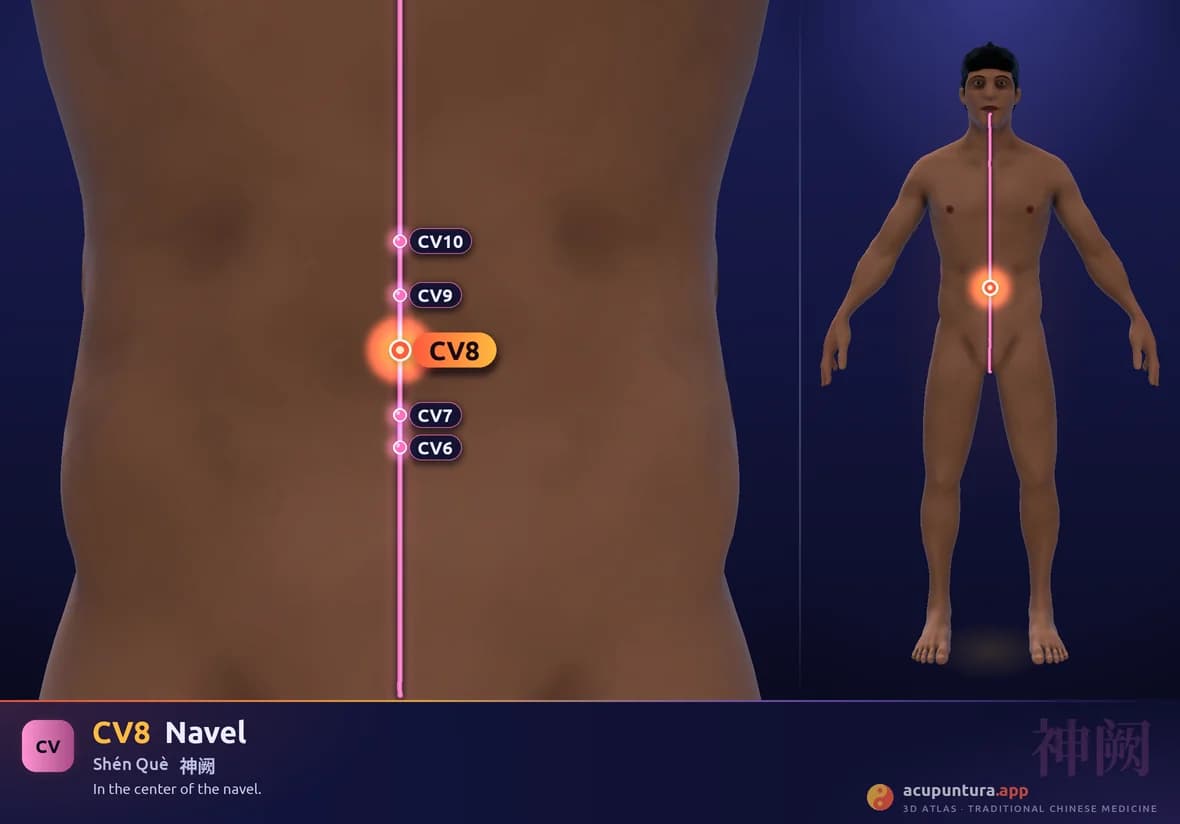
Ren Mai (Conception Vessel) Channel
Navel
神阙Shén QuèUse caution during pregnancy
Navel: never needled, indirect moxa only. During pregnancy, gentle and brief moxa at most.
Anatomical location
In the center of the navel.
Main function
Warms Yang, strengthens the Spleen, regulates the intestines.
Therapeutic indications
- Abdominal pain
- diarrhea
- edema
- anal prolapse
- chronic diarrhea
- rectal prolapse
- collapse
- cold extremities
- borborygmi
Name and classical tradition
Shenque, 神阙, is the navel, and its name is one of the most evocative on the Ren Mai. 神 is the spirit, and also whatever changes in unpredictable, prodigious ways (變化莫測為神); 阙 (闕) is the entrance tower of a palace, the majestic gate. The usual reading goes back to the life of the fetus: the umbilical cord, which attaches here, brings the nourishment that makes the marvel of development possible, and the navel would be the palace gate of that process. It is a coherent etymology, though it comes from modern manuals rather than from an ancient commentator.
The firmest fact is a prohibition, found in the Zhenjiu Jiayi Jing (Systematic Classic of Acupuncture and Moxibustion), which does not call the point Shenque but simply 臍中, the center of the navel: "臍中,禁不可刺,刺之令人惡瘍,遺矢者死不治." It is not to be needled; doing so produces malignant sores, and if fecal incontinence appears, death is certain. The name 神闕 is therefore later. The prohibition has held in practice: the navel is treated with indirect moxa, over salt or ginger, never with a needle.
Its alternative names include plain descriptions, 臍中, the name in the Jiayi Jing, and 臍孔, as well as more evocative ones: 命蒂, "stalk of life," which alludes to the umbilical cord, 氣合, 環谷, and 維會.