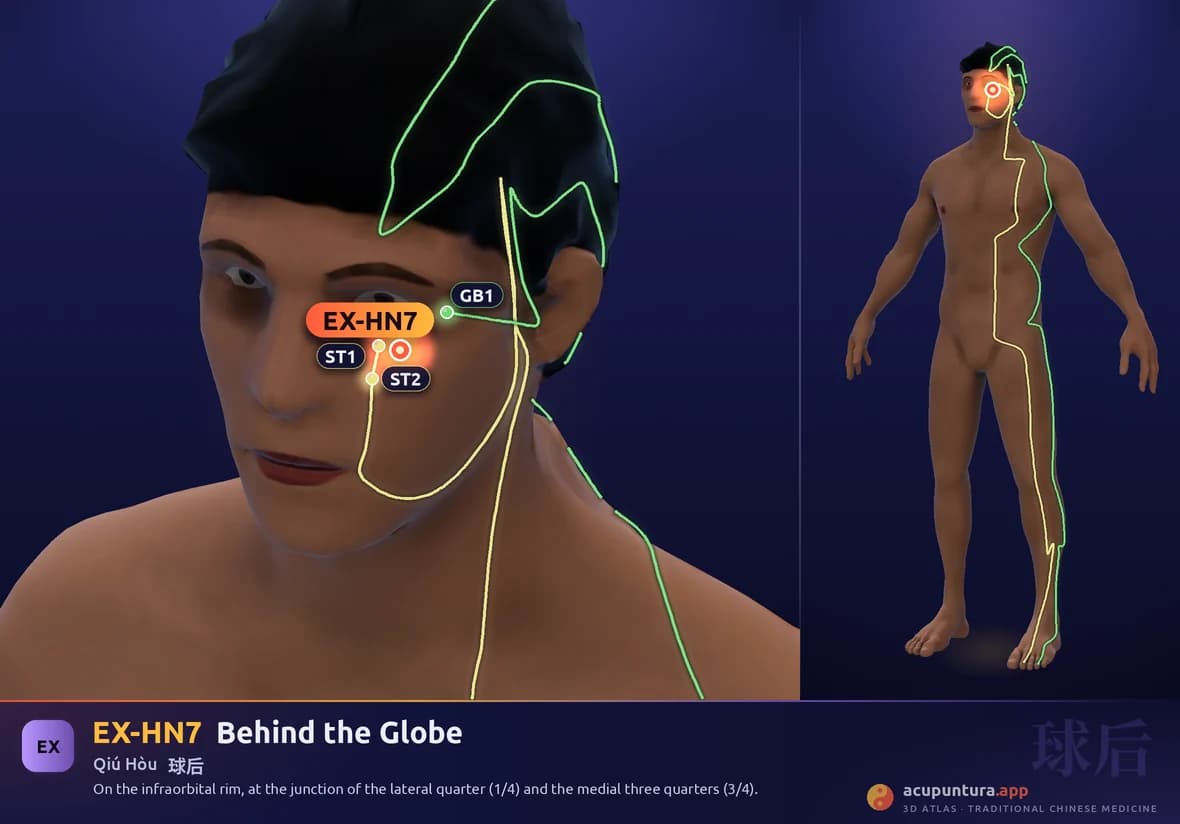
Extra point · Head and Neck
Behind the Globe
球后Qiú HòuAnatomical location
On the infraorbital rim, at the junction of the lateral quarter (1/4) and the medial three quarters (3/4).
Same point as CP8 · Qiú Hòu — Curious Points catalogMain function
Benefits the eyes, activates the local collateral.
Therapeutic indications
- Myopia
- optic nerve atrophy
- glaucoma
- retinopathy
Name and classical tradition
Qiuhou, 球后, means "behind the globe": 球, the sphere, the eyeball; 后 (後), behind. The name describes the technique exactly: the needle enters at the lower rim of the orbit and is directed backward, behind the eye.
It is not a point of the classical texts. It does not appear in the works we have been able to check, and the vocabulary itself gives it away: 球 as a name for the eyeball is a term of modern anatomy, and the point belongs to the acupuncture ophthalmology of the twentieth century. It lies in the orbit, next to ST1, Chengqi, one of the points the Zhenjiu Jiayi Jing (Systematic Classic of Acupuncture and Moxibustion) forbade to moxa.