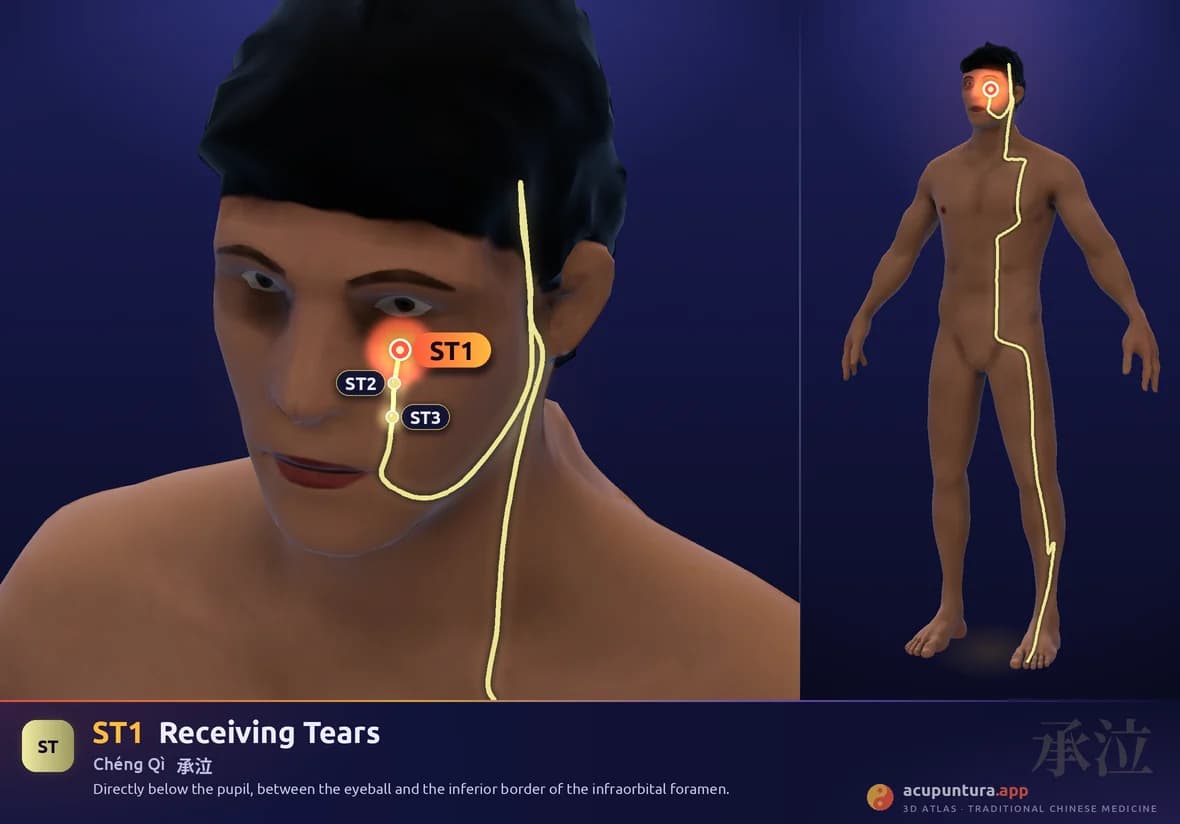
Stomach Channel
Receiving Tears
承泣Chéng QìAnatomical location
Directly below the pupil, between the eyeball and the inferior border of the infraorbital foramen.
Main function
Disperses Wind, benefits the eyes, clears Heat, unblocks the channel.
- Crossing point with the Yang Qiao and Ren Mai
Therapeutic indications
- Tearing
- blurred vision
- eyelid spasm
- eye pain
- myopia
- night blindness
- facial paralysis
- Conjunctivitis
- Poor night vision
- Eyelid twitching
- Glaucoma
- Red eyes
Name and classical tradition
Chengqi, 承泣, is the point where the Stomach channel begins, just below the eye, and its name places it with an image: 承 means to receive, to support from below; 泣 is tears. It is the place that catches tears as they fall. This breakdown is the one every source repeats, and although its current formulation is modern, the basic sense agrees with the location the tradition has always given it, on the inferior rim of the orbit.
The first verifiable mention is in Huangfu Mi's Zhenjiu Jiayi Jing (Systematic Classic of Acupuncture and Moxibustion), in the 3rd century; it has not been found in the Lingshu (Spiritual Pivot) or the Suwen (Basic Questions). The sources agree that it is a crossing point of the Yangqiao, the Ren Mai and the foot Yangming itself.
The Jiayi Jing gives it two alternative names, 鼷穴 and 面窌, "hollow of the face," and locates it «在目下七分,直目瞳子», seven fen below the eye, in line with the pupil, as a meeting of the Yangqiao, the Ren Mai and the foot Yangming. And it excludes it from moxa: «不可灸». The reference works add 目下, "under the eye."
Other names
- 鼷穴Jiayi Jing
- 面髎Jiayi Jing