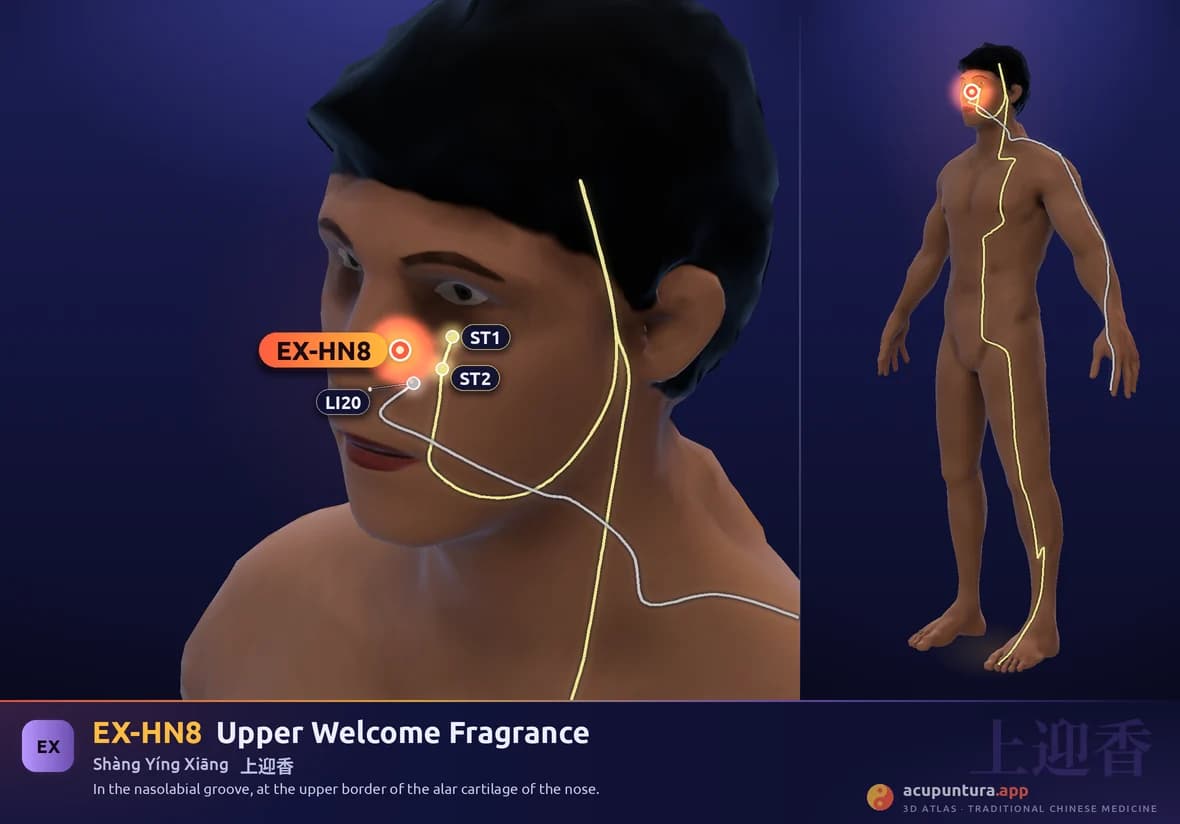
Extra point · Head and Neck
Upper Welcome Fragrance
上迎香Shàng Yíng XiāngAnatomical location
In the nasolabial groove, at the upper border of the alar cartilage of the nose.
Same point as CP14 · Shàng Yíng Xiāng — Curious Points catalogMain function
Opens the nose, disperses Wind.
Therapeutic indications
- Rhinitis
- sinusitis
- nasal congestion
- anosmia
Name and classical tradition
Shangyingxiang, 上迎香, is the "upper Yingxiang." It takes its name from LI20, Yingxiang, "the one that receives odors," the last point of the Large Intestine, beside the wing of the nose, and it lies above it, at the upper end of the nasolabial groove. Modern manuals also give it the name 鼻通, "the one that opens the nose."
It does not appear in the classical works we have been able to check. It should not be confused with 內迎香, the inner Yingxiang, which the Zhenjiu Dacheng (Great Compendium of Acupuncture and Moxibustion) describes inside the nostril: "內迎香二穴,在鼻孔中,治目熱暴痛,用蘆管子搐出血最效", a point that was bled with a reed tube.