Large Intestine Channel
Welcome Fragrance
迎香Yíng XiāngAnatomical location
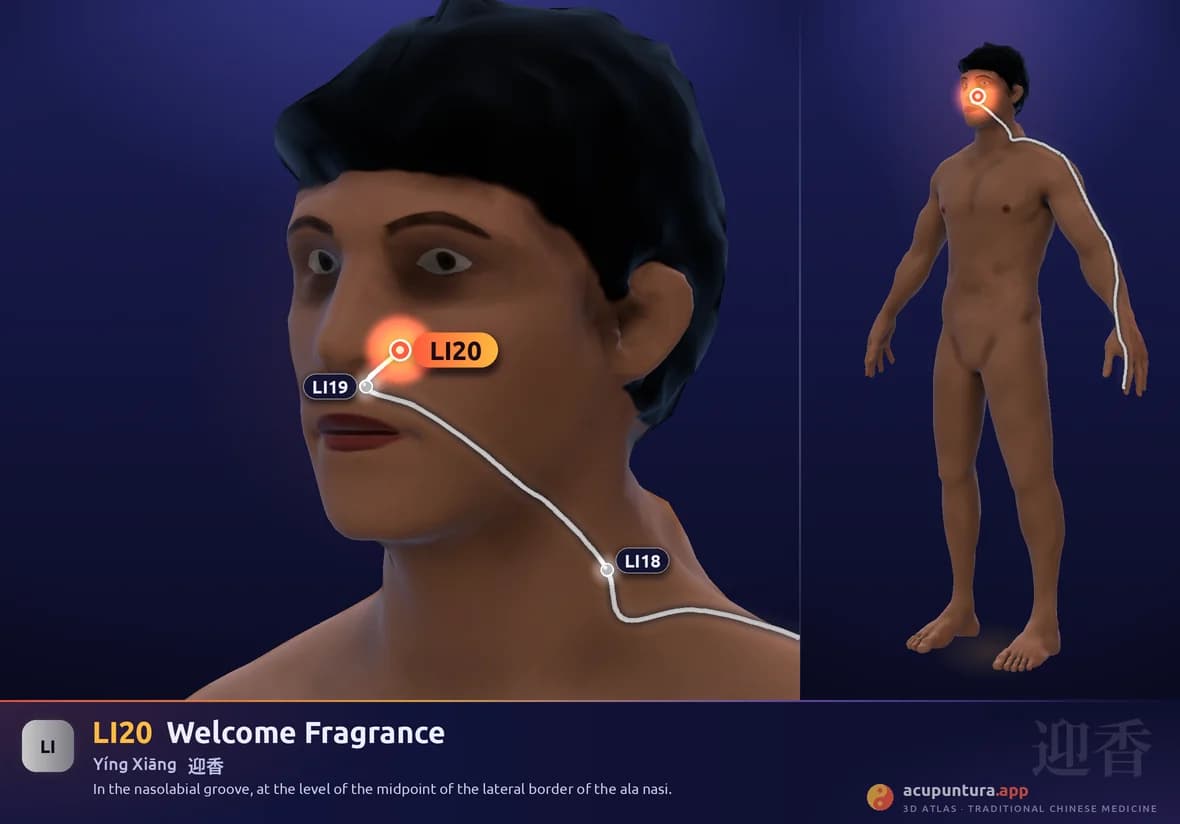
In the nasolabial groove, at the level of the midpoint of the lateral border of the ala nasi.
Main function
Opens the nasal passages, disperses Wind-Heat.
- Crossing point with the Stomach
Therapeutic indications
- Rhinitis
- nasal congestion
- epistaxis
- facial paralysis
- Sinusitis
- Loss of smell
- Facial pruritus
- Facial edema
- Biliary ascariasis
- Watery rhinorrhea
- Allergic rhinitis
Name and classical tradition
Yingxiang, 迎香, means "welcome fragrance." 迎 is to welcome, to go out to meet; 香 is aroma. The point lies beside the wings of the nose, and its name indicates its main function: restoring the sense of smell and opening a blocked nose, a use that has always made it one of the most frequently cited points of the face. One gloss adds that 香 also alludes to the qi of the five grains of the Spleen and Stomach, through the relationship between smell and food, a reading with no classical citation.
Yingxiang is the last point of the channel and the place where the Large Intestine connects with the Stomach channel, which begins right next to it. It has an alternative name that should be read with care: 衝陽. It is the same name as that of ST42, Chongyang, a completely different point, the Yuan-Source point of the Stomach, on the dorsum of the foot. This is probably no coincidence: the alias seems to allude to the yang impulse that passes here into the Stomach channel, which is precisely the channel to which the other Chongyang belongs. The sources trace the point to the Zhenjiu Jiayi Jing (Systematic Classic of Acupuncture and Moxibustion).
Other names
- 沖陽Jiayi Jing