Extra point · Lower Limb
Eyes of the Knee
膝眼Xī YǎnAnatomical location
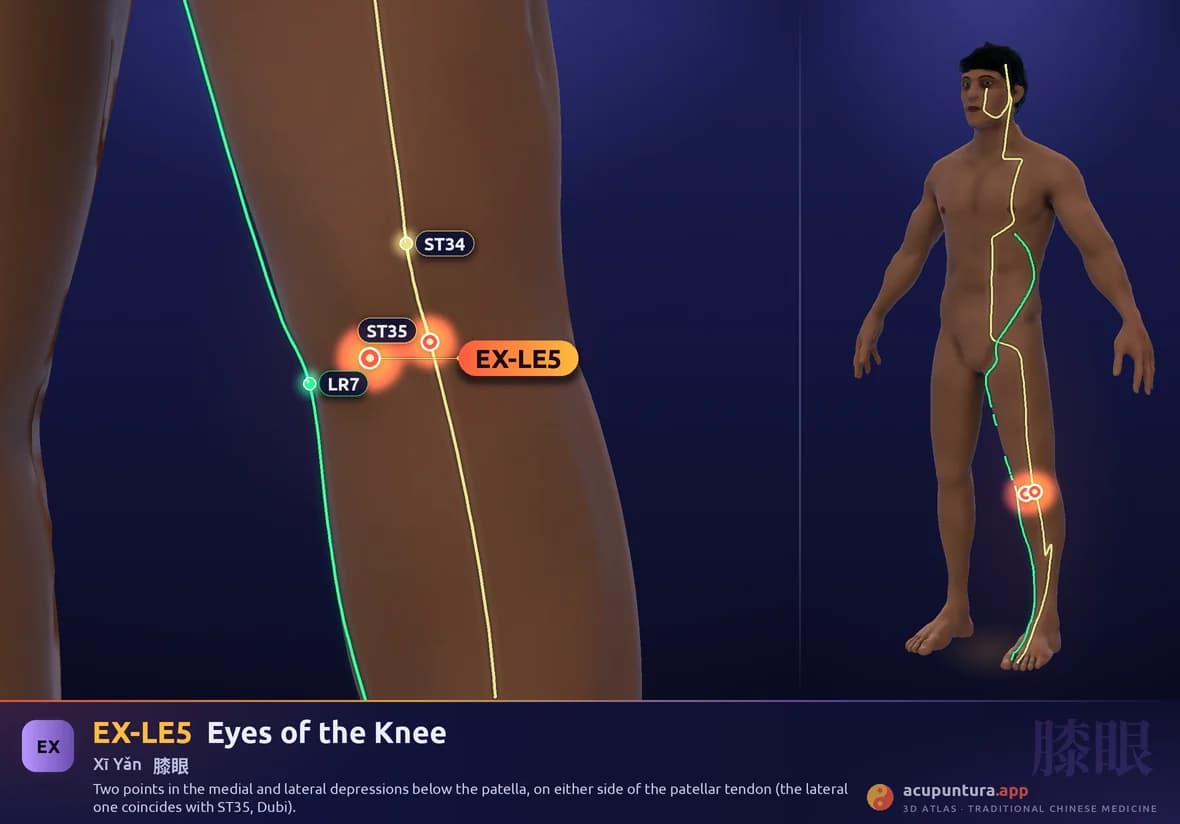
Two points in the medial and lateral depressions below the patella, on either side of the patellar tendon (the lateral one coincides with ST35, Dubi).
Same point as 145PC · Xī Yǎn — Curious Points catalogMain function
Strengthens the knee, disperses local Wind-Dampness.
Therapeutic indications
- Knee pain
- knee arthritis
- joint weakness
Name and classical tradition
Xiyan, 膝眼, means the “eyes of the knee”: 膝, knee; 眼, eyes. They are the two depressions that form on either side of the tendon below the patella when the knee is bent. The outer one coincides with ST35, Dubi, the “calf’s nose.”
The term is old. The Qianjin Yifang (Supplementary Prescriptions Worth a Thousand Gold) by Sun Simiao, in the chapter on beriberi, gives a moxa sequence on the leg that includes the eyes of the knee under another name: «初灸風市,次伏兔,次犢鼻,次膝目,次三里», first Fengshi, then Futu, Dubi, the “eyes of the knee,” and Sanli. The fact that the text names Dubi and 膝目 separately shows that the relationship between the two points has changed over time.