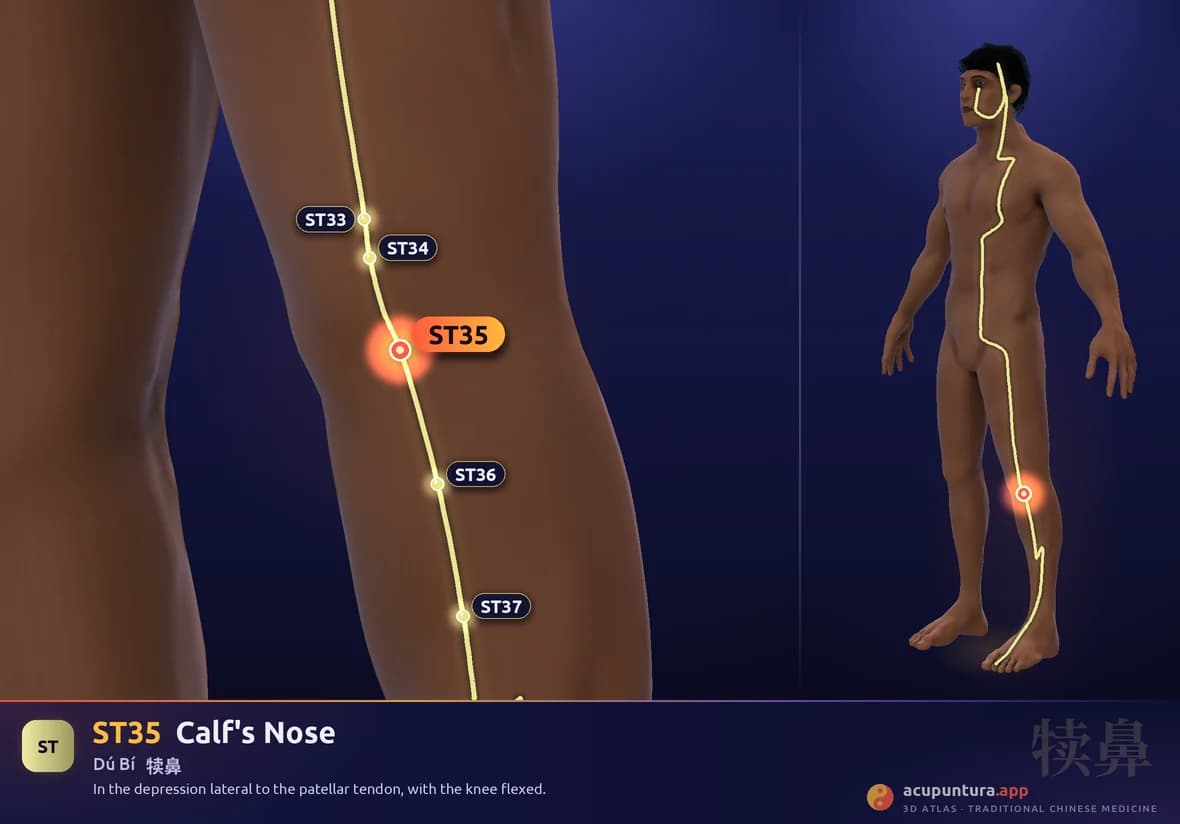
Stomach Channel
Calf's Nose
犊鼻Dú BíAnatomical location
In the depression lateral to the patellar tendon, with the knee flexed.
Main function
Disperses Wind-Dampness, benefits the knee, relieves pain.
Therapeutic indications
- Knee pain
- knee swelling
- knee stiffness
- knee arthritis
- knee pain and swelling
- gonarthrosis
- limited knee movement
- beriberi
- knee osteoarthritis
Name and classical tradition
Dubi (犊鼻) is the “calf’s nose.” 犊 (犢) is a calf, a young bull; 鼻 is the nose or muzzle. Seen from the side, the flexed knee shows the patellar tendon between two depressions, one on each side, and the whole resembles a calf’s muzzle with its two nostrils. It is an old image, accepted by all sources without controversy.
The point appears in the Lingshu (Spiritual Pivot), in the chapter Ben Shu (本輸), alongside other fundamental points of the channel. It is popularly known as 外膝眼, the “outer eye of the knee,” a descriptive name in continuous use rather than a formal ancient one. Just below the knee, at three cun, is ST36.