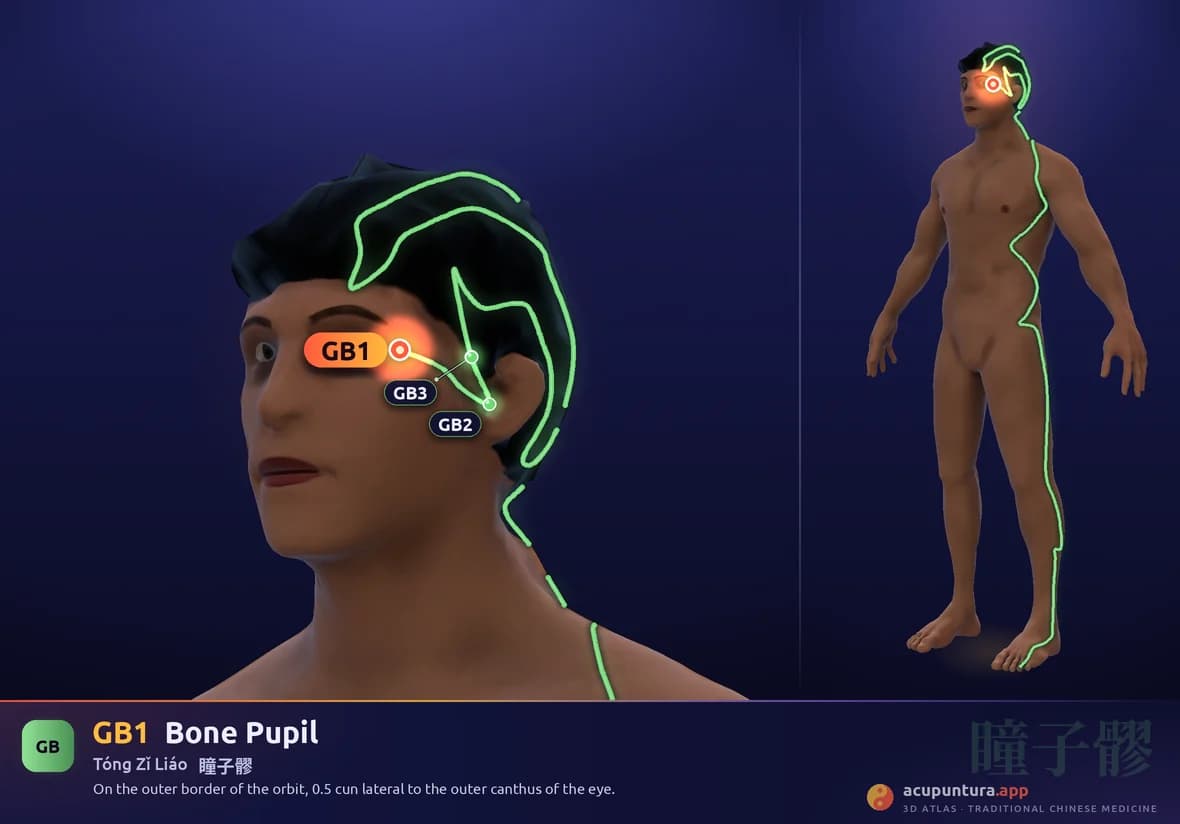
Gallbladder Channel
Bone Pupil
瞳子髎Tóng Zǐ LiáoAnatomical location
On the outer border of the orbit, 0.5 cun lateral to the outer canthus of the eye.
Main function
Expels Wind-Heat, benefits the eyes.
- Crossing point with the Triple Energizer and Ren Mai
Therapeutic indications
- Eye pain
- headache
- conjunctivitis
- blurred vision
- tearing
- glaucoma
- migraine
- wrinkles at the outer corner of the eye
Name and classical tradition
Tongziliao, 瞳子髎, opens the Gallbladder channel at the outer corner of the eye, and its name says exactly where: 瞳子 is the pupil, the «child of the eye,» and 髎 designates a hollow or cleft in the bone. It is, literally, the cleft beside the pupil, on the lateral border of the orbit. The same 髎 reappears further down the channel, at the hip, with GB29, and in both cases it names a palpable bony depression.
Reference works trace it to the Zhenjiu Jiayi Jing (Systematic Classic of Acupuncture and Moxibustion) of Huangfu Mi, although the exact passage that names it has not been located. Where there is agreement is on its status as a meeting point: the hand Taiyang, that of the Small Intestine, and the two Shaoyang, hand and foot, meet at it.
Tradition has given it several alternative names: 后曲, 前关, 太阳, and 鱼尾, «fish tail.» This last is an image easy to see at the corner of the eye, where the wrinkles fan out. The alias 太阳 should not be confused with the extra point Taiyang at the temple, which is a different point even though it lies nearby.