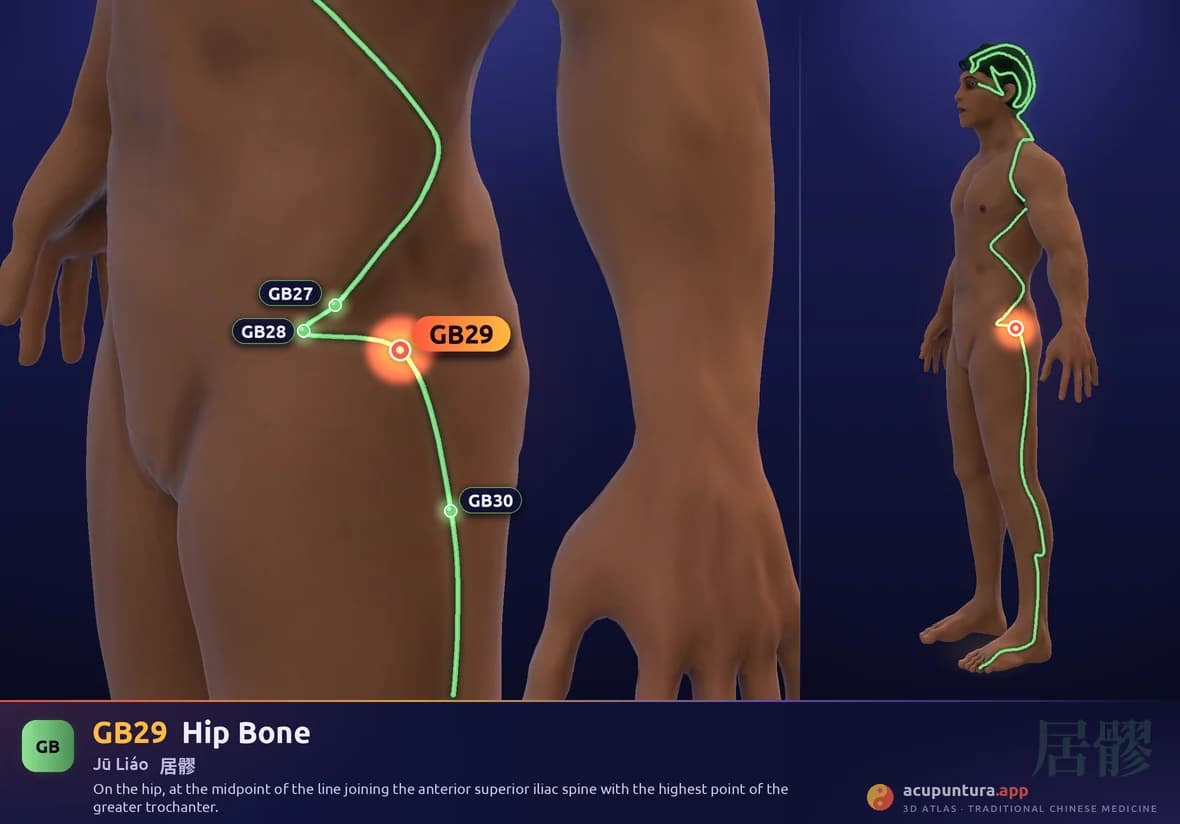
Gallbladder Channel
Hip Bone
居髎Jū LiáoAnatomical location
On the hip, at the midpoint of the line joining the anterior superior iliac spine with the highest point of the greater trochanter.
Main function
Regulates Qi and Blood, relieves hip pain.
- Crossing point with the Yang Qiao Mai
Therapeutic indications
- Hip pain
- sciatica
- lumbago
- low back and hip pain
- paralysis of the lower limb
- hernia
- thigh pain
Name and classical tradition
Juliao, 居髎, is the “crevice where one sits.” 居 means to dwell, to remain, to sit, and by association with the seated posture it is applied to the hip; 髎 is a bony hollow, the same character that opens the channel at the eye, with GB1. The point lies in the depression of the hip, between the anterior superior iliac spine and the greater trochanter of the femur, and the name fits that anatomy well.
Secondary sources trace it to the Zhenjiu Jiayi Jing (Systematic Classic of Acupuncture and Moxibustion), with no literal citation. It is a crossing point of the foot Shaoyang with the Yang Qiao Mai, and it closes, at the edge of the hip, the series of lateral points linked to the Girdle Vessel, just before GB30.