Gallbladder Channel
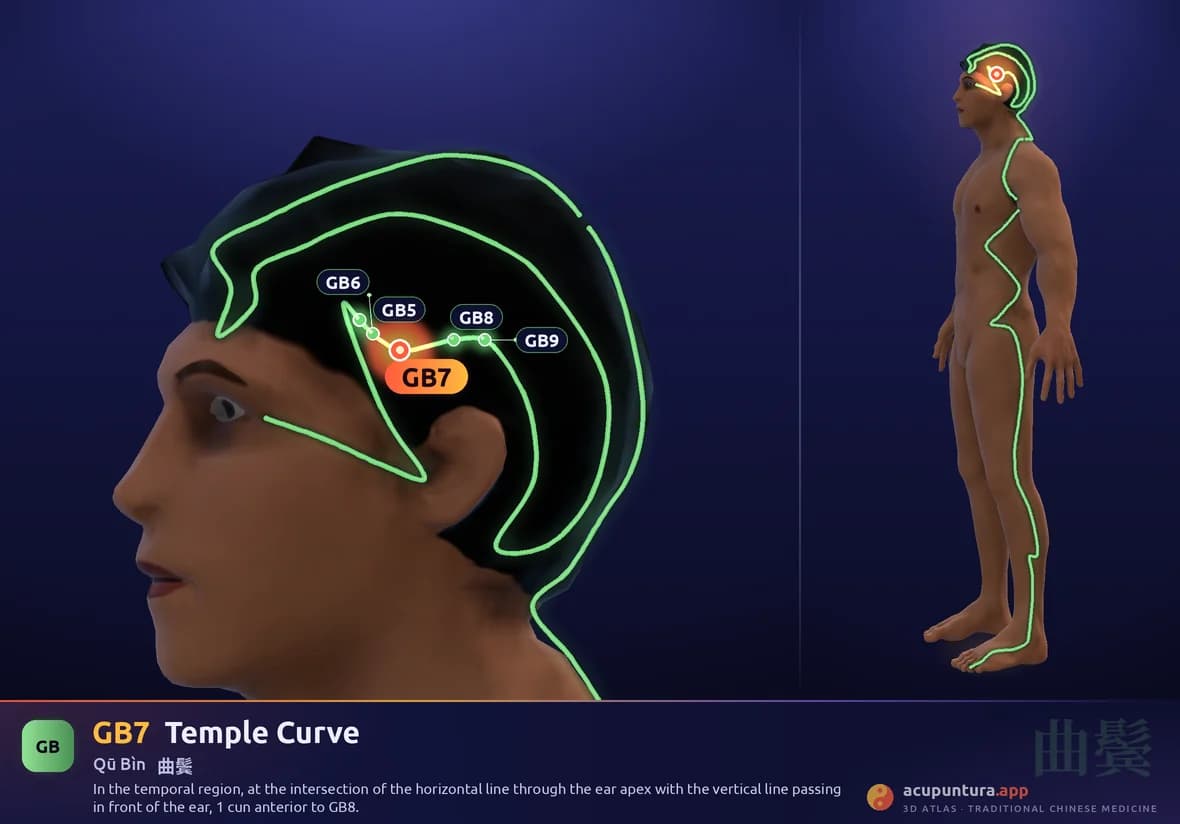
Temple Curve
曲鬓Qū BìnAnatomical location
In the temporal region, at the intersection of the horizontal line through the ear apex with the vertical line passing in front of the ear, 1 cun anterior to GB8.
Main function
Expels Wind, relieves headache and trismus.
- Crossing Point with the Bladder
Therapeutic indications
- Migraine
- toothache
- trismus
- vertigo
- Cheek swelling
- Neck stiffness
- Vomiting
Name and classical tradition
Qubin, 曲鬓, is a descriptive name, easy to verify in the mirror. 曲 is "curved," "bent," and 鬓 refers to the sideburns, the hair at the temples. The point is where the line of the sideburn curves backward above the ear: the curve of the sideburn. The reference works record the variant 曲发, "curve of the hair," which says the same thing in other words.
There is also a modern reading that links 鬓 with the Kidney and the Blood, and the point with a vapor that condenses into rain. It has no classical citation, and next to the visual evidence of the literal name it adds little. Secondary sources attribute the point to the Zhenjiu Jiayi Jing (Systematic Classic of Acupuncture and Moxibustion).