Triple Energizer Channel
Dispersing the Brook
消泺Xiāo LuòAnatomical location
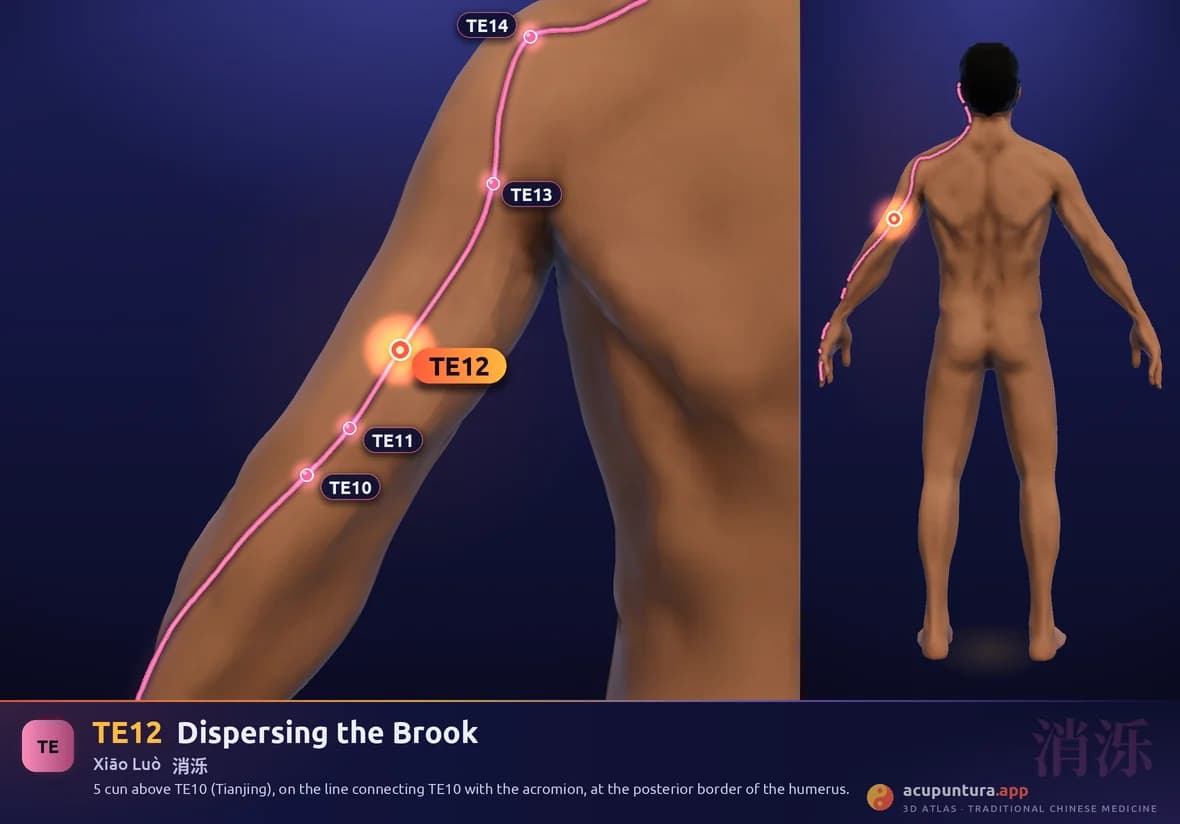
5 cun above TE10 (Tianjing), on the line connecting TE10 with the acromion, at the posterior border of the humerus.
Main function
Expels Wind-Heat, benefits the head and eyes, relieves pain.
Therapeutic indications
- Headache
- dizziness
- eye pain
- arm pain
- shoulder pain
- epilepsy
- pain in the arm
- stiffness in the nape of the neck
- cephalalgia
Name and classical tradition
Xiaoluo, 消泺, combines 消, to dissolve, consume, or dissipate, with 泺 (濼), the name of an ancient river in what is now Shandong Province, and also a lake or marsh. The modern gloss explains that the damp vapor descending from TE11 dissolves here and falls as rain, forming a kind of surface lake. This is an interpretation with no classical citation.
The point is traced to the Zhenjiu Jiayi Jing (Systematic Classic of Acupuncture and Moxibustion), although no citation confirms it. One modern source mentions it, together with Qinglengyuan, in the old practice of variolation against smallpox, a detail of anecdotal and unverified origin. The point lies on the posterior aspect of the arm, between Qinglengyuan and TE13.