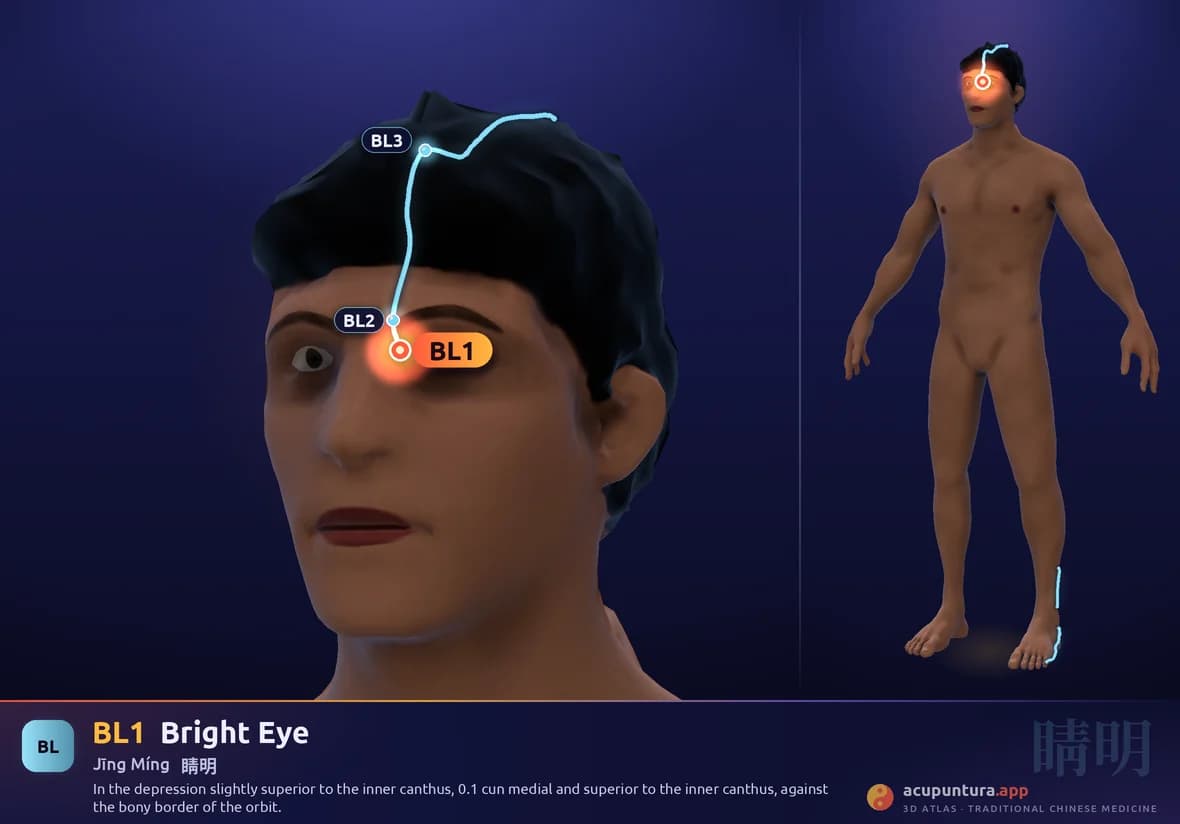
Bladder Channel
Bright Eye
睛明Jīng MíngAnatomical location
In the depression slightly superior to the inner canthus, 0.1 cun medial and superior to the inner canthus, against the bony border of the orbit.
Main function
Meeting point of the Bladder, Small Intestine, Stomach, Gallbladder, Triple Energizer, Yang Qiao Mai, and Yin Qiao Mai channels. Benefits the eyes, clears Heat, expels Wind, relieves eye pain.
- Crossing point with the Yang Qiao Mai and the Yin Qiao Mai
- Crossing point with the Bladder, Small Intestine, Stomach, Gallbladder, and Triple Energizer
Therapeutic indications
- Eye disorders
- blurred vision
- tearing
- redness and swelling of the eyes
- myopia
- hyperopia
- astigmatism
- glaucoma
- cataracts
- headache
- nasal congestion
- fever
- Conjunctivitis
- Night blindness
- Eye pain
- Optic atrophy
- Red eyes
Name and classical tradition
Jingming, 睛明, means "bright eyes" or "clarity of the eye." 睛 is the eye, the pupil; 明, light, clarity. The point opens the Bladder channel at the inner corner of the eye, and the modern gloss explains it by saying that the Blood of the channel arrives here and the eye, once it receives it, sees clearly. Because 睛 and 精, "essence," are pronounced the same, the name sometimes appears written as 精明 in textual variants, a play on words that philology has yet to resolve.
The sources trace it to the Zhenjiu Jiayi Jing (Systematic Classic of Acupuncture and Moxibustion), with no verified literal quotation. The reference works record a series of alternative names for it, almost all descriptive, which speak of the corner of the eye and of tears: 目內眥, "inner corner of the eye," 目眥, 淚孔, "tear opening," 淚空, and 淚腔. The Zhenjiu Jiayi Jing gives it the alias 淚孔 and presents it as a meeting of three channels, "手足太陽、足陽明之會," the hand and foot Taiyang and the foot Yangming. Wang Bing's note to the Suwen (Basic Questions) adds the Yangqiao and Yinqiao vessels, bringing the count to five: a list that grows with the commentaries.
Other names
- 淚孔Jiayi Jing