Bladder Channel
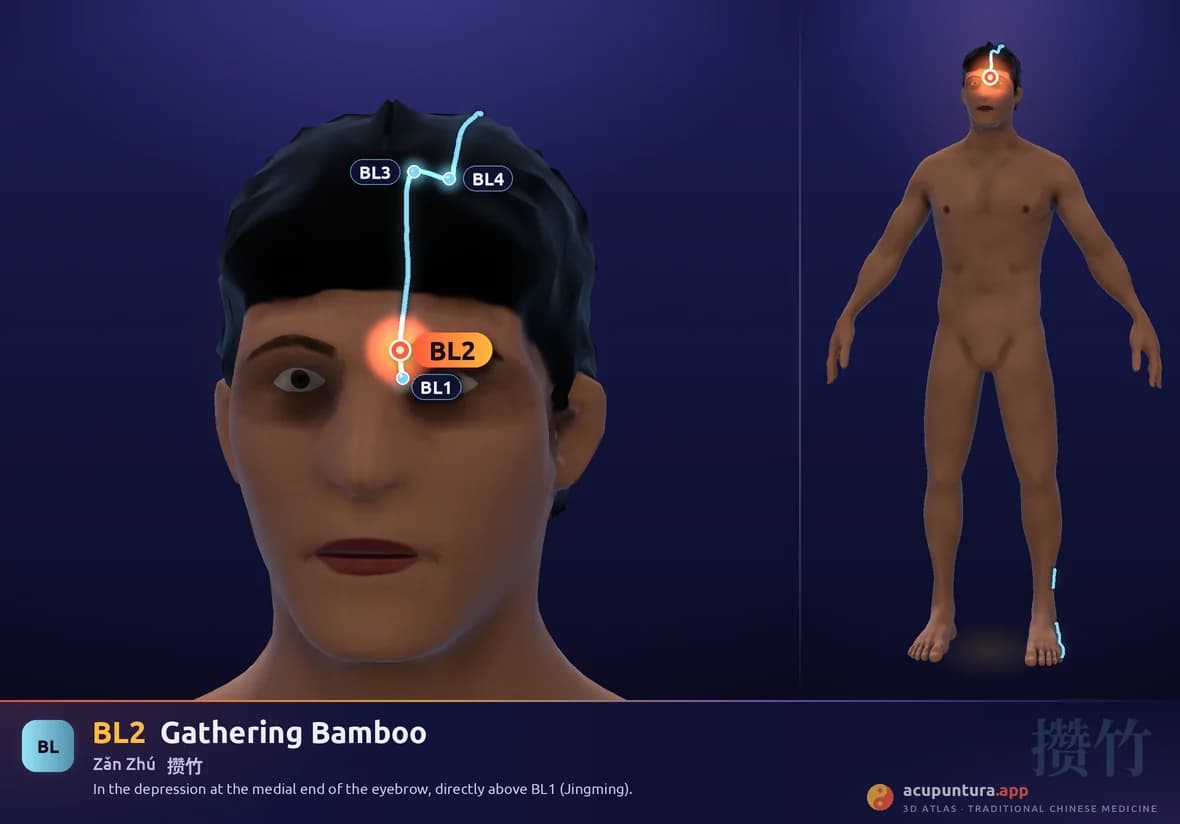
Gathering Bamboo
攒竹Zǎn ZhúAnatomical location
In the depression at the medial end of the eyebrow, directly above BL1 (Jingming).
Main function
Expels Wind, clears Heat, benefits the eyes, relieves headache, calms the Shen (Spirit).
Therapeutic indications
- Headache
- migraine
- frontal pain
- eye pain and redness
- blurred vision
- tearing
- eyelid spasm
- facial paralysis
- convulsions
- epilepsy
- dizziness
- insomnia
- anxiety
- Frontal headache
- Supraorbital pain
- Frontal sinusitis
- Eyelid twitching
- Ptosis
- Red eyes
- Hiccups
- Rhinitis
Name and classical tradition
Zanzhu, 攒竹, is the "gathered bamboo." 攒 (攢) means to gather, to press together; 竹, bamboo. The point is at the inner end of the eyebrow, and the image compares the hairs of the eyebrow, bunched at their base, to a tight bundle of bamboo leaves. It is a convincing visual reading. Another, modern one is also in circulation, which speaks of cold Qi in the channel rising from BL1 and arriving here in small amounts, like a bundle of thin stalks, but no ancient text supports it.
The list of alternative names is long, and eyebrows and light dominate it: 眉頭, "head of the eyebrow," 眉本, "root of the eyebrow," 始光, "beginning of light," 夜光, "night light," 明光, 光明, 員在, and 員柱. Such variety suggests widespread use across several works, although the attributions of each alias have not been verified one by one. The first source the reference works cite is the Zhenjiu Jiayi Jing (Systematic Classic of Acupuncture and Moxibustion). Be careful not to confuse the alias 光明 with GB37, Guangming, which is a different point.