Bladder Channel
Bowing Servant
仆参Pú CānAnatomical location
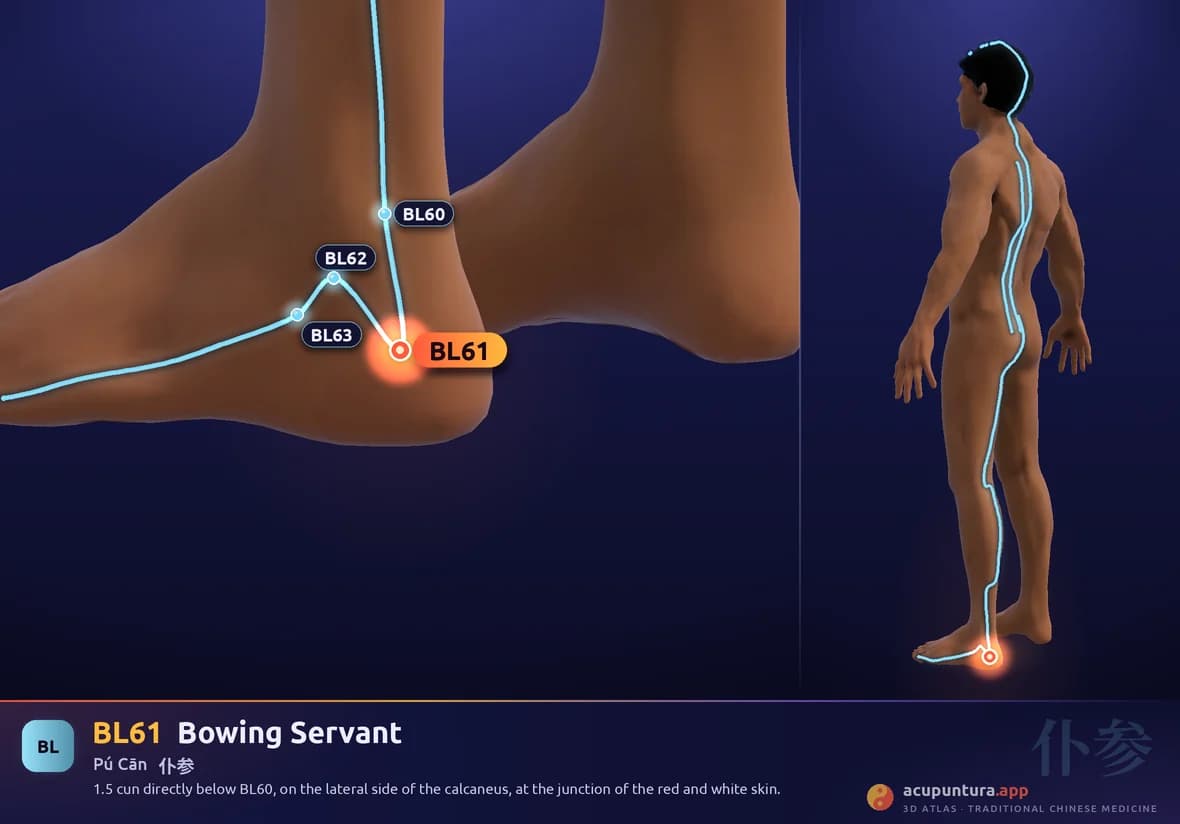
1.5 cun directly below BL60, on the lateral side of the calcaneus, at the junction of the red and white skin.
Main function
Relaxes the sinews, relieves pain, strengthens the lumbar region, benefits the foot.
Therapeutic indications
- Heel pain
- low back pain
- sciatica
- leg weakness
- epilepsy
- muscle spasms
- Heel pain
- Atrophy and weakness of the foot
- Leg pain
- Plantar fasciitis
Name and classical tradition
Pucan, 仆参, has one of the most curious etymologies on the channel, although its source has not been identified. 仆 (僕) is the servant, the attendant; 参 (參) means to take part, to accompany. In ancient chariots drawn by three horses, 參 designated the side horses, the ones that accompanied the central one. The point, on the lateral and inferior part of the heel, would evoke the position of that accompanying horse.
There is another, astronomical reading. 參 is also the name of one of the twenty-eight lunar mansions, the Shen constellation (參宿), of seven stars. According to this interpretation, 僕 would mean “inverted” here, and the point would be the seventh counting from the end of the channel, in an inverted position relative to that constellation. Both readings seem to come from a scholarly tradition, but until their source is verified, it is best to treat them as glosses.
The Zhenjiu Jiayi Jing (Systematic Classic of Acupuncture and Moxibustion) locates it in the depression below the heel bone, finding it with the foot arched. The reference works give it the alternate name 安邪.
Other names
- 安邪Jiayi Jing