Bladder Channel
Kunlun Mountains
昆仑KūnlúnContraindicated during pregnancy
Jing-River point that descends and unblocks; classically associated with fetal expulsion.
Anatomical location
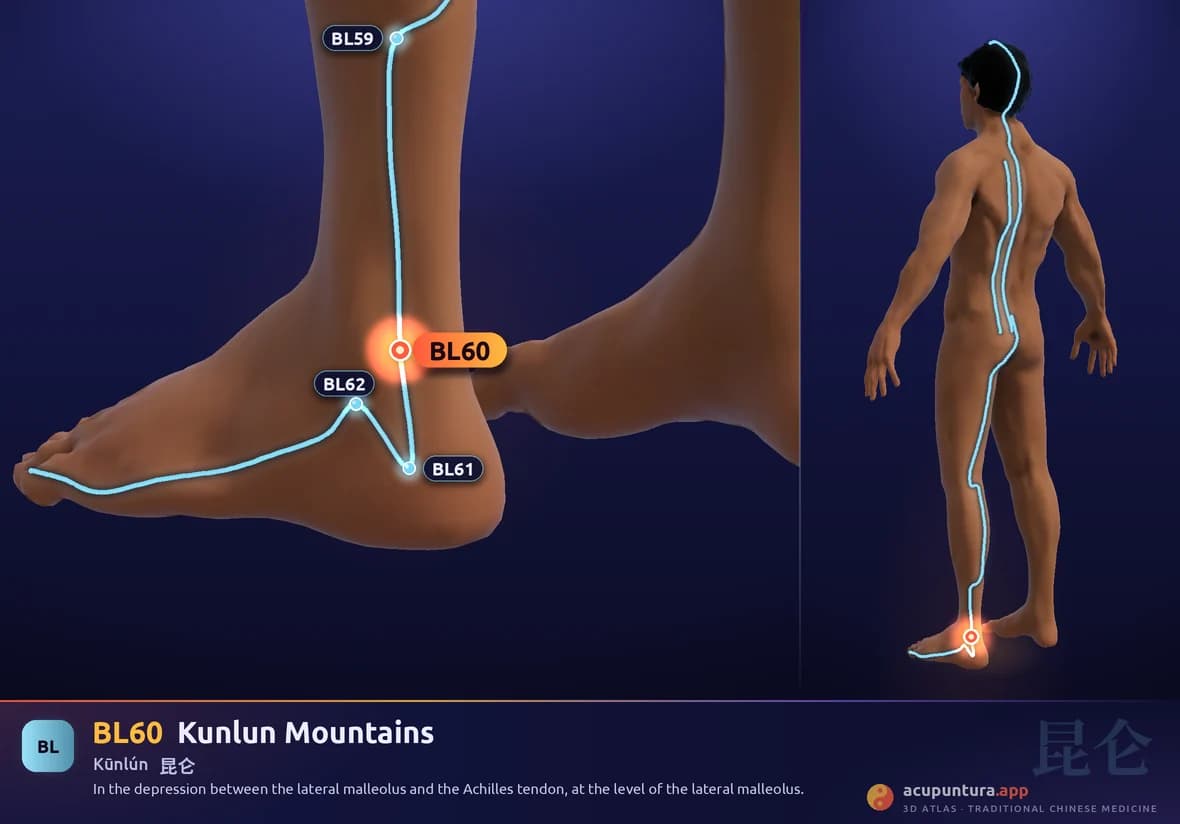
In the depression between the lateral malleolus and the Achilles tendon, at the level of the lateral malleolus.
Main function
Jing-River point (Fire), expels Wind, relieves pain, strengthens the lumbar region, facilitates childbirth.
- Jing-River point (Fire)
Therapeutic indications
- Low back pain
- sciatica
- occipital headache
- stiff neck
- ankle pain
- epilepsy
- difficult labor
- Occipital headache
- Lumbago
- Ankle pain and swelling
- Heel pain
- Vertigo
- Nosebleed
- Infantile convulsions
- Shoulder pain
- Difficult labor at term
- Tension headache
- Hyperuricemia and gout
- Kidney stones and renal colic
- Lumbar disc herniation
- Rheumatoid arthritis
- Knee osteoarthritis
- Plantar fasciitis
Name and classical tradition
Kunlun, 昆仑, is named after a mythical mountain. In Chinese cosmology and mythology, the Kunlun (崑崙) was the great mountain range of the west, the axis of the world and the home of the Queen Mother of the West, Xiwangmu. On the body, the mountain is the lateral malleolus, the bony prominence of the ankle, and the point lies behind it. The use of the names of great mountains for bony prominences recurs at other points. Whether the name is meant to evoke the myth explicitly is a possible interpretation, but no ancient text confirms it.
The Lingshu (Spiritual Pivot), in the Ben Shu (本輸) chapter, places it precisely: «在外踝之後,跟骨之上», behind the lateral malleolus, above the calcaneus. It is the Jing-River point (經穴) of the Bladder, which on the Yang channels corresponds to Fire.