Kidney Channel
Pubic Bone
横骨HénggǔUse caution during pregnancy
Lower abdominal chain of the Kidney over the uterus; avoid.
Anatomical location
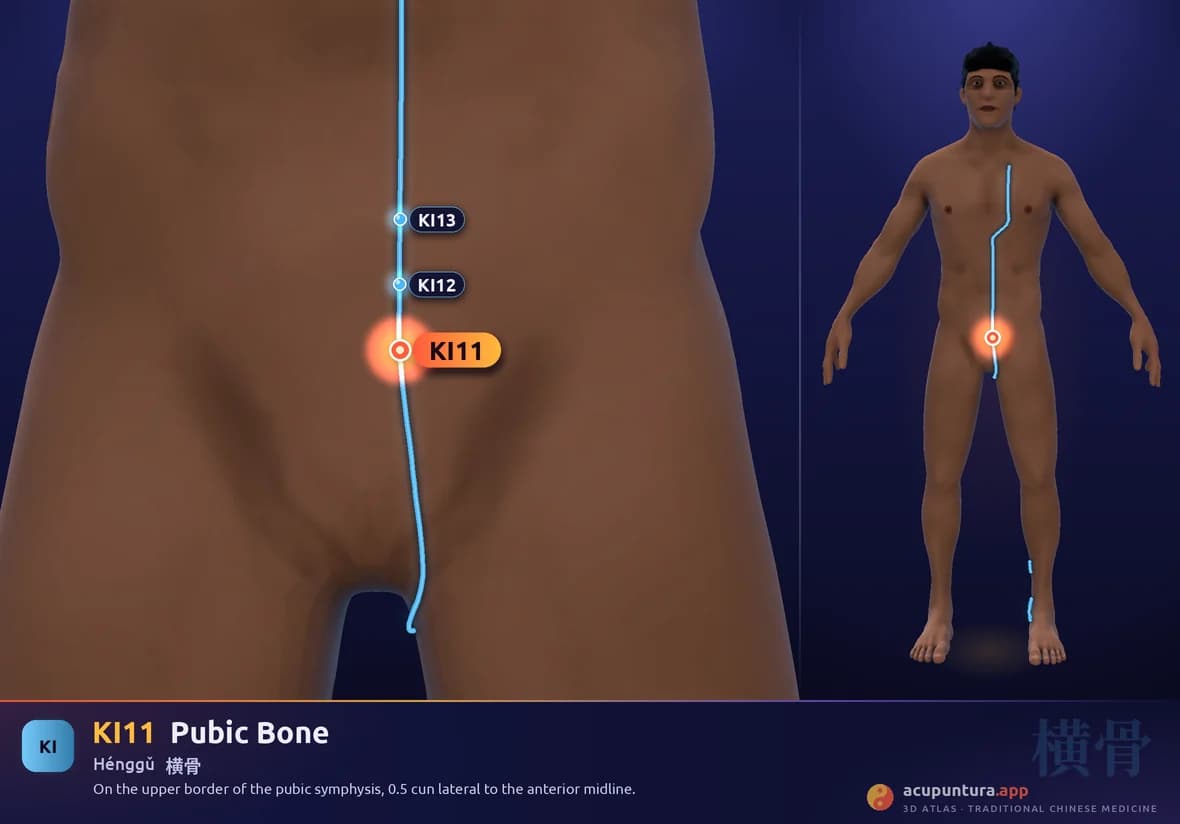
On the upper border of the pubic symphysis, 0.5 cun lateral to the anterior midline.
Main function
Regulates Kidney Qi, strengthens the Lower Jiao, benefits urination and the reproductive organs.
- Crossing point with the Chong Mai
Therapeutic indications
- Dysmenorrhea
- leukorrhea
- enuresis
- impotence
- pelvic pain
- edema
- hypogastric pain
- urinary retention
- nocturnal emission
- genital prolapse
- hernia
Name and classical tradition
Henggu, 横骨, is the “transverse bone,” and the name is anatomical: 横骨 was the name of the pubic bone in classical Chinese anatomy. The point lies on its upper border, next to the midline, and takes its name from the bone, like other points that inherited an anatomical reference. The modern gloss adds that the Qi of the channel spreads horizontally here and that the bone alludes to the relationship between the Kidney and the bones. It is a reading with no classical citation.
The most complete citation for the abdominal stretch of the channel is the one for this point, which several sources attribute to the Zhenjiu Jiayi Jing (Systematic Classic of Acupuncture and Moxibustion): “橫骨一名下極,在大赫下一寸,衝脈、足少陰之會,刺入一寸,灸五壯”. Henggu, also called Xiaji, is one cun below Dahe; it is the meeting point of the Chong Mai (Penetrating Vessel) and the foot Shaoyin; needle one cun deep and apply five cones of moxa. The citation has not been checked against a critical edition, but it is repeated in independent sources.
With Henggu begins the stretch in which the Kidney channel and the Chong Mai ascend the abdomen together. Its alternative name is 下極, “lower extremity.” It should not be confused with CV2, Qugu, of the Ren Mai, although some sources record similar aliases.
Other names
- 下極Jiayi Jing