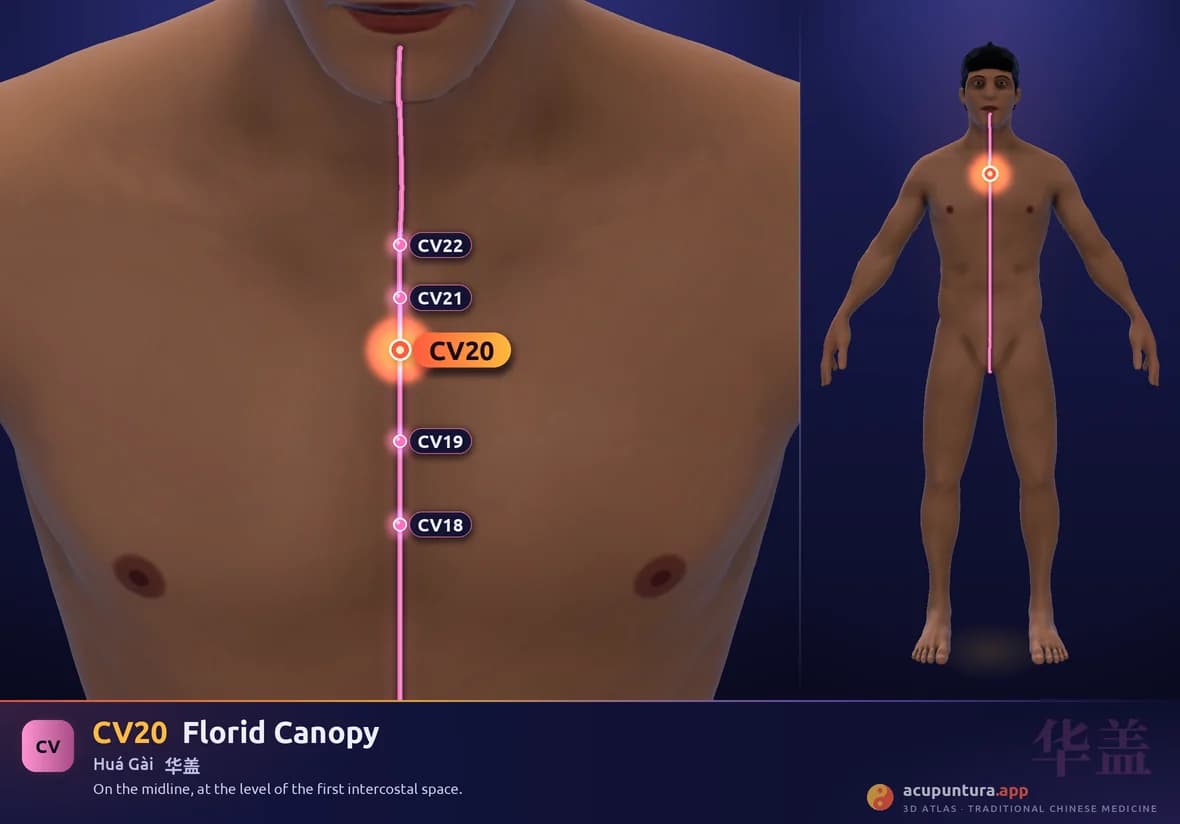
Ren Mai (Conception Vessel) Channel
Florid Canopy
华盖Huá GàiAnatomical location
On the midline, at the level of the first intercostal space.
Main function
Regulates chest Qi, benefits the Lungs.
Therapeutic indications
- Cough
- asthma
- chest pain
- chest oppression
- chest and costal pain
- sore throat
Name and classical tradition
Huagai, 华盖, is the “floral canopy.” 华 (華) means flower, splendor; 盖 (蓋), cover, canopy. The 華蓋 was the ornamental canopy that covered the emperor's carriage, a symbol of his dignity. The translation as “jade pavilion” does not correspond to the characters.
The soundest reading refers to a classical epithet of the Lung. Zang-Fu theory calls the Lung the canopy of the organs (肺為五臟之華蓋), because its lobes cover the heart like a canopy, and Yang Shangshan used this to explain the name of LU3, Tianfu. The point, on the upper part of the sternum, borrows that epithet. In the court of the chest, the canopy covers the purple palace, CV19, which lies just below. Another, modern gloss speaks of a protective layer that covers the body.
The first work to record it is the Zhenjiu Jiayi Jing (Systematic Classic of Acupuncture and Moxibustion), which places it «在璇璣下一寸陷者中», in the depression one cun below Xuanji, CV21, and assigns it cough with rebellious Qi that leaves the patient unable to speak: «咳逆上氣,喘不能言,華蓋主之». Later works do not agree on the measurement: Hua Shou's Shisi Jing Fahui (Elucidation of the Fourteen Channels), in the Yuan period, gives two cun, and the Zhenjiu Dacheng (Great Compendium of Acupuncture and Moxibustion), in the Ming period, gives one cun and six fen.