Lung Channel
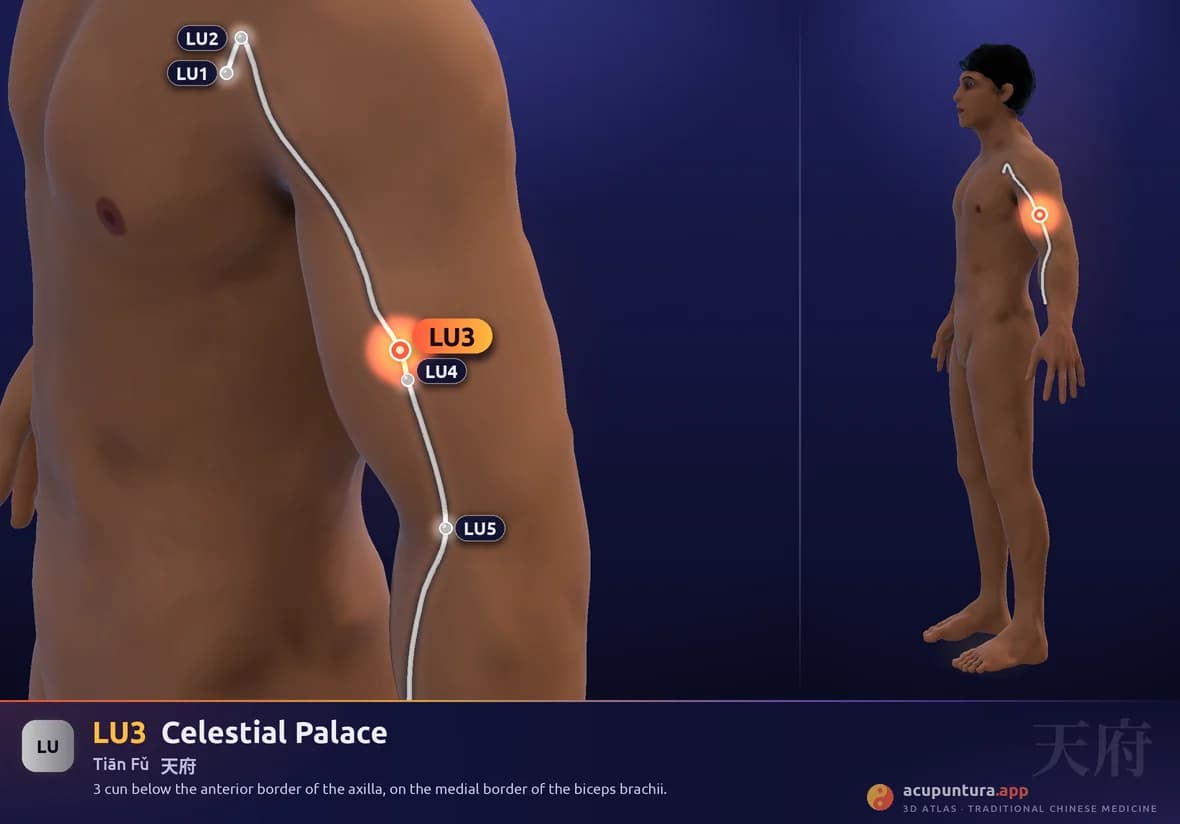
Celestial Palace
天府Tiān FǔAnatomical location
3 cun below the anterior border of the axilla, on the medial border of the biceps brachii.
Main function
Regulates the Lung, stops bleeding, benefits the nose.
- Window of Heaven point
Therapeutic indications
- Epistaxis
- asthma
- arm pain
- hemoptysis
- intractable nosebleed
- goiter
- pain on the medial side of the arm
- sadness and crying without reason
- disorientation
- dizziness
- sensation of heat rising
Name and classical tradition
Tianfu, 天府, is the "palace of heaven" or "celestial storehouse," and it forms a pair with LU1, the "central storehouse" of the chest: two 府 on the same channel, one at the center of the body and the other high on the arm. The name appears in the Lingshu (Spiritual Pivot), in the Ben Shu chapter (本輸), and the Han Re Bing chapter (寒熱病) places it at "腋下動脈," the pulsation below the axilla.
The reason for the 天 comes from the classical theory of the lung. The Suwen (Basic Questions), in the Yin Yang Ying Xiang Da Lun chapter, establishes that "天氣通於肺," the Qi of heaven communicates with the lung. From there, Yang Shangshan, in the seventh century, glosses in the Huangdi Neijing Mingtang (Yellow Emperor's Inner Classic, Bright Hall Edition) that the lung is the canopy (華蓋) covering the other organs, their "heaven," so the point where its Qi gathers deserves the name celestial palace. It is the oldest known exegesis of this point.
The location becomes more precise over time. The Zhenjiu Jiayi Jing (Systematic Classic of Acupuncture and Moxibustion) fixes it "在腋下三寸,臂臑內廉動脈中," 3 cun below the axilla, in the pulsation on the inner side of the arm, and adds a prohibition: "禁不可灸,灸之令人逆氣," no moxibustion, because it makes the Qi rebel. The Waitai Miyao (Secret Essentials from the Imperial Library) by Wang Tao, compiled in the Tang period, records a memorable location technique: the patient is asked to bring the tip of the nose to the arm, and the point is where the nose touches it. The nose is the orifice (竅) of the lung, so the gesture joins the organ, its opening, and the point in a single movement. Centuries later, the Ming-period Zhenfang Liuji will refer to it, more prosaically, at the level of the nipple.