Ren Mai (Conception Vessel) Channel
Mysterious Threshold
璇玑Xuán JīAnatomical location
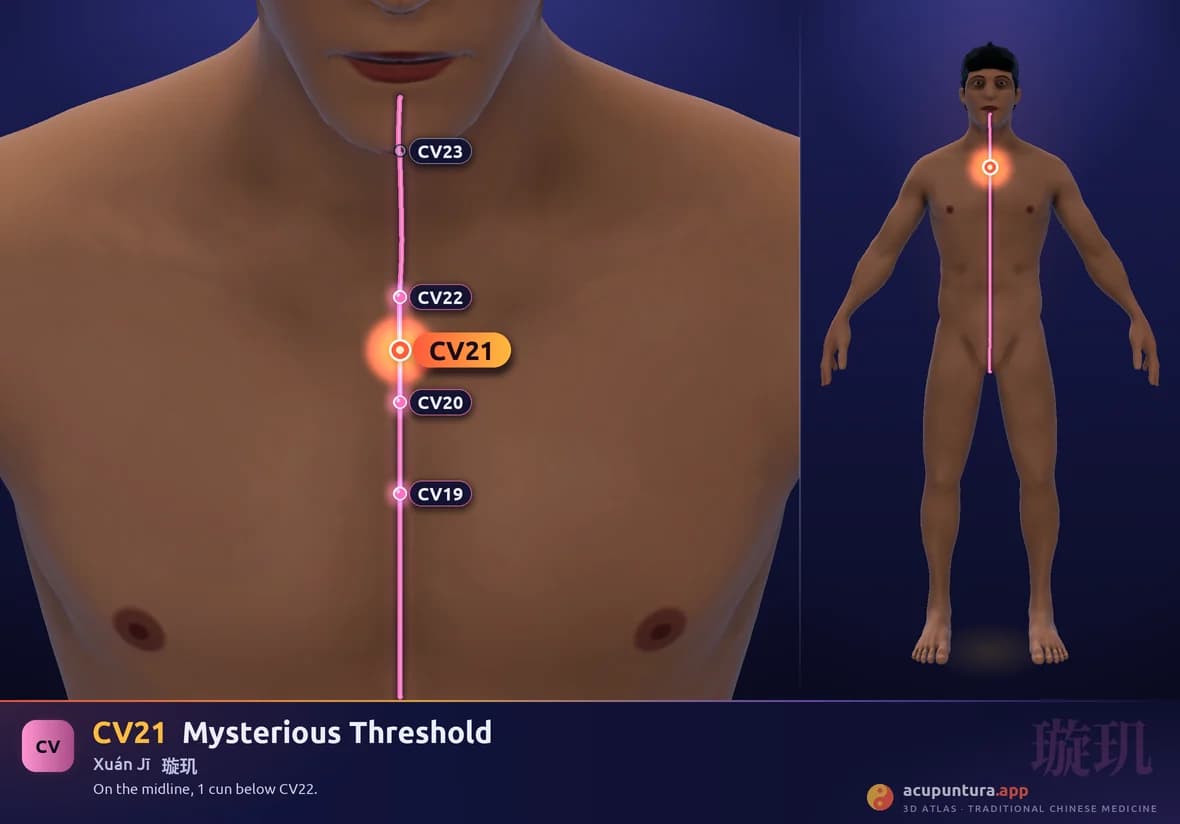
On the midline, 1 cun below CV22.
Main function
Regulates the Qi of the chest, benefits the Lung and throat.
Therapeutic indications
- Cough
- asthma
- chest pain
- sore throat
- difficulty swallowing
Name and classical tradition
Xuanji, 璇玑, takes its name from an astronomical instrument and from a group of stars. In Chinese astronomy, 璇璣 designates the four stars that form the bowl of the Big Dipper, as opposed to the three of the handle, called 玉衡. The astronomy treatise of the Jinshu (Book of Jin) puts it this way: «魁四星為琁璣,杓三星為玉衡». 璇璣 was also the name of the armillary sphere, the rotating instrument used to observe the sky, and of its axis of rotation.
Medicine borrowed the image. The Yijing Lijie, a Qing-period exegetical text, explains it according to the sources: «璇璣,渾天儀也,以象天機之運旋,肺金上浮,天象也,其繫上懸,為轉運之機». Xuanji is the armillary sphere, representing the turning of the celestial mechanism; the Lung, being Metal, floats above like the heavens; its connection hangs from on high and is the axis of rotation. The thorax would be the frame of that sphere, and the point, below the throat, its axis. It is one of the clearest examples of the correspondence between body and cosmos (天人相應) in the nomenclature of the points.
The first work to record it is the Zhenjiu Jiayi Jing (Systematic Classic of Acupuncture and Moxibustion), which also uses it as a reference for locating KI27, Shufu, two cun to each side. It closes, at the top, the series of court names of the chest on the Ren Mai.