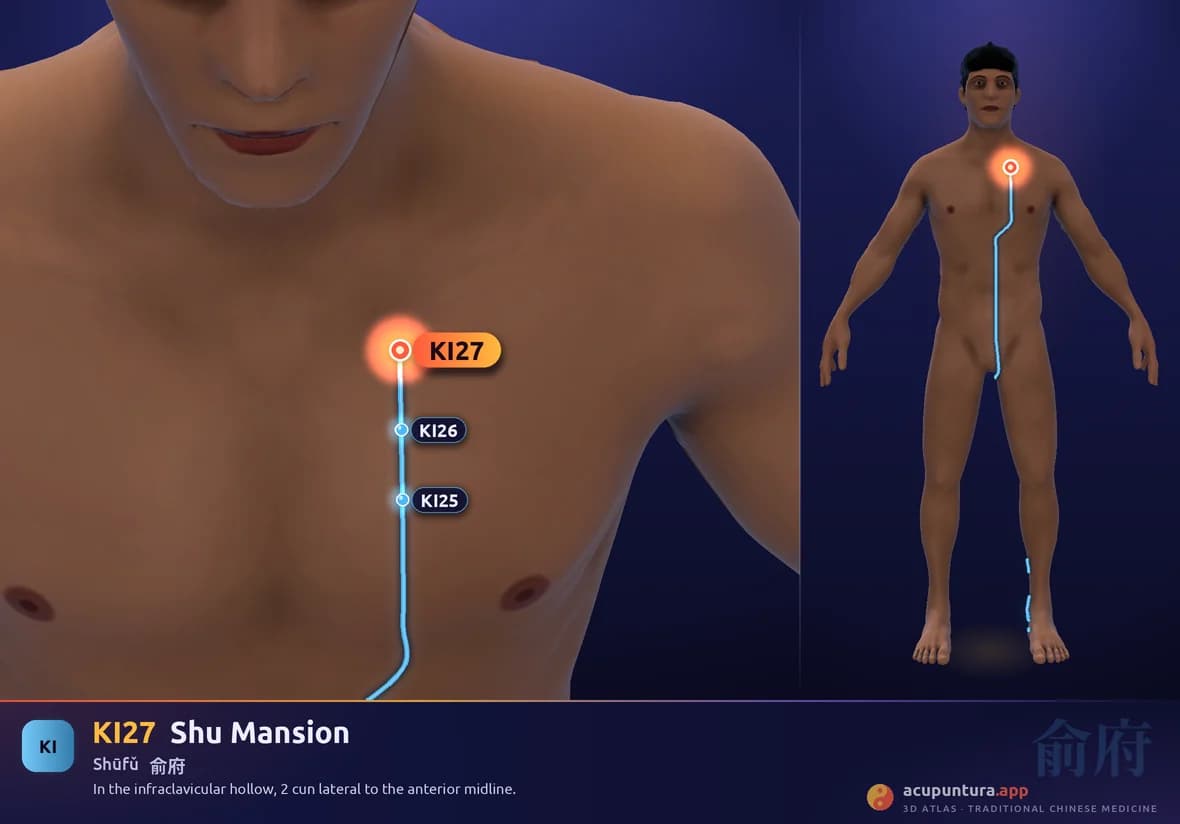
Kidney Channel
Shu Mansion
俞府ShūfǔAnatomical location
In the infraclavicular hollow, 2 cun lateral to the anterior midline.
Main function
Regulates Lung Qi, benefits the chest, and treats respiratory, thoracic, and shoulder disorders.
Therapeutic indications
- Cough
- asthma
- chest pain
- stiff neck
- shoulder pain
- vomiting
- poor appetite
- dyspnea
Name and classical tradition
Shufu, 俞府, is the last point of the Kidney channel, below the clavicle, and its name is one of the best documented on the thoracic stretch. 俞 is the transport point, the same character as in the Shu points; 府 is the residence, the storehouse, and also the viscera. The modern gloss interprets it as the place where the channel's Qi and Blood return to the internal systems of the body.
The Zhenjiu Jiayi Jing (Systematic Classic of Acupuncture and Moxibustion) locates it with a direct quotation: "巨骨下,璇璣旁各二寸陷者中", below the great bone, the clavicle, two cun to each side of Xuanji, CV21, in the depression. The reference to the great bone is the same one the Jiayi Jing uses for LU2, Yunmen, and LI16, Jugu.
The reference works give it the alternate name 腧中, which underscores the point's internal aspect. With it ends the course of a channel that began on the sole of the foot, at KI1.