Extra point · Back
Lower Shu of the Gastric Cavity
胃脘下俞Wèi Wǎn Xià ShùAnatomical location
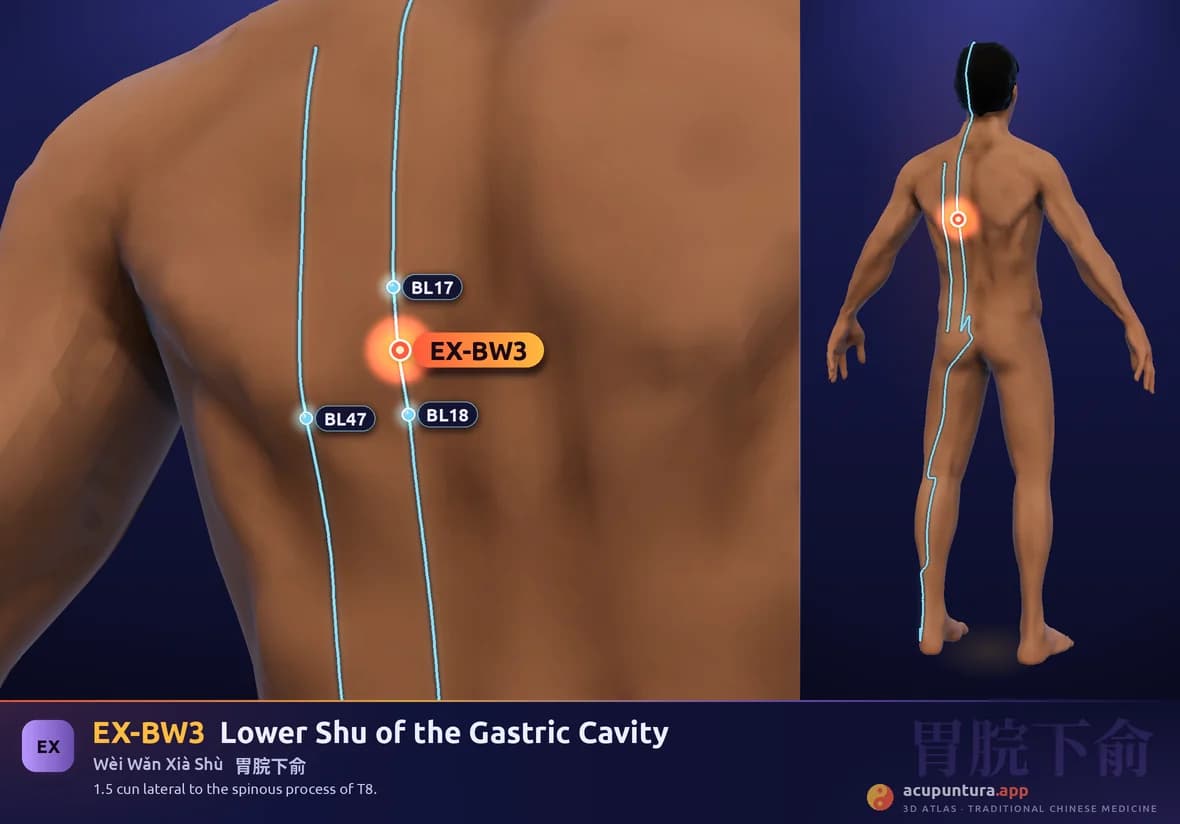
1.5 cun lateral to the spinous process of T8.
Same point as CP62 · Yí Shū — Curious Points catalogMain function
Regulates the Spleen and pancreas, tonifies Yin.
Therapeutic indications
- Diabetes (wasting-thirst pattern / Xiaoke)
- pancreatitis
- gastritis
- costal pain
Name and classical tradition
Weiwanxiashu, 胃脘下俞, is the “Shu below the stomach”: 胃脘, the stomach cavity; 下, below; 俞, the transport point of the back. It lies beneath the eighth thoracic vertebra, the only one without its own Shu on the Bladder channel, between BL17, the Diaphragm Shu, and BL18, the Liver Shu.
It is one of the few extra points of the back with a verifiable Tang source. The Qianjin Yaofang (Essential Prescriptions Worth a Thousand Gold), in chapter 21, indicates it for the thirst of diabetes: “治消渴咽喉乾,灸胃脘下輸三穴各百壯,穴在背第八椎下橫三寸” — for thirst with a dry throat, one hundred cones on each of the three points, on a line of three cun below the eighth vertebra. That use explains the name it has received in modern times, 胰俞, the Shu of the pancreas.