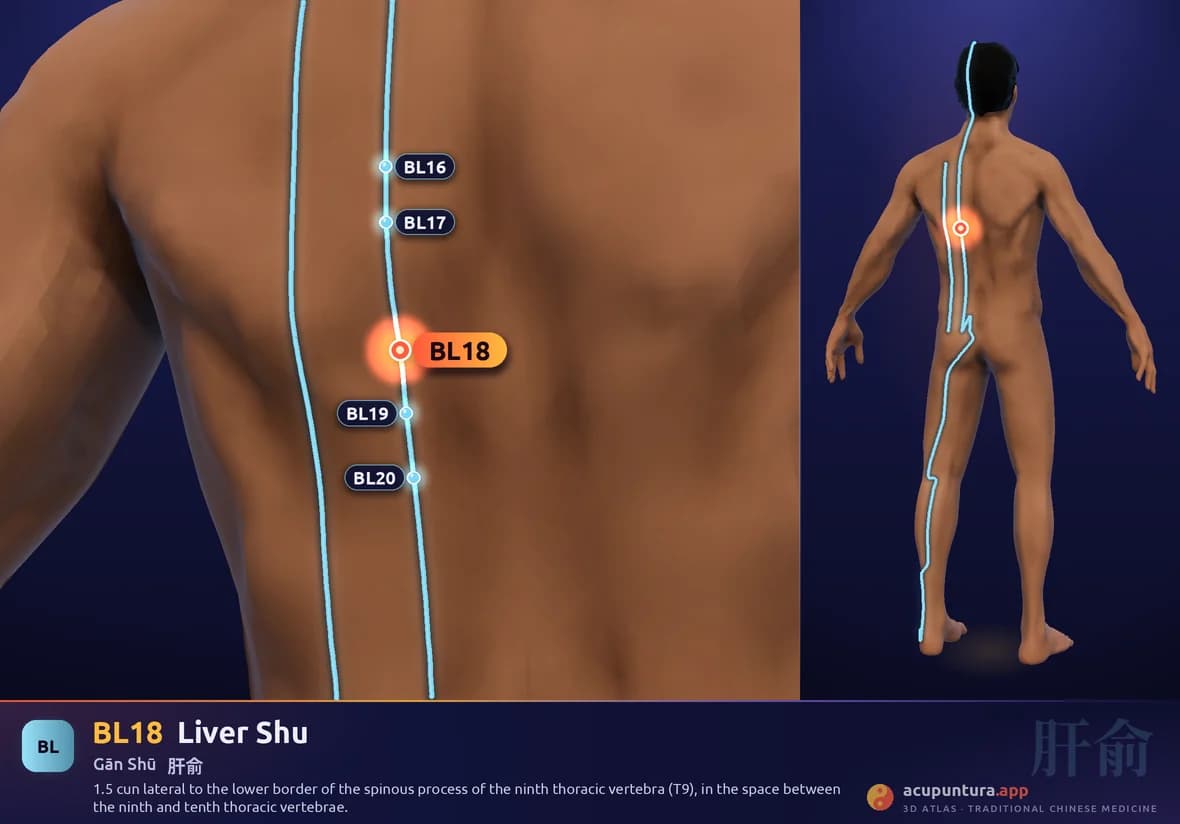
Bladder Channel
Liver Shu
肝俞Gān ShūAnatomical location
1.5 cun lateral to the lower border of the spinous process of the ninth thoracic vertebra (T9), in the space between the ninth and tenth thoracic vertebrae.
Main function
Regulates the Liver, drains Liver Fire, calms Internal Wind, nourishes Liver Blood, benefits the eyes, relaxes the sinews, regulates Liver Qi, relieves pain.
- Back-Shu point of the Liver
Therapeutic indications
- Hypochondriac pain
- back pain
- jaundice
- vomiting
- nausea
- stomach pain
- abdominal distension
- belching
- eye disorders
- blurred vision
- night blindness
- headache
- vertigo
- dizziness
- convulsions
- epilepsy
- insomnia
- irritability
- depression
- anger
- hysteria
- flank pain
- chest pain
- epigastric pain
- hepatitis
- cholecystitis
- gastritis
- gastric ulcer
- costal pain
- red eyes
- hemorrhages
- hyperlipidemia (high cholesterol and triglycerides)
- irritable bowel syndrome
- fatty liver
- gallstones and biliary colic
- premenstrual syndrome
- alopecia areata
Name and classical tradition
Ganshu, 肝俞, is the back transport point of the Liver. 肝 is the liver; 俞, the transport point. It is one of the best-documented Shu points. The Lingshu (Spiritual Pivot), in the chapter Bei Shu (背腧), places it “在九焦之間”, in the space of the ninth vertebra. In the chapter Wei Qi (衛氣), the same Lingshu says of the foot Jueyin, the Liver channel, that its visible branch, its “標”, is at the Shu point of the back: “標在背俞也”. The Zhenjiu Jiayi Jing (Systematic Classic of Acupuncture and Moxibustion) gives the measurement precisely: “在第九椎下兩傍各一寸五分”, one and a half cun on each side below the ninth vertebra.
Three ancient sources agree, which places Ganshu in the earliest core of the system, as opposed to the Shu points added later, such as BL16 or BL14. Next to it, on the outer line, is BL47, Hunmen, the “gate of the hun,” the soul that the Lingshu links with the Liver.