Bladder Channel
Diaphragm Shu
膈俞Gé ShūAnatomical location
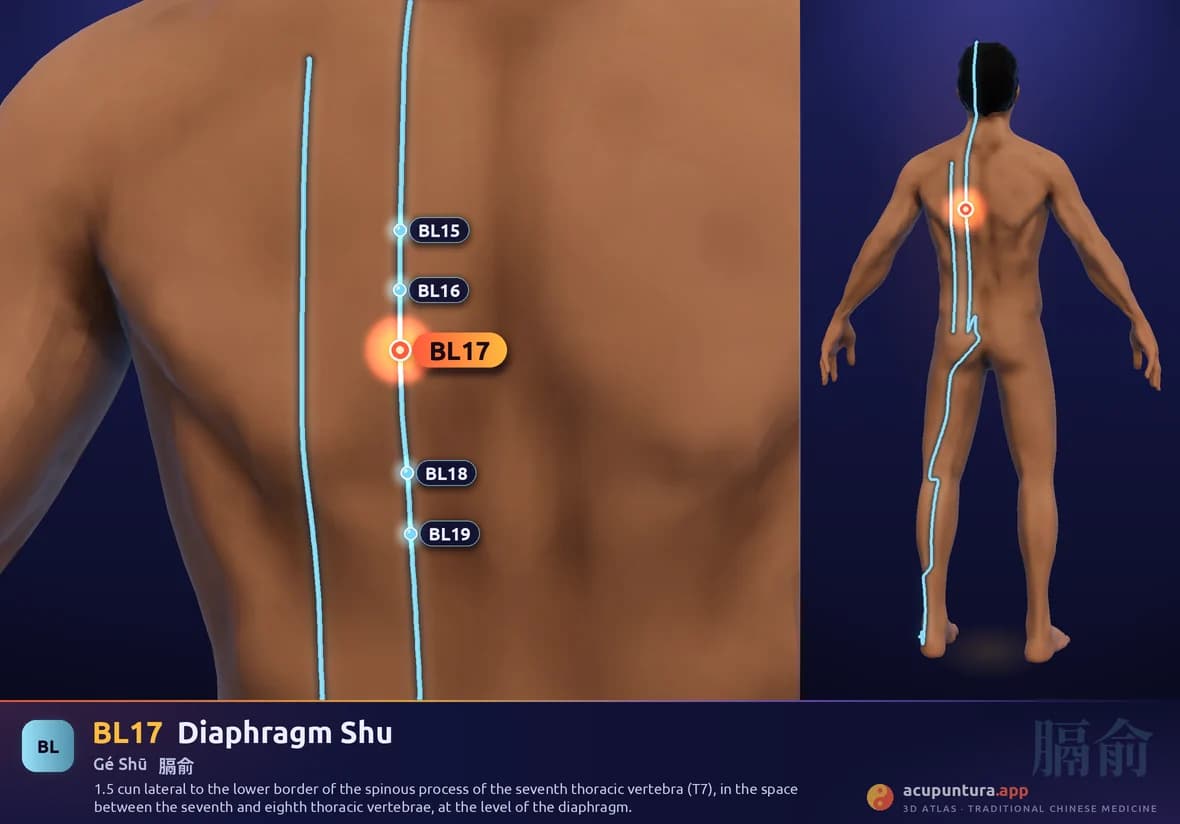
1.5 cun lateral to the lower border of the spinous process of the seventh thoracic vertebra (T7), in the space between the seventh and eighth thoracic vertebrae, at the level of the diaphragm.
Main function
Regulates the Blood, nourishes the Blood, stops bleeding, harmonizes the Stomach, descends rebellious Qi, benefits the diaphragm, relieves hiccups and nausea.
- Influential (Hui) Point of Blood
- Crossing point with the Du Mai
Therapeutic indications
- Blood disorders (anemia
- hemorrhages
- bruising
- Blood Stasis)
- chest pain
- hiccups
- nausea
- vomiting
- belching
- dysphagia
- asthma
- cough
- back pain
- night sweats
- fever of unknown origin
- skin diseases
- hives
- itching
- hemoptysis
- hematemesis
- epistaxis
- anemia
- difficulty swallowing
- diabetes mellitus (Xiao Ke)
- gastroesophageal reflux
- endometriosis
- psoriasis
- atopic dermatitis
- alopecia areata
- acne
- herpes zoster and postherpetic neuralgia
- chemotherapy-induced nausea and vomiting
- chemotherapy-induced leukopenia
Name and classical tradition
Geshu, 膈俞, is the transport point of the diaphragm. 膈 is the diaphragm; 俞, the transport point. The point lies at the level of the seventh thoracic vertebra, between BL15, the Shu of the Heart, above, and BL18, that of the Liver, below, and the diaphragm separates precisely those regions. The Lingshu (Spiritual Pivot), in the chapter Bei Shu (背腧), includes it in its list: “膈腧在七焦之間”, the Shu of the diaphragm is in the space of the seventh vertebra.
Geshu is also the meeting point of the Blood (血會) among the eight Influential (Hui) points. The Nanjing (Classic of Difficulties) states it in Difficulty 45, “血會膈俞”, and Yang Jizhou's Zhenjiu Dacheng (Great Compendium of Acupuncture and Moxibustion), from the Ming period, reasons it from the position of the point: above is the Shu of the Heart, which governs the Blood, and below that of the Liver, which stores it; between the two, Geshu is the meeting point of the Blood.
The reference works record a graphic variant of its name, 鐲俞, not independently verified. Next to it, on the outer line, is BL46, Geguan.