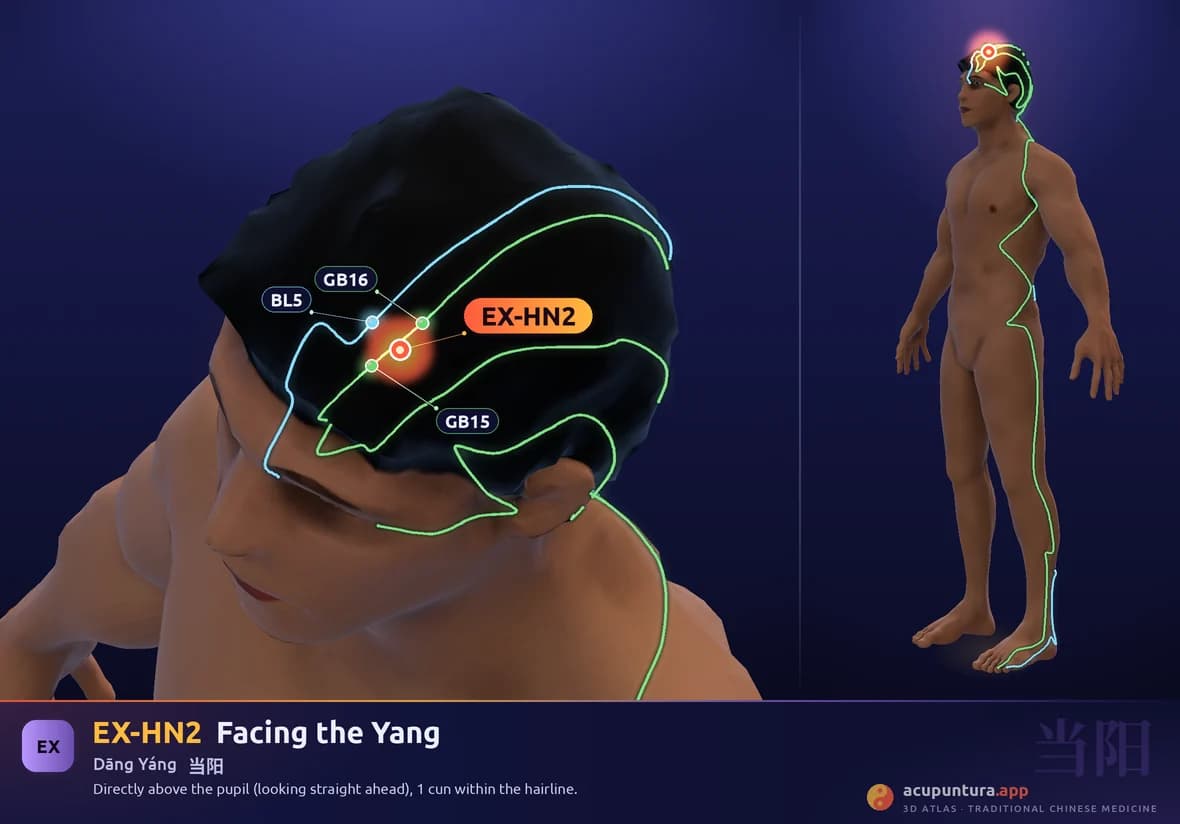
Extra point · Head and Neck
Facing the Yang
当阳Dāng YángAnatomical location
Directly above the pupil (looking straight ahead), 1 cun within the hairline.
Main function
Disperses wind, benefits the eyes, relieves headache.
Therapeutic indications
- Frontal headache
- vertigo
- nasal congestion
- eye pain
Name and classical tradition
Dangyang, 当阳, means "facing the yang" or "facing the sun." 当 (當) is to face something, to correspond to it; 阳 (陽), yang, light, the high and the anterior. The point is on the forehead, one cun inside the hairline, on the vertical line of the pupil: the part of the body that faces forward and receives the light, the yang zone of the head.
It does not appear under this name in the classical works we have been able to check, from the Neijing (Yellow Emperor's Inner Classic) to the Zhenjiu Dacheng (Great Compendium of Acupuncture and Moxibustion), and its textual history remains unclear. It lies just posterior to GB15, Toulinqi, near the midline of the forehead, where GV24, Shenting, was one of the points the Zhenjiu Jiayi Jing (Systematic Classic of Acupuncture and Moxibustion) forbade to the needle.