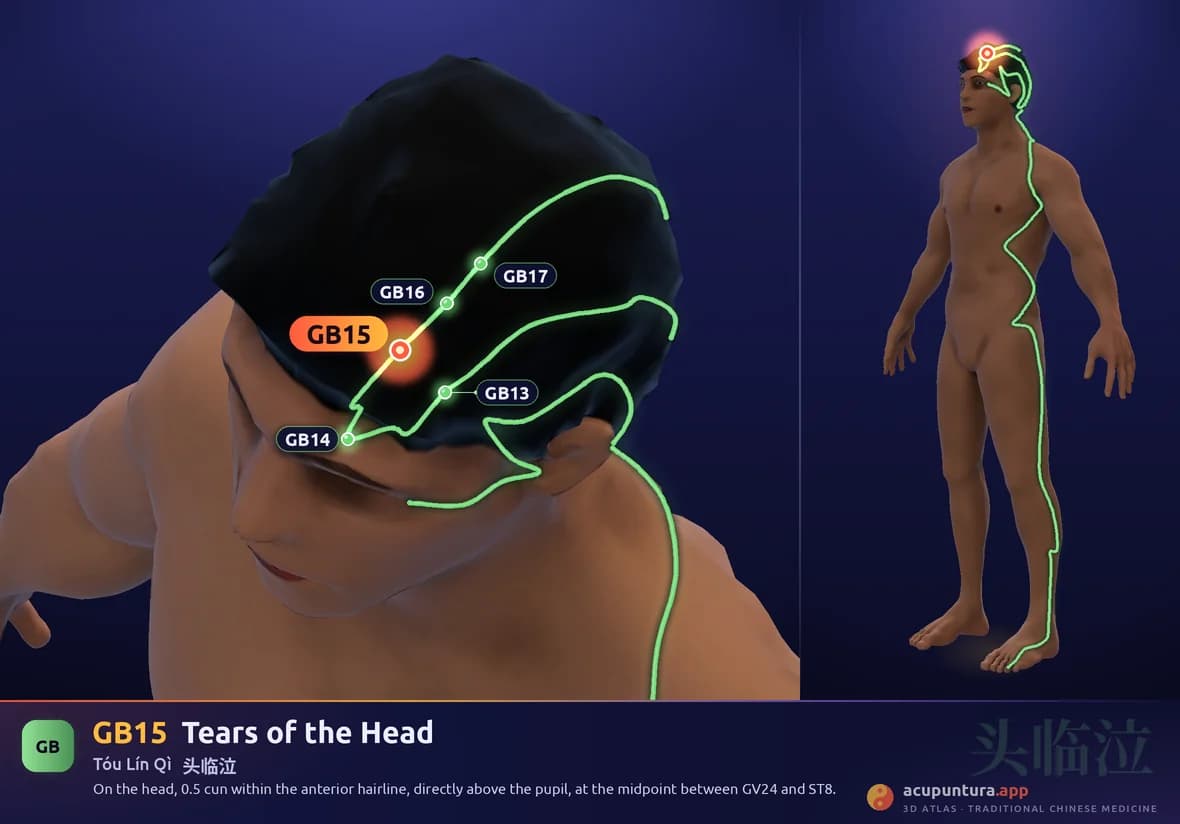
Gallbladder Channel
Tears of the Head
头临泣Tóu Lín QìAnatomical location
On the head, 0.5 cun within the anterior hairline, directly above the pupil, at the midpoint between GV24 and ST8.
Main function
Expels Wind, benefits the eyes and nose.
- Crossing Point with the Bladder
Therapeutic indications
- Headache
- rhinitis
- eye pain
- tearing
- nasal obstruction
- eye congestion
- epilepsy
- vertigo
Name and classical tradition
Toulinqi, 头临泣, pairs with GB41, the Foot Linqi, and both share the same naming history. The Zhenjiu Jiayi Jing (Systematic Classic of Acupuncture and Moxibustion) called it simply 临泣. In the Song dynasty, the Shengji Zonglu (Comprehensive Record of Sages' Benevolence) designated it 目临泣, "Eye Linqi," and the Zhenjiu Zisheng Jing (Classic of Acupuncture and Moxibustion for Nurturing Life) fixed 头临泣, "Head Linqi," to distinguish it from its namesake on the foot. It is the same process that set GB11 apart from GB44.
临 means "to look down from above" and, by extension, "to direct" or "to be in charge of"; 泣 means tears. The functional reading, which is the sound one, takes the name as the point that governs tearing: it lies on the forehead, in line with the pupil, and is used for eye disorders. There is also a modern energetic gloss, according to which damp, cold Qi drips here from "heaven" to "earth," like tears. It has no classical citation.
It is a crossing point of the Foot Taiyang and Shaoyang with the Yang Wei Mai.