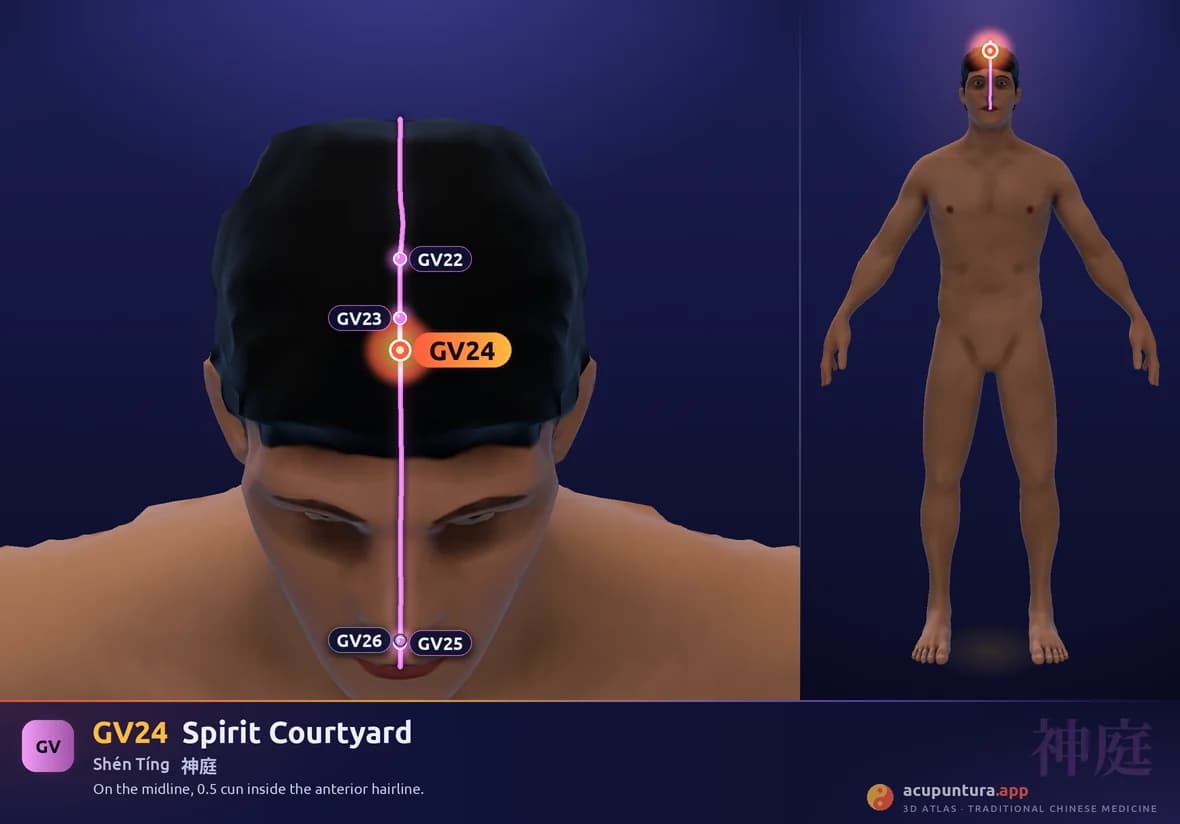
Du Mai (Governing Vessel) Channel
Spirit Courtyard
神庭Shén TíngAnatomical location
On the midline, 0.5 cun inside the anterior hairline.
Main function
Calms the Shen, expels Wind, benefits the head.
- Crossing Point with the Bladder and Stomach
Therapeutic indications
- Headache
- insomnia
- anxiety
- blurred vision
- Frontal headache
- Vertigo
- Rhinitis
- Epistaxis
- Eye pain
- Epilepsy
- Palpitations
- Post-traumatic stress
- Depression
- Cognitive decline and dementia
Name and classical tradition
Shenting, 神庭, is the “courtyard of the spirit.” 神 is the Shen, the spirit, and also, in the modern gloss, celestial Qi; 庭, the courtyard, the atrium, the place where people gather and from which they disperse. The point lies on the midline of the forehead, half a cun inside the hairline, and its frontal position ties it to the mind. On either side of it lies GB13, Benshen, the “root of the spirit.”
The Zhenjiu Jiayi Jing (Systematic Classic of Acupuncture and Moxibustion), the first work to record it, locates it «在髮際直鼻»: at the hairline, in line with the nose, as a meeting point of the Du Mai, the foot Taiyang, and the Yangming, and adds a serious prohibition: «禁不可刺,令人癲疾,目失精», do not needle, because it causes madness and dims the eyesight. Reference works record the alternative name 髮際, “hairline,” which locates it without metaphor.