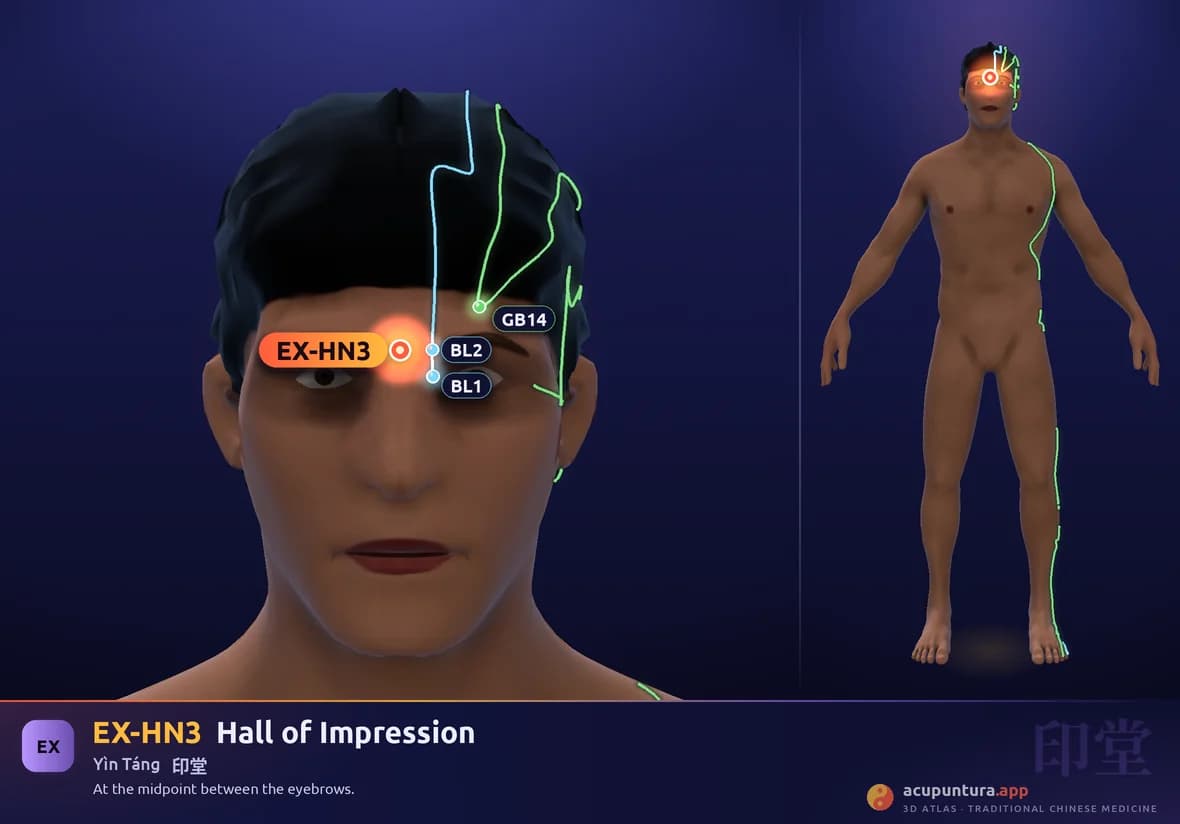
Extra point · Head and Neck
Hall of Impression
印堂Yìn TángAnatomical location
At the midpoint between the eyebrows.
Same point as CP3 · Yìn Táng — Curious Points catalogMain function
Calms the Shen, disperses Wind, opens the nasal passages, clears the mind.
- Classic point for calming the mind (Third Eye)
Therapeutic indications
- Frontal headache
- insomnia
- anxiety
- sinusitis
- rhinitis
- vertigo
- infantile convulsions
Name and classical tradition
Yintang, 印堂, is the "hall of the seal." 印 is the seal, the mark that is stamped; 堂, the main hall. The point is between the eyebrows, at the spot where in Chinese culture a mark was placed on the forehead, and the name describes that location more than any function.
Yang Jizhou's Zhenjiu Dacheng (Great Compendium of Acupuncture and Moxibustion), from the Ming period, lists it among the points outside the channels with a short entry: "印堂一穴,在兩眉中陷中是穴,針一分,灸五壯,治小兒驚風". The point is in the depression between the eyebrows, needled to one fen and treated with five cones of moxa, and it is used for infantile convulsions from fright. The reading as a "third eye," which accompanies the point in many books today, is a modern comparison, borrowed from other traditions, with no support in the Chinese texts. In the most recent international nomenclature the point has been moved to the Du Mai (Governing Vessel), along whose course it lies, between GV24 and GV25.