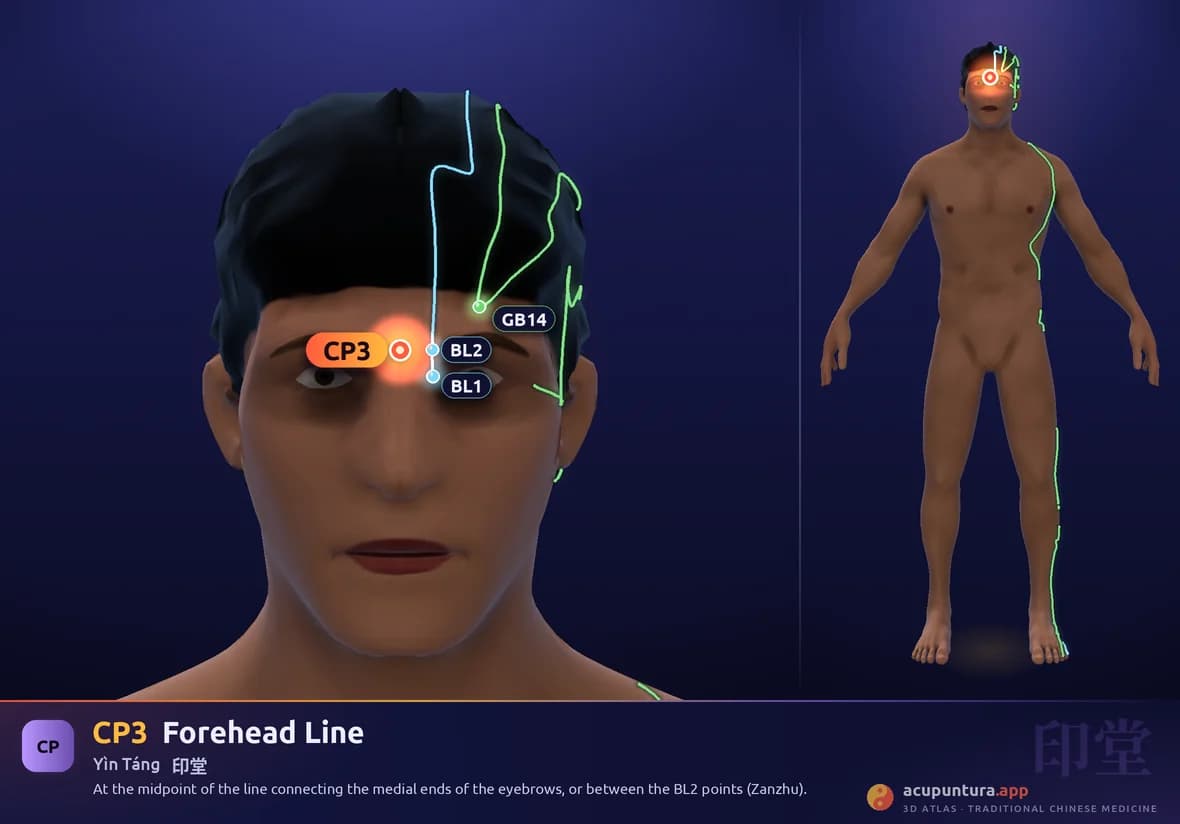
CP3

Curious point · CP catalog

Forehead Line

印堂Yìn Táng

Anatomical location

At the midpoint of the line connecting the medial ends of the eyebrows, or between the BL2 points (Zanzhu).

Same point as EX-HN3 · Yìn Táng — international nomenclature

Main function

Calms the Shen, disperses Heat, regulates Lung Qi, relieves sadness.

Therapeutic indications

  • Frontal headache
  • glare
  • vertigo
  • nose and eye disorders
  • hypertension (bleed)
  • childhood epilepsy
  • menopausal hot flashes
  • sadness
  • nervous depression
Location of point CP3, Forehead Line
CC BY-ND 4.0 (opens in a new tab)
View point on the 3D modelCP3 on the anatomy
Needling techniqueThrough-needling from CP3 to CP4 (Shangen) or oblique insertion 0.3-0.5 cun.
Depth0.3-0.5 cun
MoxibustionUse with caution (3-5 cones or 5-10 minutes).
PrecautionsAvoid deep needling; bleed only in specific cases.

Basic formulas from the vademecum · 1

View the vademecum

Named functional sets from the school: here the point does not act on its own, but through the role it plays within the maneuver.

  • Calm the ShenReturns the Shen to its dwelling: HT7 is the Yuan-Source point of the Heart, which houses it; PC7 is the Yuan-Source point of the Pericardium, which protects it; GV20 and CP3 (Yintang) settle it from above.Yintang, the Hall of the Seal (EX-HN3 in the international nomenclature).
Cover of the guide “Protocols for the 20 most common patterns”

Free guide · PDF

Protocols for the 20 patterns you see most in practice

Each pattern with its tongue, its pulse, the treatment principle and the points to tonify and disperse. Made for the treatment table, not the bookshelf.

Do you use CP3 with your patients?

In the Clinic you record it in the patient's file, next to the tongue, the pulse and the measurements, so at the next session you know exactly what you used. The Atlas is built in.

See the Clinic