Extra point · Head and Neck
Sun
太阳Tài YángAnatomical location
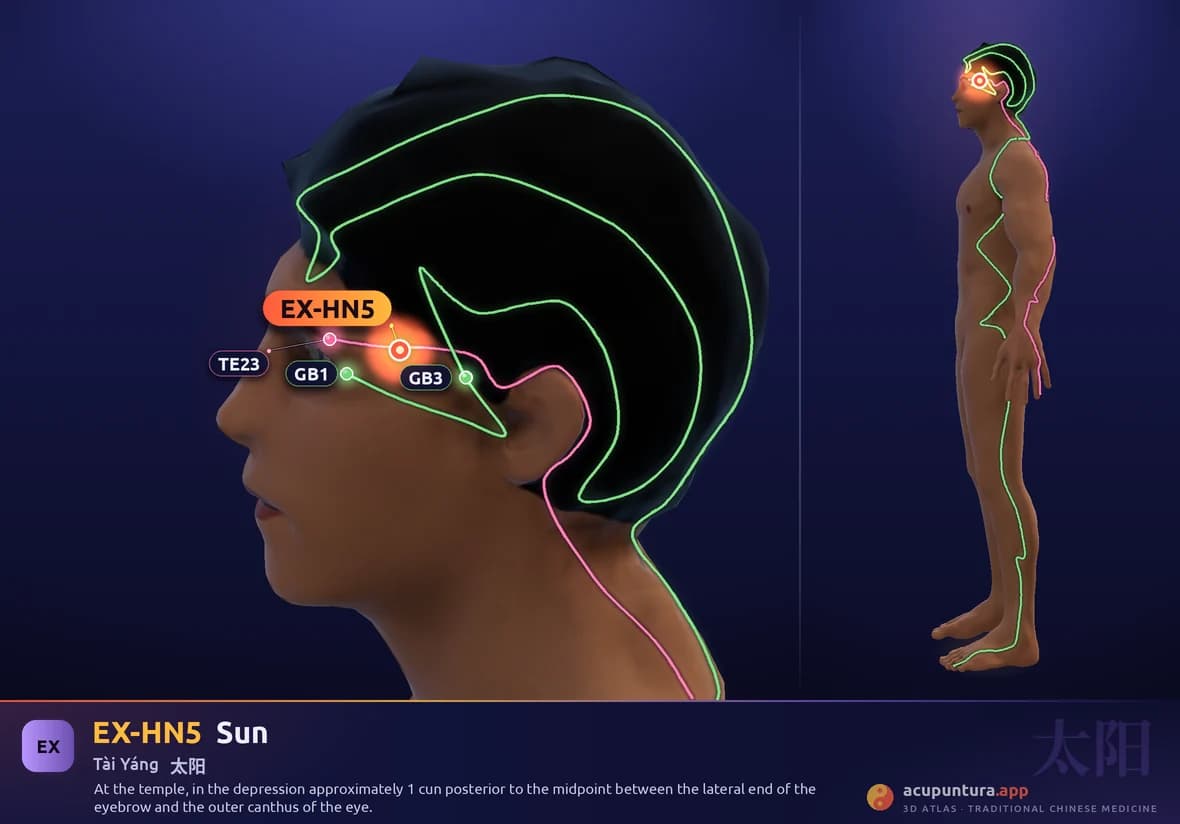
At the temple, in the depression approximately 1 cun posterior to the midpoint between the lateral end of the eyebrow and the outer canthus of the eye.
Same point as CP9 · Tài Yáng — Curious Points catalogMain function
Disperses Wind and Heat, benefits the eyes and the head, stops pain.
Therapeutic indications
- Temporal headache
- migraine
- eye pain
- facial deviation
Name and classical tradition
Taiyang, 太阳, is the "great yang," the Chinese name for the sun, and also the name of the two Taiyang channels. Here it designates the temple, the area still called that in everyday Chinese. The point is in the depression behind the end of the eyebrow and the outer canthus of the eye.
The Zhenjiu Dacheng (Great Compendium of Acupuncture and Moxibustion) describes it among the points outside the channels with a very specific technique: "太陽二穴,在眉後陷中,太陽紫脈上是穴,治眼紅腫及頭,用三稜針出血". It lies on the purple vein of the temple, treats red, swollen eyes and the head, and is bled with the three-edged needle. To make the vein visible, the book advises binding the neck tightly with a strip of cloth: "用帛一條,緊纏其項頸,紫脈即見,刺血出立愈". The same book records 太陽 as an alias of GB1, Tongziliao, which is very close.