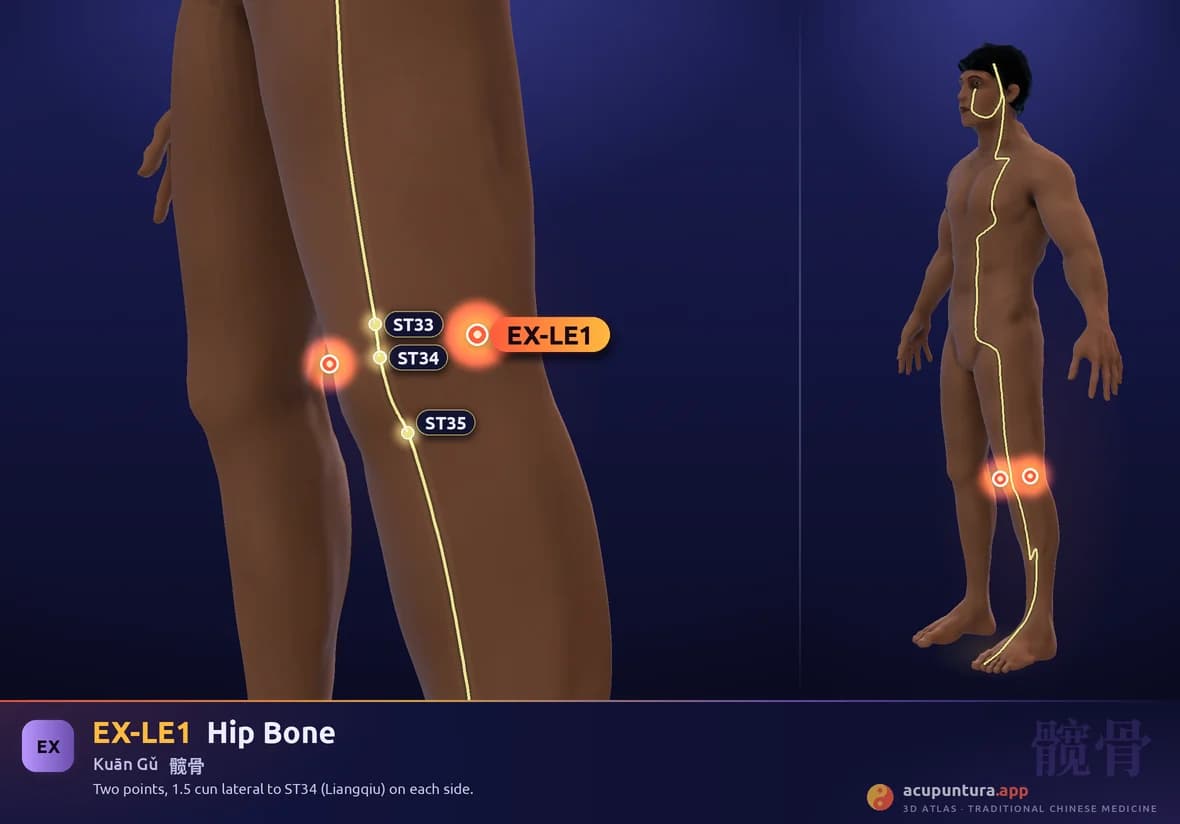
Extra point · Lower Limb
Hip Bone
髋骨Kuān GǔAnatomical location
Two points, 1.5 cun lateral to ST34 (Liangqiu) on each side.
Same point as 157PC · Kuān Gǔ — Curious Points catalogMain function
Activates the collateral, relieves knee pain.
Therapeutic indications
- Knee pain and weakness
- arthritis
- atrophy of the lower limbs (Wei pattern)
Name and classical tradition
Kuangu, 髋骨, means the “hip bone,” a puzzling name, because the point is not on the hip but on the thigh: there are two points 1.5 cun to either side of ST34, Liangqiu, above the knee.
The Zhenjiu Dacheng (Great Compendium of Acupuncture and Moxibustion) describes the same location under an almost identical name: «髓骨四穴,在梁邱兩傍各開一寸五分,兩足共四穴,治腿痛灸七壯», four points on either side of Liangqiu, for leg pain. In the treatment lists in book 10 it already appears as 髖骨, together with GB31, Fengshi, for swollen, aching legs. The two spellings, 髓 and 髖, look very much alike, and it is probably the same name copied in two different ways.