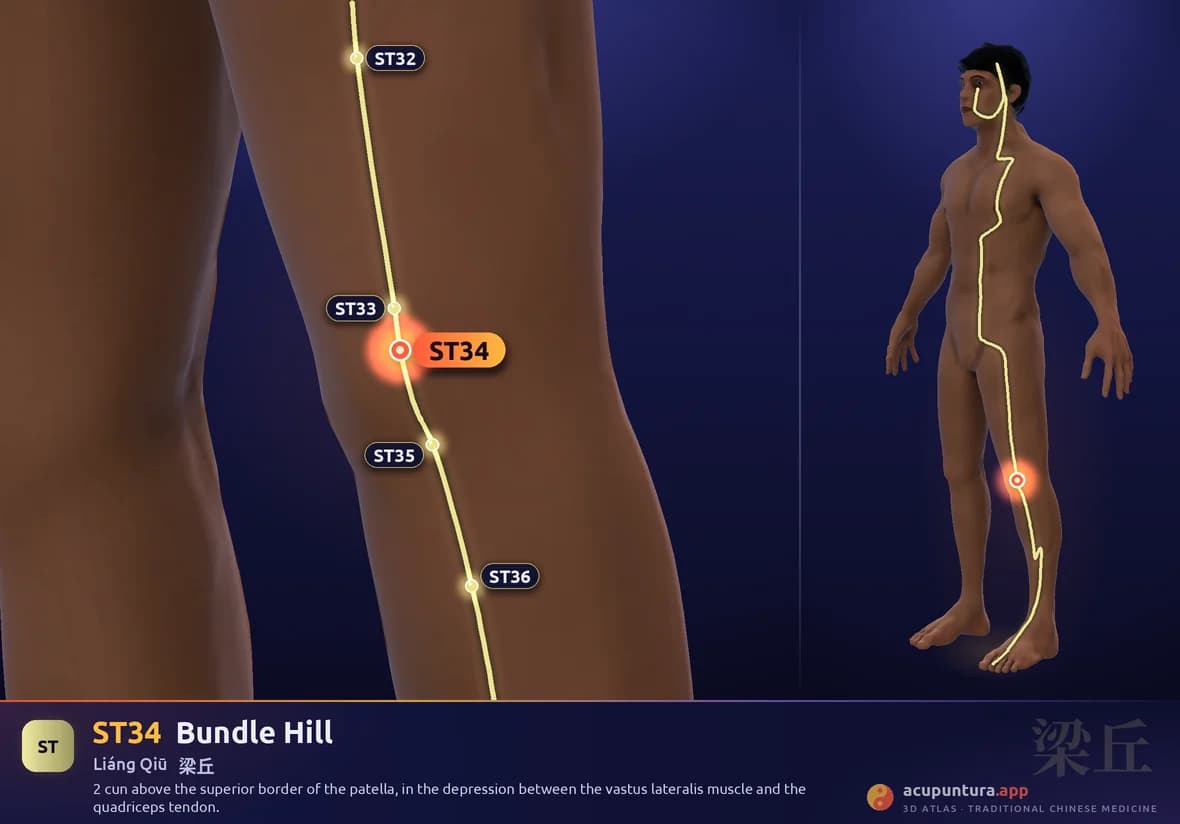
Stomach Channel
Bundle Hill
梁丘Liáng QiūAnatomical location
2 cun above the superior border of the patella, in the depression between the vastus lateralis muscle and the quadriceps tendon.
Main function
Relieves acute pain, regulates the Stomach, harmonizes the Intestines, benefits the knee.
- Xi-Cleft point
Therapeutic indications
- Acute stomach pain
- epigastric pain
- knee pain
- mastitis
- diarrhea
- acute gastric pain
- knee pain and swelling
- paralysis of the lower limb
Name and classical tradition
Liangqiu (梁丘) is the “ridge hill.” 梁 is a beam or ridge; 丘 is a hill. The anatomical reading compares the femur to a beam or ridge, and the prominent muscle mass above the knee, the vastus lateralis, to a small hill on top of it. It is a plausible descriptive reading, consistent with the use of 丘 and 陵 in other points, such as ST26.
The Zhenjiu Jiayi Jing (Systematic Classic of Acupuncture and Moxibustion) devotes two indications to it that survive word for word: “大驚,乳痛,梁丘主之,” great fright and breast pain, Liangqiu governs them; and “脛苕苕痹,膝不能屈伸,不可以行,梁丘主之,” Bi of the lower leg, knee that can neither bend nor extend, and inability to walk.
Liangqiu is the Xi-Cleft point (郄穴) of the Stomach channel, the deep accumulation point that the tradition reserves for acute conditions. The acute breast pain recorded in the Jiayi Jing fits this role, and the tradition has also used it for acute stomach pain.