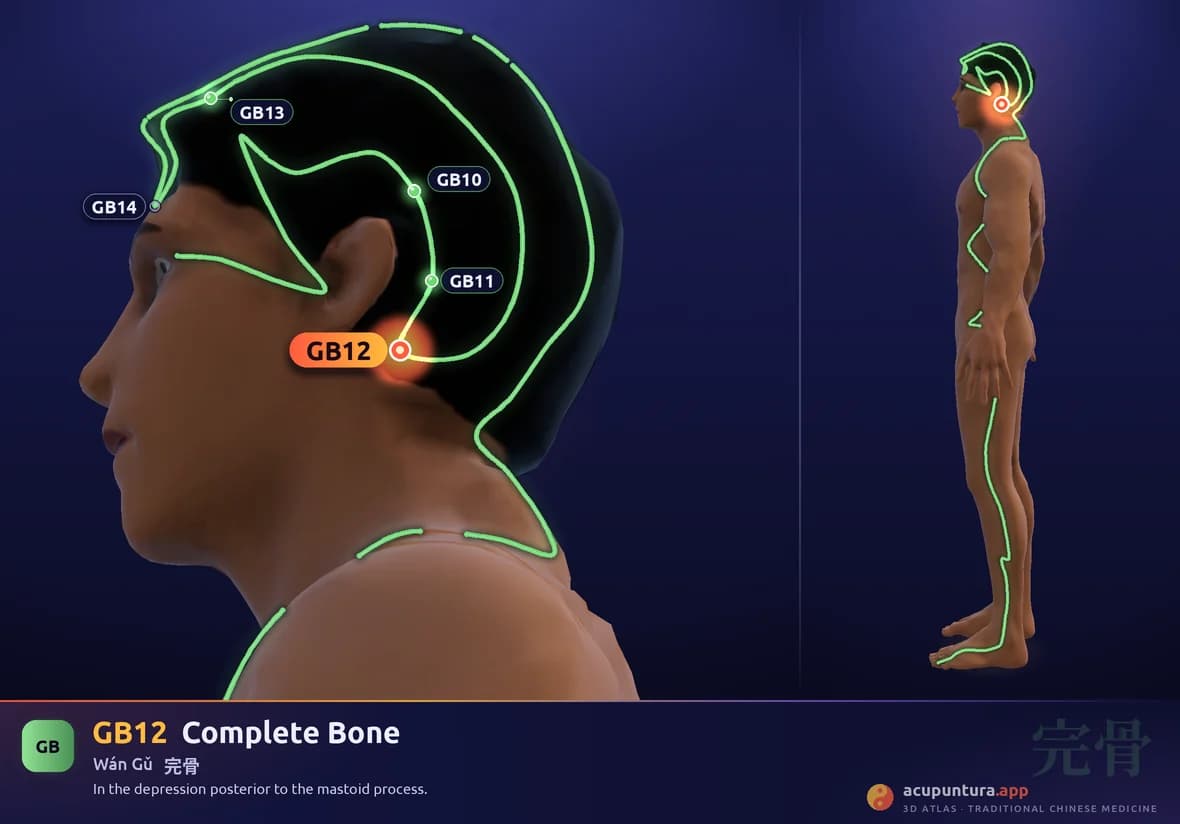
Gallbladder Channel
Complete Bone
完骨Wán GǔAnatomical location
In the depression posterior to the mastoid process.
Main function
Expels Wind, relieves headache and neck pain.
Therapeutic indications
- Headache
- stiff neck
- tinnitus
- Insomnia
- Facial paralysis
- Toothache
- Epilepsy
- Malaria
Name and classical tradition
Wangu, 完骨, is one of the rare points of the head whose name rests on a verified classical citation, even if an indirect one. 完骨 was the anatomical name for the mastoid process, the bony prominence behind the ear: 完, "complete," "whole," and 骨, "bone." The Lingshu (Spiritual Pivot) uses it this way in the Gu Du chapter (骨度), devoted to body measurements: «耳后当完骨者,广九寸», the width between the two wangu, behind the ears, is nine cun.
The point, then, is not named for its function but for the bone beneath which it lies, as with other points that inherited the name of an anatomical landmark. The Zhenjiu Jiayi Jing (Systematic Classic of Acupuncture and Moxibustion) places it «在耳后,入发际四分», behind the ear, four fen inside the hairline. Secondary sources also trace it to the Suwen (Basic Questions), chapter Qi Xue Lun, a passage that could not be verified. It is a crossing point of the foot Taiyang and Shaoyang.