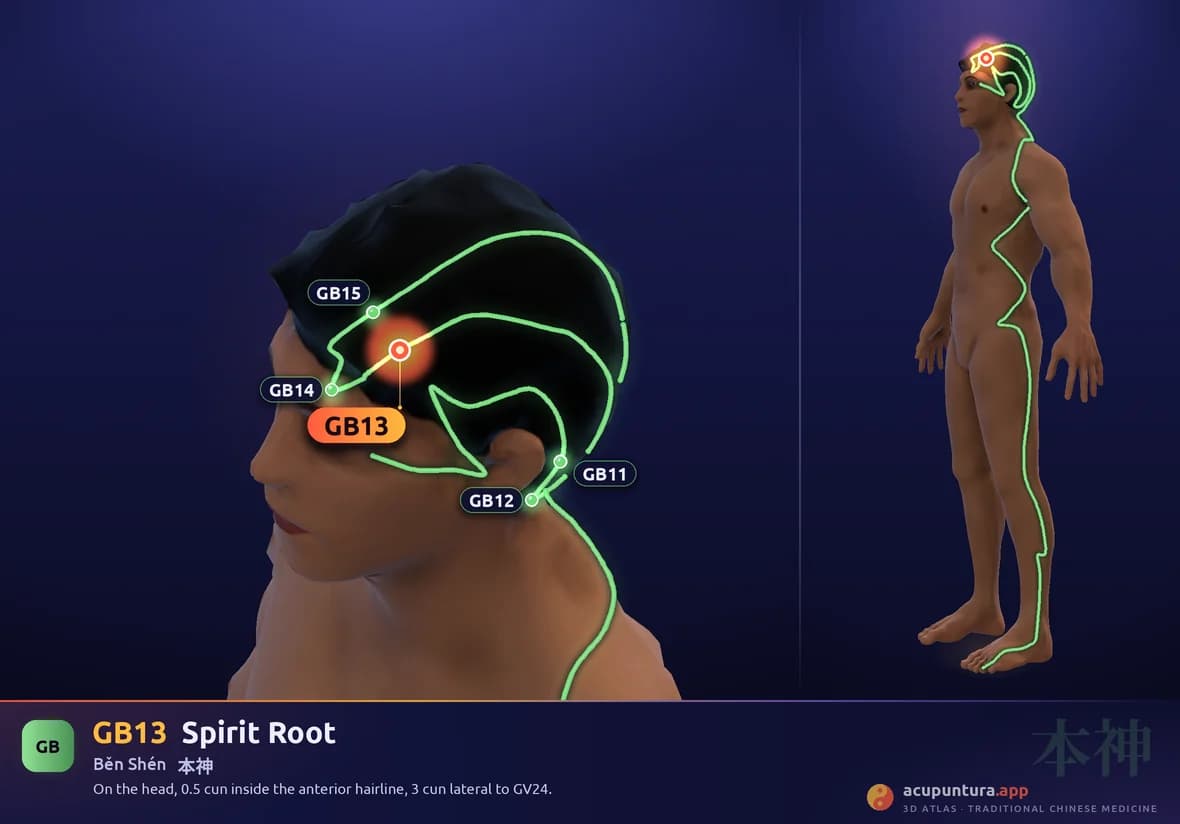
Gallbladder Channel
Spirit Root
本神Běn ShénAnatomical location
On the head, 0.5 cun inside the anterior hairline, 3 cun lateral to GV24.
Main function
Calms the Shen, eliminates Wind.
- Crossing Point with the Bladder
Therapeutic indications
- Headache
- vertigo
- epilepsy
- Insomnia
- Anxiety
- Infantile convulsions
- Neck stiffness
Name and classical tradition
Benshen, 本神, means "root of the spirit": 本 is the root, the origin, and 神 is the Shen (Spirit), which Chinese medicine places in the Heart and, by extension, in the head as the seat of the "original spirit" (元神). The usual interpretation takes its neighbor into account: the point lies beside Shenting, GV24, the "courtyard of the spirit," on the hairline of the forehead. The two names share the 神 and read as a small constellation devoted to the spirit high on the forehead.
The Zhenjiu Jiayi Jing (Systematic Classic of Acupuncture and Moxibustion) assigns it, in the book of indications, «頭痛目眩,頸項強急,胸脅相引,不得傾側,本神主之». Headache with vertigo, stiffness of the nape, tightness between the chest and the flanks that prevents turning to the side: Benshen takes care of all of this. In the location entry, the same work presents it as a meeting point of the foot Shaoyang and the Yang Wei Mai. It is a direct citation, and one of the few in the head series of the channel.