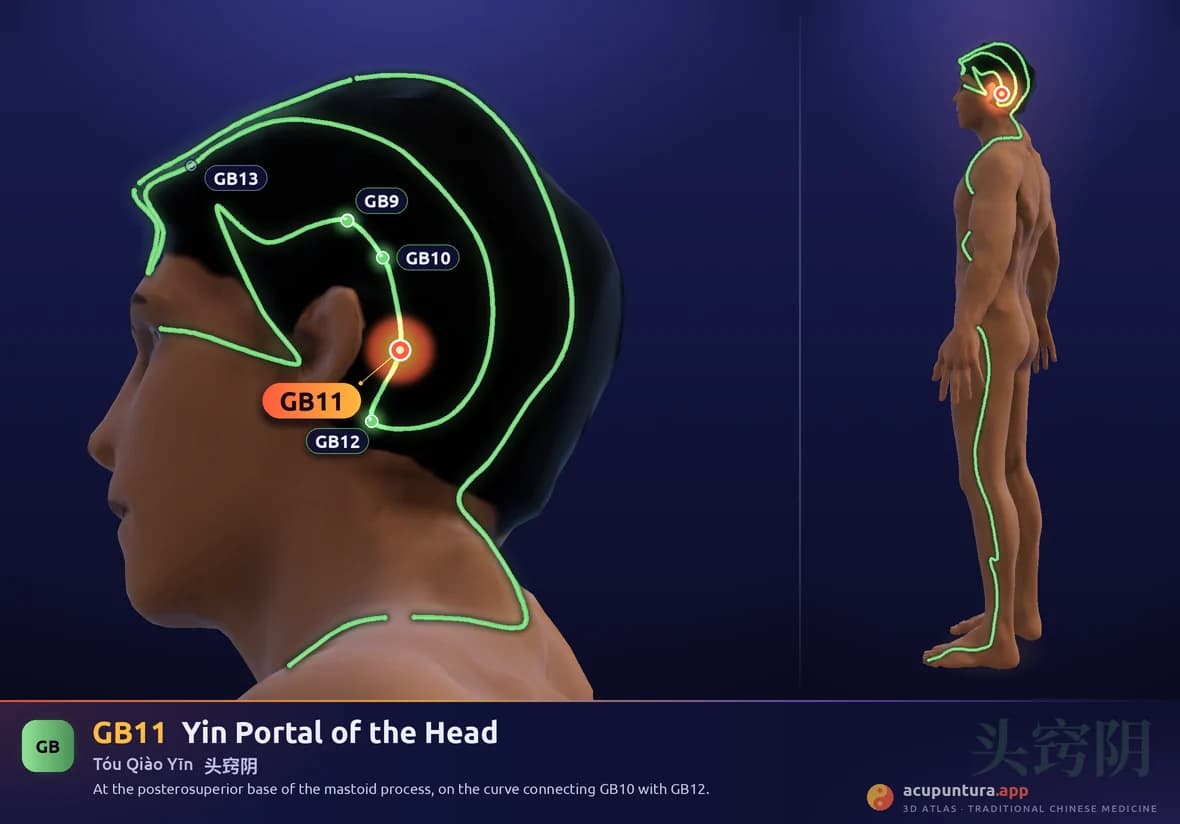
Gallbladder Channel
Yin Portal of the Head
头窍阴Tóu Qiào YīnAnatomical location
At the posterosuperior base of the mastoid process, on the curve connecting GB10 with GB12.
Main function
Expels Wind-Heat, benefits the ears.
Therapeutic indications
- Headache
- tinnitus
- sore throat
- stiff neck
- Deafness
- Eye pain
- Neck stiffness
Name and classical tradition
Touqiaoyin, 头窍阴, is a name that has changed over the centuries. The Zhenjiu Jiayi Jing (Systematic Classic of Acupuncture and Moxibustion), in the third century, called it simply 窍阴. The problem was that the same channel had another 窍阴 at its opposite end, on the fourth toe. In the Song period the ambiguity was resolved: the Shengji Zonglu renamed it 首窍阴, with 首, "head," and Wang Zhizhong's Zhenjiu Zisheng Jing fixed the form 头窍阴, which is the one that has remained. Its homonym became GB44, the 窍阴 of the foot. The same device of adding 头 or 足 separated GB15 from GB41 in that period.
The rest of the name reads as follows: 窍 are the orifices, the openings of the senses, and 阴 is Yin. One reading relates it to the Yin openings of the internal organs, so that the point would act on disorders of the sensory orifices tied to the Yin of the organs. Another speaks of damp Qi that accumulates in the lower part of the body's "heaven." Both are glosses without classical citation.
Among its alternative names is 枕骨, the occipital bone, which locates it by anatomical proximity, behind the ear and above the mastoid process.