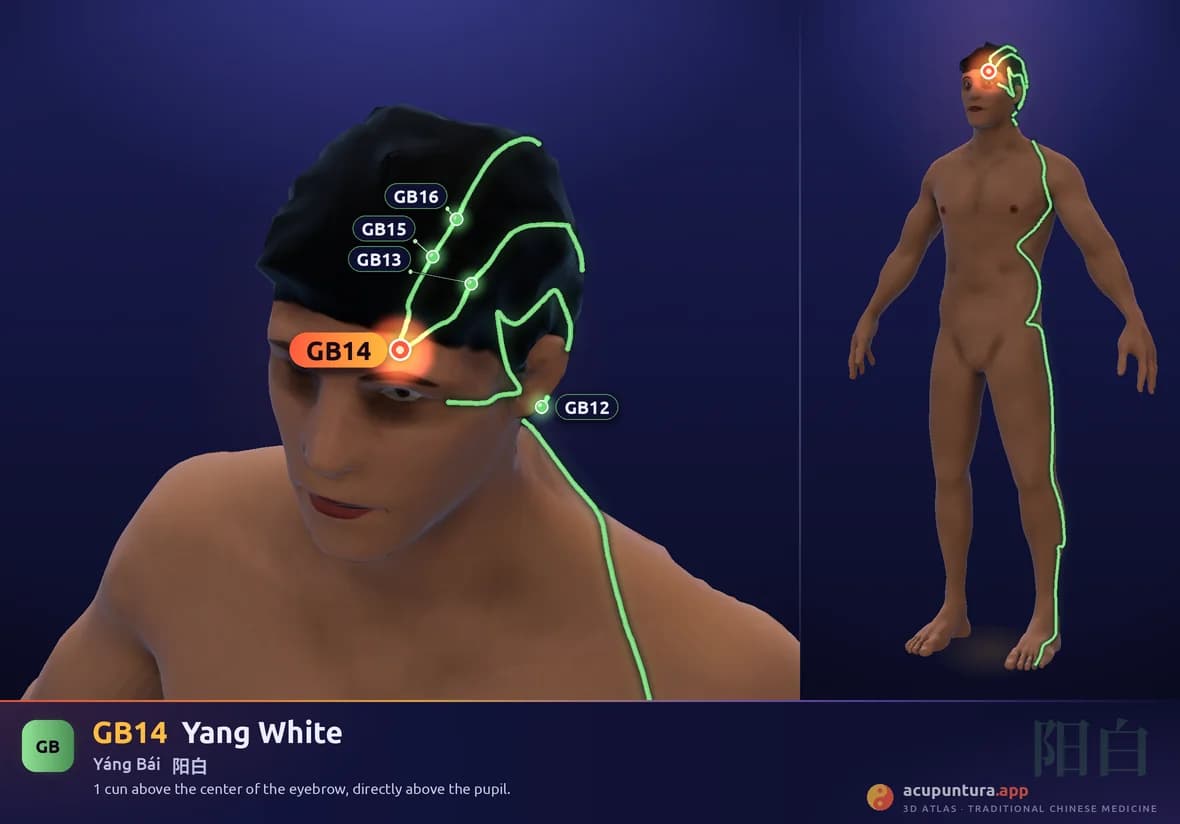
Gallbladder Channel
Yang White
阳白Yáng BáiAnatomical location
1 cun above the center of the eyebrow, directly above the pupil.
Main function
Expels wind, benefits the eyes.
- Crossing point with the Bladder, Stomach, and Triple Energizer
Therapeutic indications
- Headache
- eye pain
- eyelid ptosis
- Frontal headache
- Eyelid twitching
- Blurred vision
- Facial paralysis
- Excessive tearing
- Vertigo
Name and classical tradition
Yangbai, 阳白, is the "Yang White." 阳 refers to the region of the body, the forehead, which is a yang surface, and to the channel itself; 白 refers to the clear, smooth skin of that area. This is a reasonable reading, though no classical citation pins it down. The point sits on the forehead, above the center of the eyebrow.
What makes Yangbai distinctive is how the list of channels that meet here has grown over the centuries. The Zhenjiu Jiayi Jing (Systematic Classic of Acupuncture and Moxibustion) presents it as a crossing point of the Foot Shaoyang and the Yang Wei Mai. Wang Bing, commenting in the Tang dynasty on the Qi Fu Lun chapter of the Suwen (Basic Questions), gives it as a crossing point of the Foot Yangming and the Yin Wei Mai. And Yang Jizhou's Zhenjiu Dacheng (Great Compendium of Acupuncture and Moxibustion), from the Ming dynasty, makes it a meeting point of five channels: the hand and foot Yangming and Shaoyang, plus the Yang Wei Mai. This is less a contradiction than a doctrine that expands, with each era adding the channels its practice observed at that spot.