Gallbladder Channel
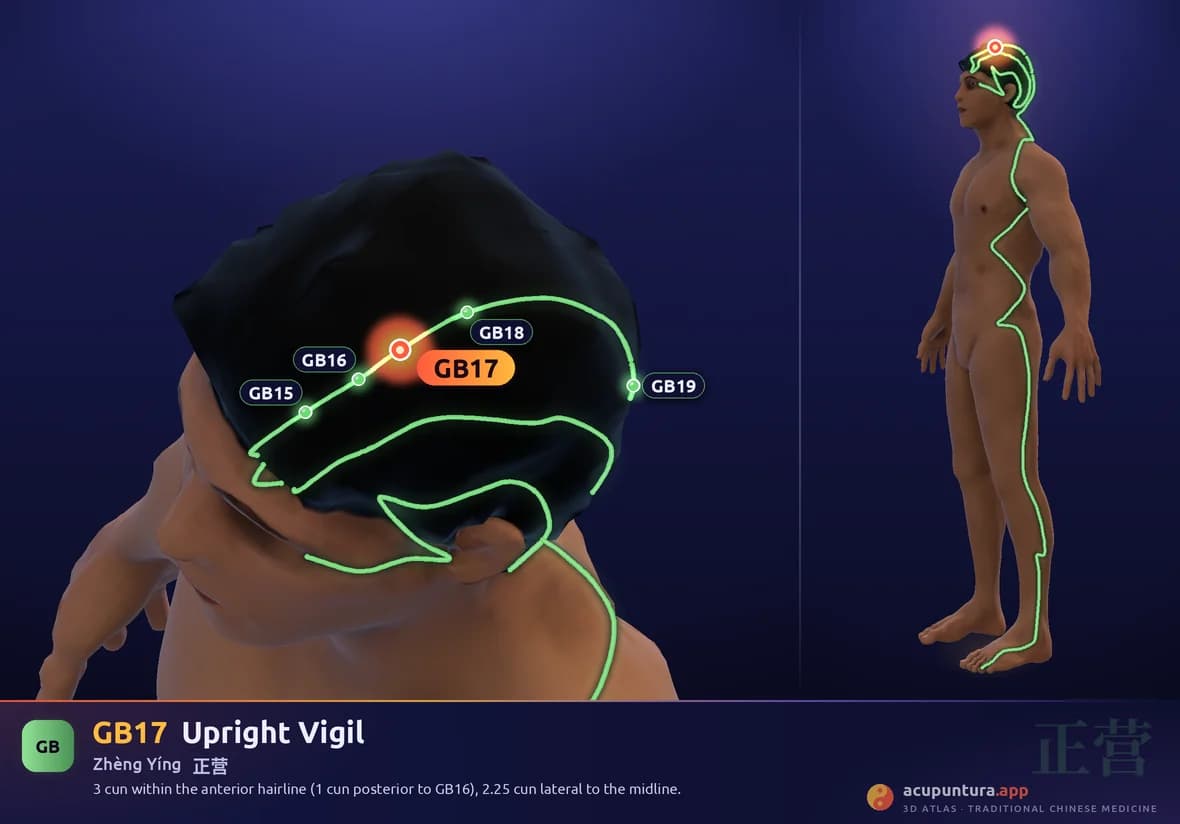
Upright Vigil
正营Zhèng YíngAnatomical location
3 cun within the anterior hairline (1 cun posterior to GB16), 2.25 cun lateral to the midline.
Main function
Eliminates Wind, relieves headache.
Therapeutic indications
- Headache
- vertigo
- toothache
- Vomiting
Name and classical tradition
Zhengying, 正营, combines 正, "straight" or "in its proper place," and 营, which means both "military camp" and, in Chinese physiology, Nutritive Qi (营气). Two readings follow from this. One is military: a camp properly positioned, a metaphor for the order the point would maintain in the yang flow of the head. The other is physiological: Nutritive Qi circulating as it should. Neither has support in a classical commentary, and both are modern glosses.
General references place it in the Zhenjiu Jiayi Jing (Systematic Classic of Acupuncture and Moxibustion), although the passage has not been located. It is a crossing point of the Foot Shaoyang with the Yang Wei Mai, like its neighbors in the cranial series.