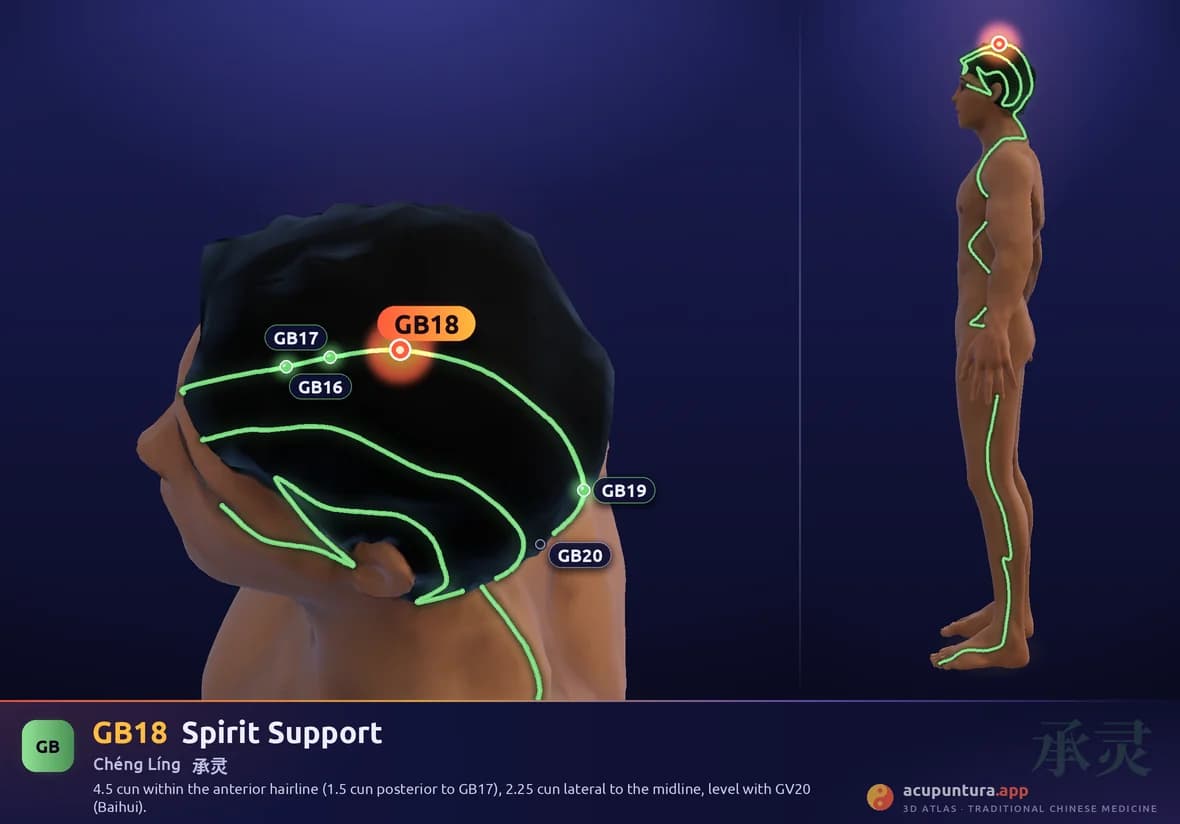
Gallbladder Channel
Spirit Support
承灵Chéng LíngAnatomical location
4.5 cun within the anterior hairline (1.5 cun posterior to GB17), 2.25 cun lateral to the midline, level with GV20 (Baihui).
Main function
Eliminates Wind, relieves headache.
Therapeutic indications
- Headache
- rhinitis
- epistaxis
- Vertigo
- Nasal congestion
- Asthma
- Chills
Name and classical tradition
Chengling, 承灵, means "the one that receives the spiritual." 承 is "to receive," in the sense of supporting from below what comes from above; 灵 is the spiritual, the numinous. The explanation offered by the reference works is more anatomical than it seems. The bone at the top of the skull was called 天灵骨, "Heavenly Spirit Bone," and the point lies below and lateral to that region, as if gathering its influence.
This is a reasoned etymology, more convincing than the Qi-vapor glosses that circulate for the neighboring points, although the citation that would document the term 天灵骨 has not been verified. Sources trace the point to the Zhenjiu Jiayi Jing (Systematic Classic of Acupuncture and Moxibustion) and consider it a crossing point of the Foot Shaoyang with the Yang Wei Mai.